![[personal profile]](https://www.dreamwidth.org/img/silk/identity/user.png) armsholdair
armsholdairTwin Peaks: From a Whisper to A Scream, The Dream to Not Go Home Again
~Revisiting a Mystery Like an Unbalanced House~
Having been a Twin Peaks watcher and fan since I was the ripe old age of eleven, when the second episode of the second season had just aired to be precise, I, nevertheless, held off watching the 2017 revival when it was first shown in 2017 because I am the type of person whom believes, at least in certain cases, that you can't go home again.
And with so many beloved family members absent, why would I want to?
In any case, it took me until only recently to fully give The Return a chance and check out the 18 part limited series for myself. I will admit, however, that I did take a glance at it at the time, reading a few synopsis and news stories, and so was already familiar with some much media hyped sequences as the origin of BOB (guess our Frank was thankfully lucky to make it home in spirit), Audrey's dance in the Roadhouse and the ending that found Dale Cooper (or, at least someone who looked like him) showing Laura Palmer (ditto with her) that she couldn't essentially go home either.
It's the mystery of the series which probably helped pull me back into the world of Twin Peaks, along with a deep love for the property (including all the actors and actresses, writers, the cinemotgraphers and composers, and the famous director himself).
Mysteries excite me, you see.
Surrealism makes me feel delightfully unbalanced, like this old attraction in a tourist trap close to where I lived called Storyland. It was called the Crooked House of the Crooked Man, like the nursery rhyme, and everything, including the floors, had all been constructed in such a manner to be slanted, making you feel dizzy, your feet in constant danger of slipping, as the floorboards refused to meet them evenly while you committed your paid for act of home invasion.
It was about the last attraction in Storyland.
And the one I most loved, feared and anticipated.
The pull of Twin Peaks is like that old crooked house.
It can leave you just as confused and reeling, but offers a strange pleasure in the act of paying it a visit, if not having to essentially live there.
~A Skeleton Key to Open Many Doors~
While trying to find my own belief on what the answers to the various mysteries in the Return (and much of the other Twin Peaks entries, from the original series to the movie) are, particularly the enigmatic ending which seemed to both mesmerise and disconcert most viewers, I have looked into what other visitors to the little town have theorized.
Along such travels, sometimes finding myself looking in grateful awe at my surroundings and at others quickly rolling up the window, I found an interesting piece by a man called Tim Kreider, whom theorized that all of Twin Peaks just might be the fantasy (or dream, as it were) of our hero Dale Cooper, whom himself murdered Laura Palmer and now wishes to forget it.
It is a very interesting read and can be found here:
quarterly.politicsslashletters.org/dreamer-twin-peaks-return/
Gotta feel sorry for Leland these days though: even when he's not guilty in a theory, people still cling onto the desperate hope that he somehow is still guilty.
He makes the perfect scapegoat in this modern age of blaming the patriarchy for everything, I suppose.
I think, though, that that willingness by the fandom to place the blame strictly on Leland Palmer adds a different aspect to the theory about Cooper being the real murderer that Kreider never even considered.
What if inside his mind, Cooper tried his best to frame Leland, to project his guilt onto the father of the victim, but it wasn't the truth? It was a dream. What if BOB was really, in essence, a stand-in for Dale Cooper, an abstraction of HIS evil, the whole time and not some theorized dark side of Leland Palmer?
It sounds odd, but consider that Lynch saw the vision of the Red Room sequence when he was forced to come up with a conclusion to the Twin Peaks Pilot for International distribution. Tie that to the accidental creation of BOB, and even the malfunctioning of the light while Cooper is examining Laura's corpse.

make tv GIFs like this at MakeaGif
It did not do this during the scene of Leland identifying the body (with Harry S. Truman and morgue attendant Jim also present in both scenes) only when Cooper had come there.

make tv GIFs like this at MakeaGif
That flashing light was often associated with the presence of BOB, to some degree.

Lynch finds Divinity in the accidents which lead to the creation of his work. I've seen him describe them as already being there, but only waiting for him to bring them to life.
The ending to the International Pilot heavily features Dale Cooper not Leland Palmer.
Even after Laura's killer has been revealed, and his detective work on the case should be over with, we stay with the FBI agent, seeing the Red Room for the first time, while he is sitting in it, an old man now, watching as Laura Palmer touches her nose (a gesture which usually indicates a shared secret or something known) are informed she is filled with secrets and then witness as she eventually leans down to whisper, at least, one of them to Dale Cooper.
This sequence became so important within Lynch's mind it was added to the actual series as Cooper's dream, retaining and heralded virtually with the sound of Sarah Palmer's muffled "Laura" as she went to check on her daughter's empty bedroom on the morning of her death. BOB was added then too, becoming a central figure of evil. But it is odd that Sarah only sees BOB after Cooper comes to Twin Peaks, following years of supposedly living with the entity using her husband as a disguise.
It's almost as if Cooper and BOB strolled into town at around the same time.
What if the upstanding agent of the FBI implanted the image of the dirty, gray haired man, so much the opposite to himself, inside the workings of the dream? Afterall, Dale Cooper stated he was a strong sender, hence why he didn't wish to be present when Andy was sketching Sarah's vision of BOB. Cooper, as the dreamer (or whomever that is in reality), brought the nightmare to Twin Peaks.
As he is trying to kill Coop, even Jean Renault makes a connection between Dale Cooper's arrival in town and the madness sweeping over it. "Suddenly the quiet people, they're quiet no more," he states. "Suddenly the simple dream become the nightmare. Maybe you brought the nightmare with you. And maybe the nightmare will die with you."
Jean Renault believes in this notion so much, he is willing to die for it.
And, maybe in some way, the man is right.
Dale Cooper was the harbinger of the bad dream. BOB all along was a mask for his identity as the killer, something to help hide and bury the truth.
From himself and even from us the viewers.
~Adjoining Rooms~
Throughout the series and film there were always odd connections between Dale and BOB, even after the Palmer family had been shucked to the side following the case's presumed solution and both the supposed killer and victim dead.
They were always there for us to see but with both characters' sharp contrast it oftentimes went over our heads.
Neither BOB nor Cooper wanted Laura Palmer to take the ring.
Neither wanted her to die.
Cooper's appearance in town coincides with the sightings of BOB, likewise, Cooper is able to see BOB without any initially revealed connection between the two, just as BOB knows exactly what happened to Cooper in Pittsburgh. How and why? Cooper certainly seems as unrelated to the troubled Palmers as MIKE, BOB's former partner, is. Yet, when Leland flicks a match, illustrating BOB's invitation for him to play with fire, it is Cooper whom picks the match up. It will be Cooper, too, whom holds the dying Leland when he is finally free of BOB, after Cooper somehow knew the man was about to give a full confession, and it will be Dale Cooper whom the camera focuses on when Harry S. Truman asks where BOB is now, before an owl is shown flying through the haunted Twin Peaks woods.
When the message came through Major Briggs that the owls were not what they seemed, it was followed by the repeated use of Cooper's name. Afterwards, in a dream, Cooper saw the image of an owl imposed over BOB's face. During Briggs camping trip with Cooper, after the Major references the Black Lodge, Cooper is even watched over intimately by an owl.
Cooper and BOB even have the same song running through their head at the same time during the latter's "Drive With a Dead Girl".
BOB essentially protects Cooper from Josie when he feeds from her fear and Cooper essentially seals his fate when he allows Annie to enter the Miss Twin Peaks contest, despite receiving a clear warning from the Giant not to let her. She effectively became his excuse to visit the Black Lodge/Red Room, and is barely considered afterwards in "The Return", as if that was her sole purpose for existing (which it was considering it was always supposed to be Audrey Horne and not Annie whom was Dale's lover and the bait used to enter the Lodge).
It will be Cooper whom, at the police station, recites the very words which BOB wrote in his host's blood at the site of Laura Palmer's murder, "Fire Walk With Me", which seems to warrant a disturbed glance from Truman infact, as if his friend's recitation of them unsettles him.
Inside the Red Room, BOB saves Cooper for a second time, this time from Windom Earle, Cooper's ex partner and mentor whom has gone insane. And after Cooper's Doppleganger's possession by BOB, the shadow self of Dale Cooper begins to resemble the demon closely, as BOB seems to just be along for the ride, his desires synonymous with Dale's.
Strange too is that Dale Cooper is not the one to defeat either Mr. C or BOB (his imprisoners for 25 years) in The Return, one's extinction left up to Lucy and the other to Freddie, a virtual newcomer to Twin Peaks. Is Cooper aware of the danger it could pose if he did it: self annhiliation? Just like one of the Log Lady's intro to an episode said: "Sometimes nature plays tricks on us and we imagine we are something other than what we truly are. Is this a key to life in general? Or the case of the two-headed schizophrenic? Both heads thought the other was following itself. Finally, when one head wasn't looking, the other shot the other right between the eyes, and, of course, killed himself."
What makes me perhaps the most curious, however, is a sequence featuring Dale Cooper, not his Doppleganger's, departure from the Red Room in Part 3. He lands outside a building in a purple landscape known as the Mauve Zone. To enter the building, Cooper must go through the window, forcing him to basically reanact how BOB repeatedly came to Laura Palmer: crawling nightly through her bedroom window.
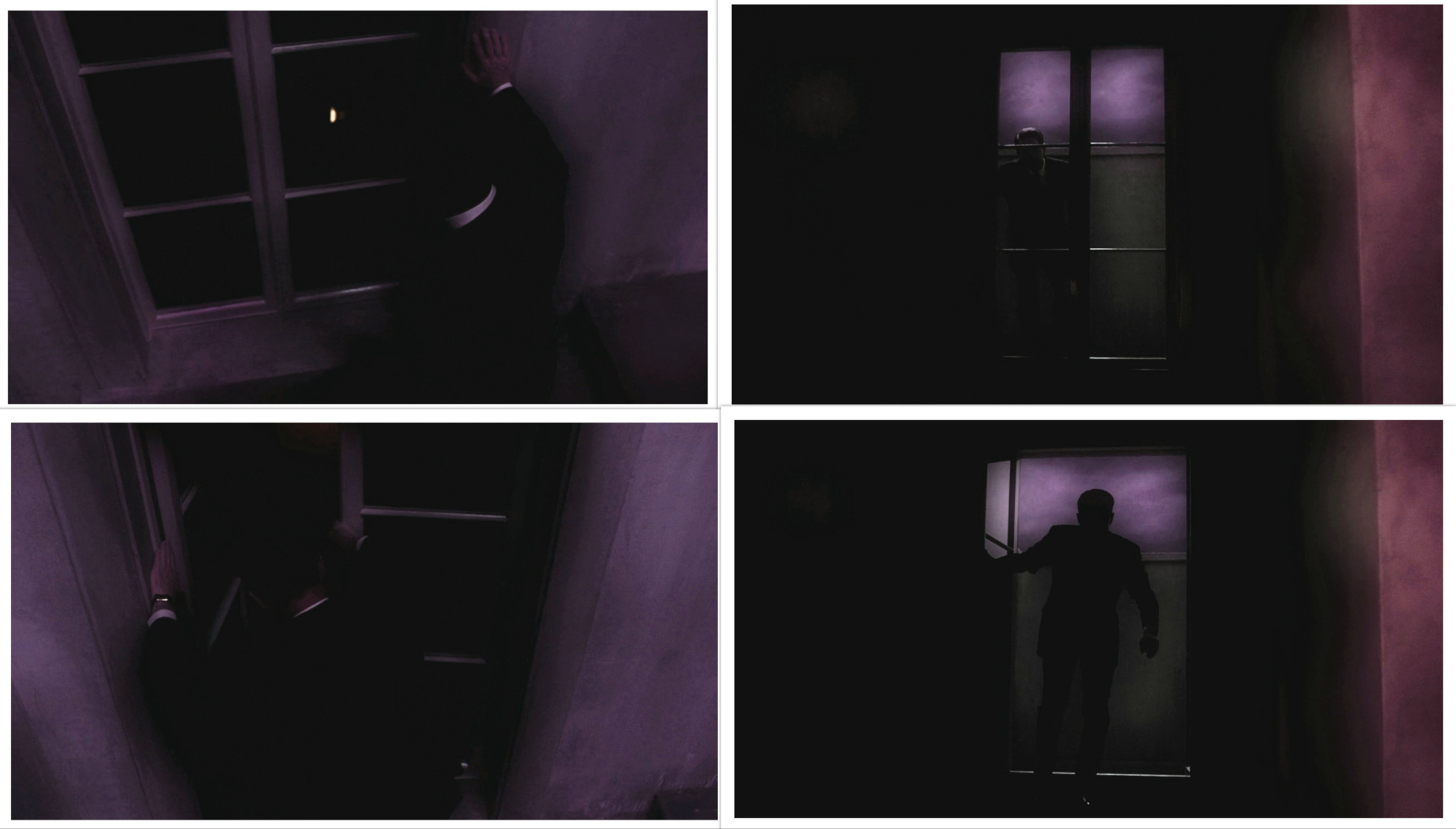
Later on, after an eyeless (whom therefore cannot see him) woman has acted as his guide, he stumbles upon a character credited simply as "American Girl" but is played by the same actress whom played Laura's friend, and survivor of BOB, Ronette. This girl (actually a woman) seems concerned as the approach of someone she calls her "mother" is heard along with a repeated banging on the door. She tells Cooper to hurry and leave, as if seeking to protect him from discovery and banishment, or perhaps worse.
Both women react to Dale as if he is a lover, one they do not want "mother" to know is with them, more than any stranger or abuser.
This all is too reminiscent of BOB and Laura's secret relationship, but this time cast in a less sexually abusive light.
Maybe that is yet another hidden truth: Whomever the killer truly was, and whoever was his victim, it was a consensual relationship, similar to Laura's kiss with Dale within the Red Room instead of the tortuous one she shared with some dirty haired, transient seeming man.
There never was a BOB.
There was only ever Dale Cooper or whomever he is supposed to truly be.
The rest was a smokescreen to hide the true fire from Cooper and the audience.
We can then think back to Laura's tapping her nose in that initial Red Room sequence and its indication that she and Cooper shared a mutual secret. We can carry it through to the words of Laura's doomed friend, Harold Smith, shortly before he killed himself: "Are you looking for secrets? Is that it? Maybe I can give you one. Do you want to know what the ultimate secret is? Laura did. The secret of knowing who killed you."
The secret Laura and Cooper share is infact that ultimate secret.
~Whispers From a Hidden Room~
Lynch was adamant he never wanted to solve the mystery at the heart of Twin Peaks, saying it would kill the show. Maybe on some level, he understood intrinsically that it inevitably would. If they revealed that Dale Cooper really killed Laura Palmer, there would be no series. Fans would have been outraged that their hero was a villain and they could hardly continue a series in the 1990s where the main protagonist was the guilty party and would need to go off to prison, or die, to suit the viewer's sensibilities. This was years before shows like Dexter or Chucky existed, afterall, and Dale Cooper had never been advertised as Hannibal Lecter.
The truth would be too problematic.
No, if it was revealed, or hinted at at all, it had to be told in a dream and that dream was officially introduced with the inclusion of the Red Room sequence in Episode 2. Remember, as well, that Cooper confesses he knows who the killer is following the dream but then conveniently forgets in the morning.
If he were to reveal it, the dream would truly be over for both the audience and himself.
Or the nightmare as Jean Renault called it.
In an act of syncronicity, during the 2nd episode of the 2nd season, Cooper will have another dream with BOB, still featuring Sarah Palmer's call for her daughter as she went through the house searching for her, but this one more out of place in a way and more mysterious than the first, its meaning never revealed before its interruption. It appeared, however, that BOB had come to have a word with our hero...this time after BOB had just terrorized and further marked Laura's look alike cousin, Maddy, for destruction.
What would BOB have told Cooper? What was the reason for the little visit?
And why, in Part 2, will the evolution of the Arm say to Cooper, "BOB BOB BOB."
We always feel as if we never quite know what's going on, it's always something out of our reach.
Like someone whispering a secret to someone else, a secret only meant for them to hear.
I believe everything hinges on the Red Room and can be narrowed down more closely to what Laura whispers to Cooper there in The Return. I also think it's time we reexamined what she whispered to him in the original series too.
We only ever have Cooper's word that it was "My father killed me", and when we hear it, it's not in that typical backwards/foward speech of the Red Room either. It's perfectly forward, feeling somehow off from what we've experienced and will experience of the Red Room.
I have to wonder, is that what she really whispered to him?
Should we trust Dale Cooper's word?
Can he even trust it himself?
Follow Cooper's claim through to his Red Room encounter, during the original series finale, with the doppleganger of the man he revealed to be the murderer: Leland Palmer. What Leland's doppleganger says to Cooper seems in direct response to Cooper's supposed memory from episode 14.
He asserts: "I did not kill anybody."
Now that is a pretty hard statement to swallow given what we know at this point from the series. Leland even admitted, while dying, that he killed both his daughter and Teresa Banks. And even if one was to argue that he is now trying to rationalize that they were BOB's actions and not his own, Leland always took credit for the murder of Jaques Renault. I suspect that was why his hair turned white afterwards: he had finally committed an act like the evil entity in possession of him.
So, why now, after his removal from the narrative, is he suddenly claiming he isn't a murderer?
After the assertion of his innocence, Leland's doppleganger looks like he is attempting to lean towards Coop, but not just lean in, he appears to be swerving his head to the side, moving torward Cooper's ear, his left ear, the same one Laura whispered into.

make tv GIFs like this at MakeaGif
I suspect, he was trying to whisper his own secret into Dale's ear, one Cooper did not want to hear, and so the detective backs away instinctively from it, avoiding that secret while trying to calmly leave and pretend it does not exist.
Cooper makes one fatal mistake, however, the one warned about in countless stories:
He looks back.
Back into what lies behind him (the past) and not before him (the future).
And when Dale does, it is to see, for the first time, his own doppleganger, the one whom is standing behind Leland's, in the same pose.
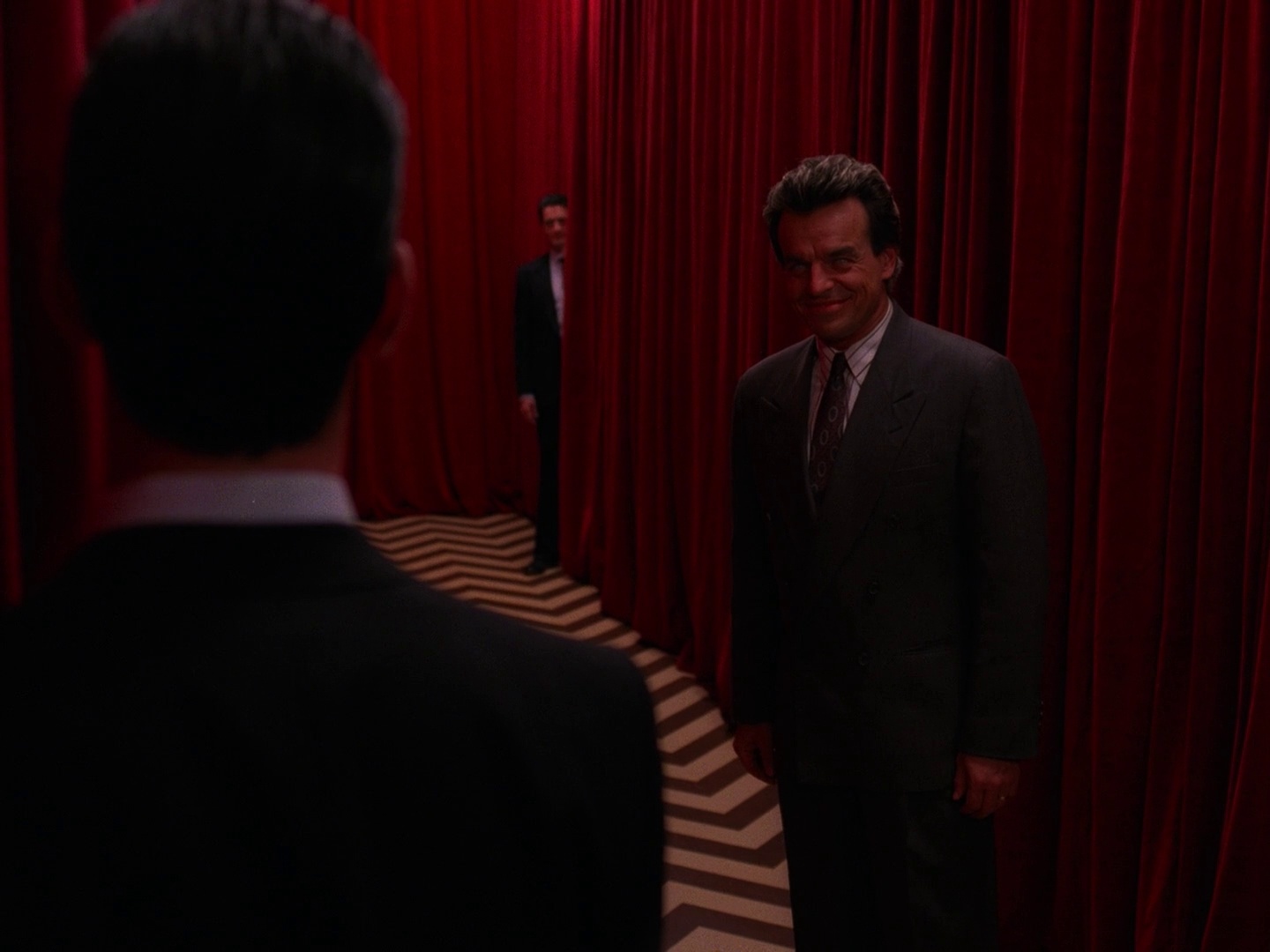
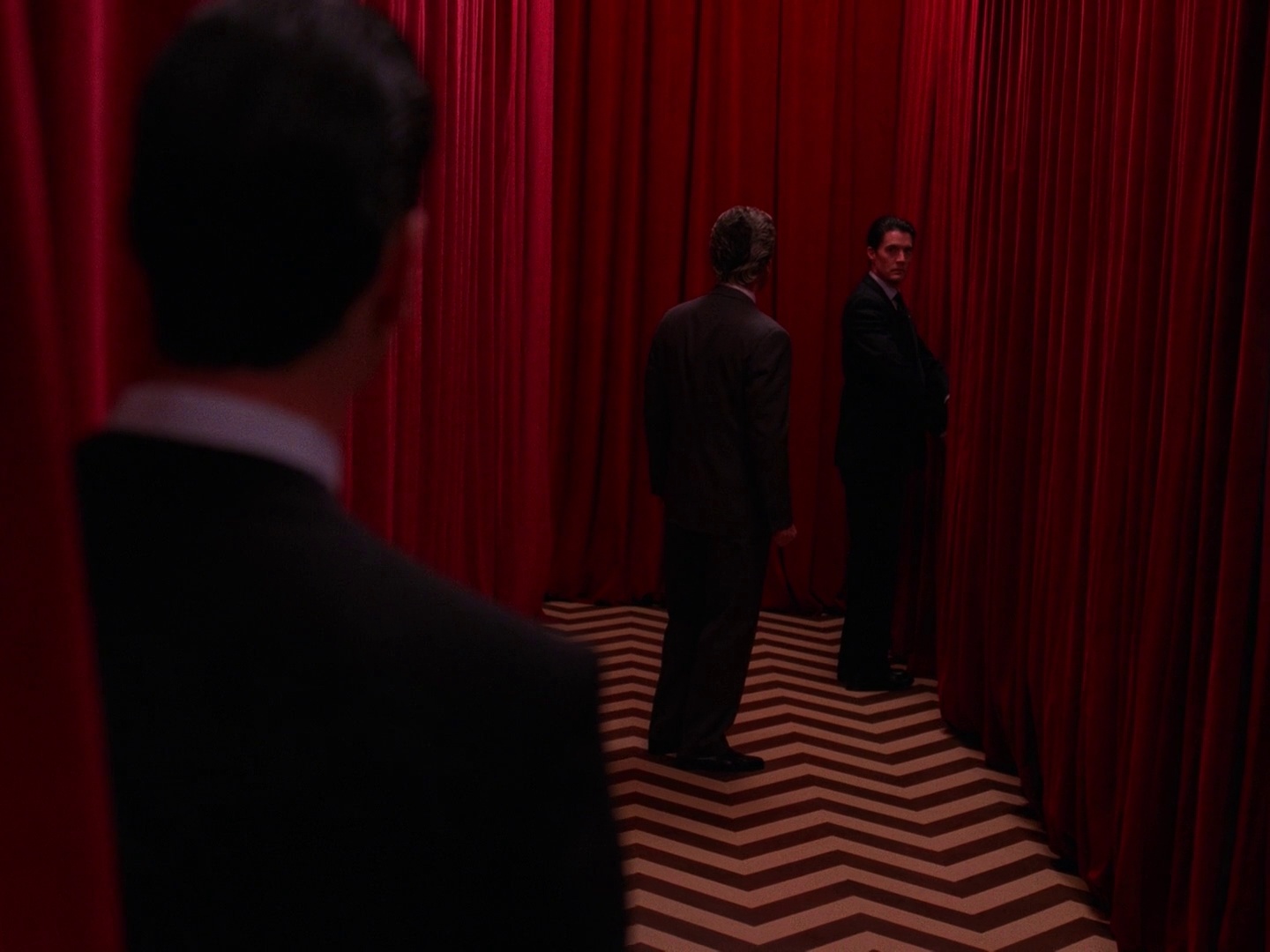
Coincidentally right after Leland claimed that he did not kill anybody.
For the first time, Cooper sees himself within the Red Room, and he is essentially behind the image of Leland Palmer, standing in the shadow of the man he identified as Laura's killer, so-called successfully solving the case.
This image is what truly frightens Dale Cooper.
Now is when he chooses to run.
At first, Leland's doppleganger looks upset by his departure until Dale's approaches him and they share a conspiratorial laugh together.
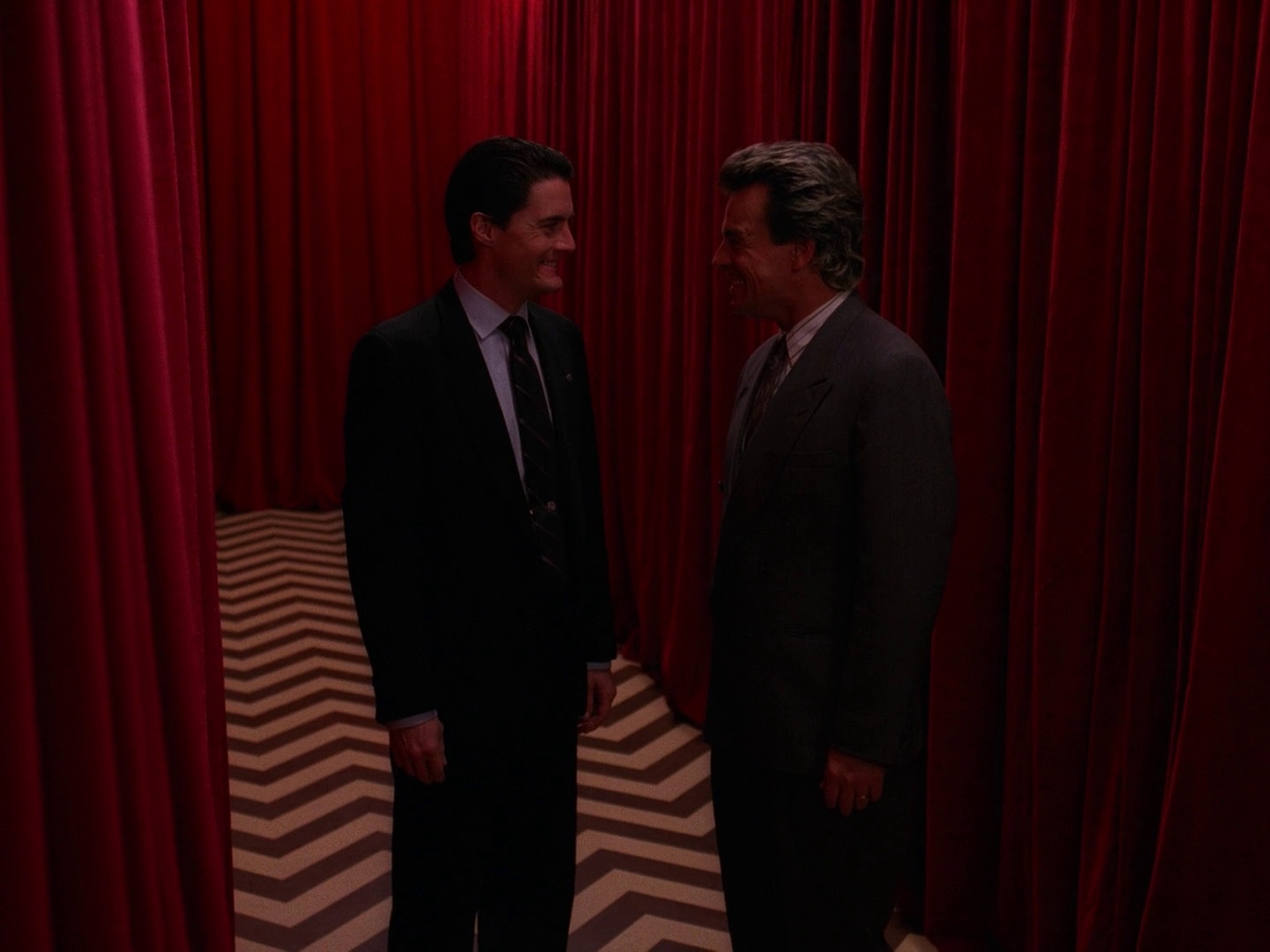
Leland Doppleganger is, for some reason, appeased now, waiting patiently in the corridor, smiling to himself, as the Dale Doppleganger takes pursuit.
What we then essentially see is Dale Cooper running away from himself in abject terror, even after being warned to not face the Lodge, or his shadow self, with imperfect courage.
This isn't the first time Cooper has become frightened in the Red Room however.
When Laura's doppleganger screamed at him in her own horror, anger and fear, climbing from a chair facing him over to one that is facing away before making a mad, defensive dash at him...
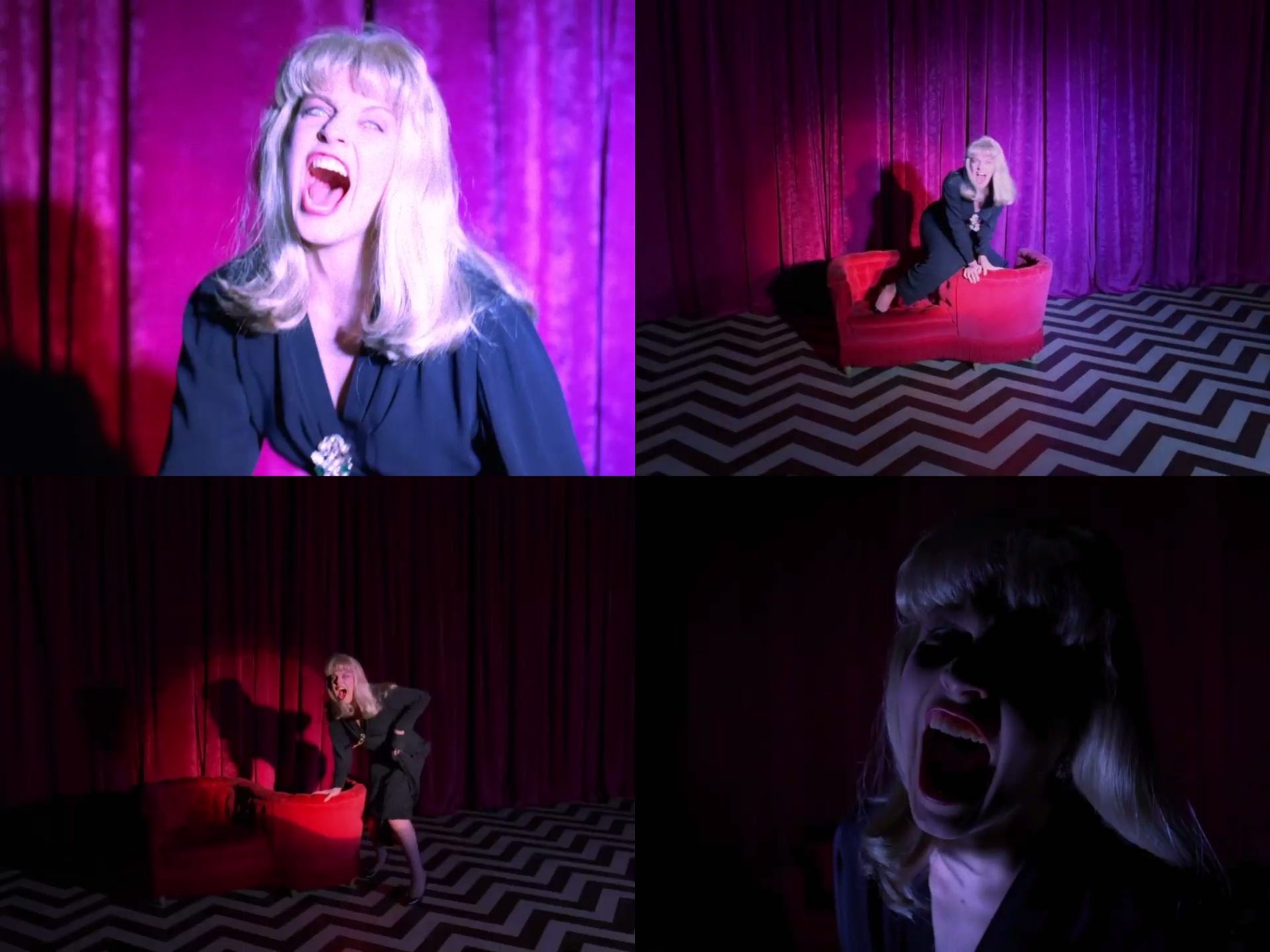
It sent the FBI agent scurrying off with an almost uncharacteristic horror too.

make tv GIFs like this at MakeaGif
In the next instant, Cooper is seen wounded after the encounter, oddly enough in the same spot Leland was bleeding at the end of Fire Walk With Me.
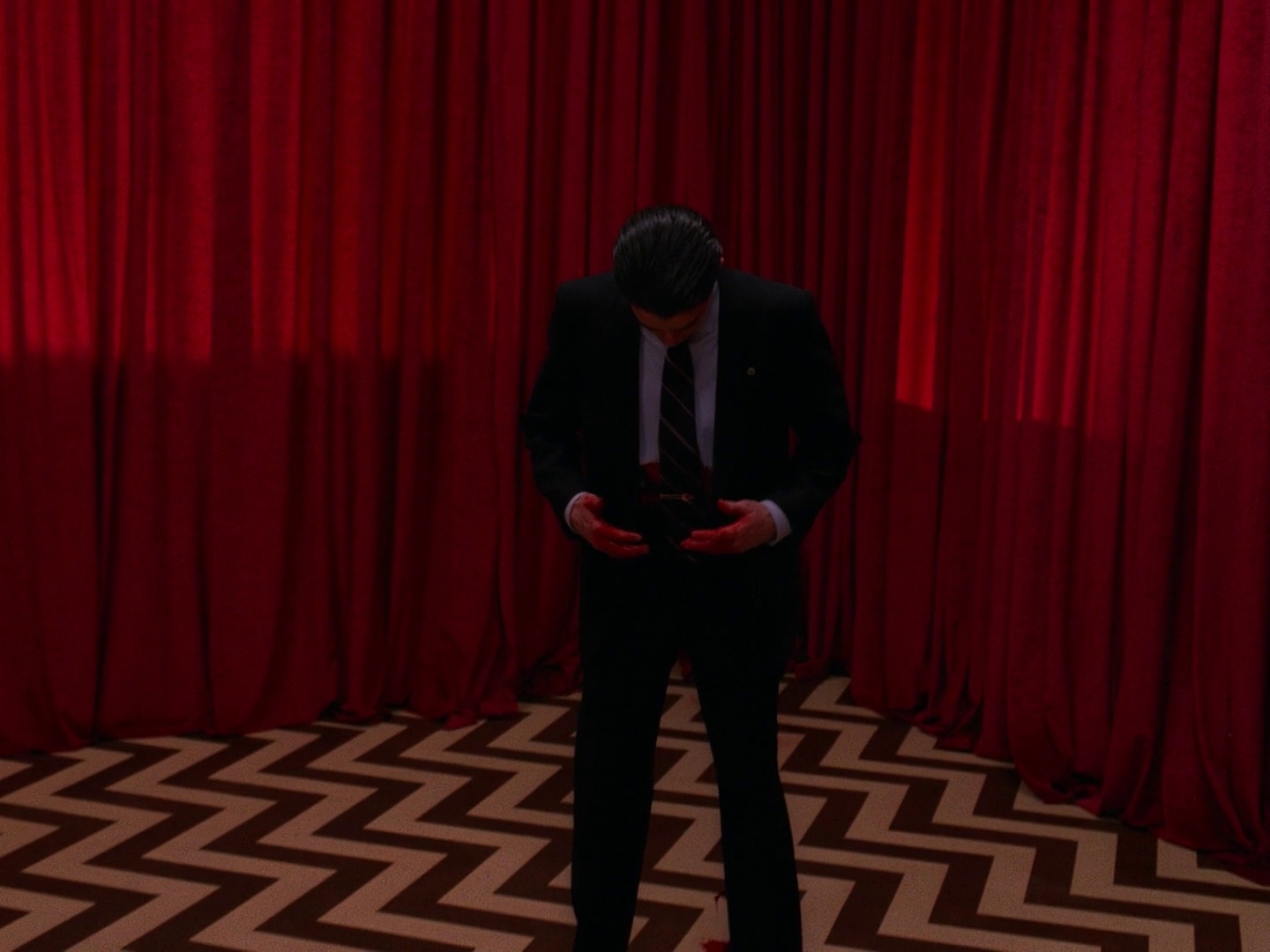
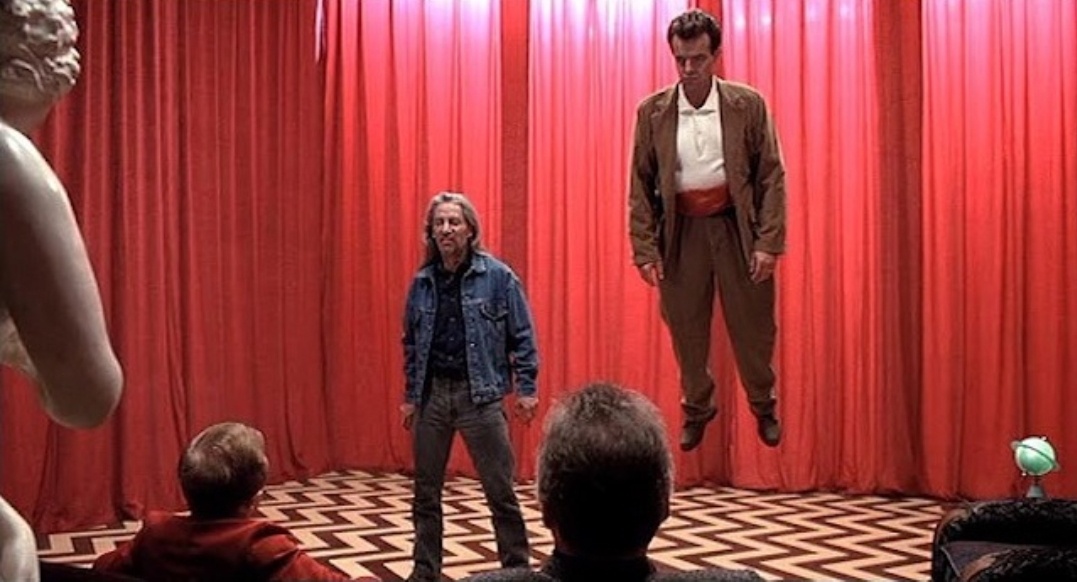
We will see the Laura Doppleganger, interestingly, for a second time, seemingly for no reason, after Cooper has found the kidnapped Annie and had a conversation where she states ominously that she saw the face of the man who killed her, fully echoing Harold Smith's words from episodes back about what the ultimate secret was. After Cooper's confusion over seeing Annie as just another Caroline is shown to great effect, where the woman turns into Caroline's doppleganger and we know the statement was really hers and not Annie's, the doppleganger of Laura will once more be seen screaming in angry terror at Dale.
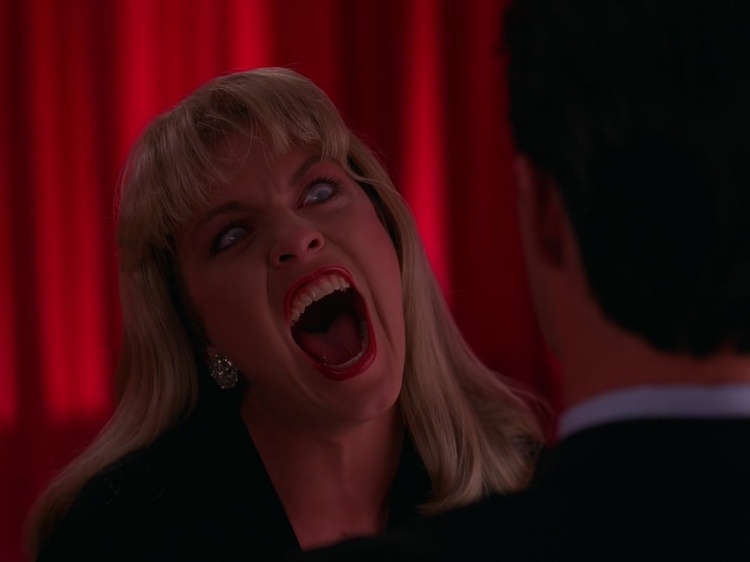
Laura Palmer's doppelganger's reaction to Cooper, and that besides from seeing himself, it scares Agent Cooper the most inside the Lodge, has always been troubling. Not even the threat to Annie, the memory of Caroline's death or BOB seem to disturb him as much as these two seemingly disparate occurrences: Laura's doppleganger and his own shadow self.
But what if they aren't so separate afterall, both being related to what has been so thoroughly hidden or buried?
What if this was the truth coming out, via both daughter and father, in the Red Room (essentially only Dale Cooper's mind), a place where Cooper could not escape from it?
Laura Palmer never whispered that her father killed her.
She whispered something that indicated he had.
~Echo Chamber~
Is Laura's initial whisper the same thing she whispers to Dale in Part 2 of The Return?
Impossible to say.
All we do know is that during the Twin Peaks Limited Event Series, Laura Palmer will once again go towards Cooper, lean down to kiss him and then whisper something into his ear. But this time Cooper will make a fairly distressed noise in response to her words and then look very distraught at the revelation, whatever it may be.
Only...
Wait.
We know what that is too.
While the whisper from the initial Red Room sequence is unknown, what Laura whispers in the Return has actually been discovered, thanks to modern technology and Lynch having made it somewhat audible for us, spoken in the same backwards/fowards speech as opposed to the suspect "My father killed me".
It isn't the clear cut answer hoped for though.
m.soundcloud.com/steven-guy-10/lauras-whispered-message-to-dale-cooper
What Laura Palmer whispers to Dale Cooper is simply this: "Don't assume, (that) nobody can spot your dark suit off but me."
It sounds strange, not even for just how it has been rendered. Cryptic. Yet another mystery to add to all the others.
But whatever it means disturbs Cooper.
Infact, he seems to understand it on some deeper level, implied by both his expression and the noise he makes.
Does he react to it in an even more physical way however?
I think it is important that only after Laura has whispered to Dale Cooper is she violently removed from the Red Room.
People like to connect it to her disappearance in Part 17/18, and the scream sounds identical, as does the sound of curtains fluttering. They theorize, however, that it was Judy (a mystical entity connected to BOB) pulling her out of Twin Peaks to destroy her, all as Cooper had been valiantly attempting to prevent her death, or perhaps the Fireman (a source of good) trying to help save her.
However, there are indications that there were two times Laura Palmer was ripped out of the Red Room, Cooper's noise during her whisper varying from Part 2 to Part 18.

make tv GIFs like this at MakeaGif

make tv GIFs like this at MakeaGif
It sounds like a shocked "huh" the first time and a defeated "unhuh" the second.
sndup.net/yts2
I believe neither of her removals had anything to do with any supernatural entity.
I believe they both connected directly to Dale Cooper.
I theorize that both times it was Cooper's direct response to what Laura Palmer had been trying to tell him and not the workings of some supernatural entity which effected her banishment. What if, trying to protect himself in both instances from what she had told him, Dale expelled Laura from the Red Room as a defense mechanism?
We have already seen this preservation tactic used in Fire Walk With Me, when, while in the Pink Room, Laura Palmer hears Jaques Renault trying to offer the information to her that the deceased Teresa Banks had been asking about Leland shortly before her death, but Laura allows the loud music to distract her from facing it, basically allowing the music to turn the shouted words into a confusing jumble.
Or a whisper.
Cooper was basically trying to do the same thing in the room of Red as Laura was in the room Pink. As the dreamer, he attempted to guard himself by changing the dream, spiriting her away from the Red Room in order to prevent himself from waking up to the truth suggested by her words.
That he was not whom he thought himself to be.
That he, and not Leland, was the one whom had murdered her.
~The Closet~
Let's take a closer look at what Laura whispered to Cooper.
Strip it away infact.
"Don't assume (that) nobody can spot your dark suit off but me"
At it's core, she was essentially saying that she knew what lay beneath his clothing.
In The Return we'd seen the various incarnations of Dale Cooper wearing vastly different wardrobes to help convey their character in pretty unsubtle ways: from the dangerous, dirty informality of Mr. C, to the blaring, brash, simple style of Dougie to the dark suit that everyone associates with the real Dale Cooper, "The Sharped Dressed Man" like ZZ Top sings about on the soundtrack.
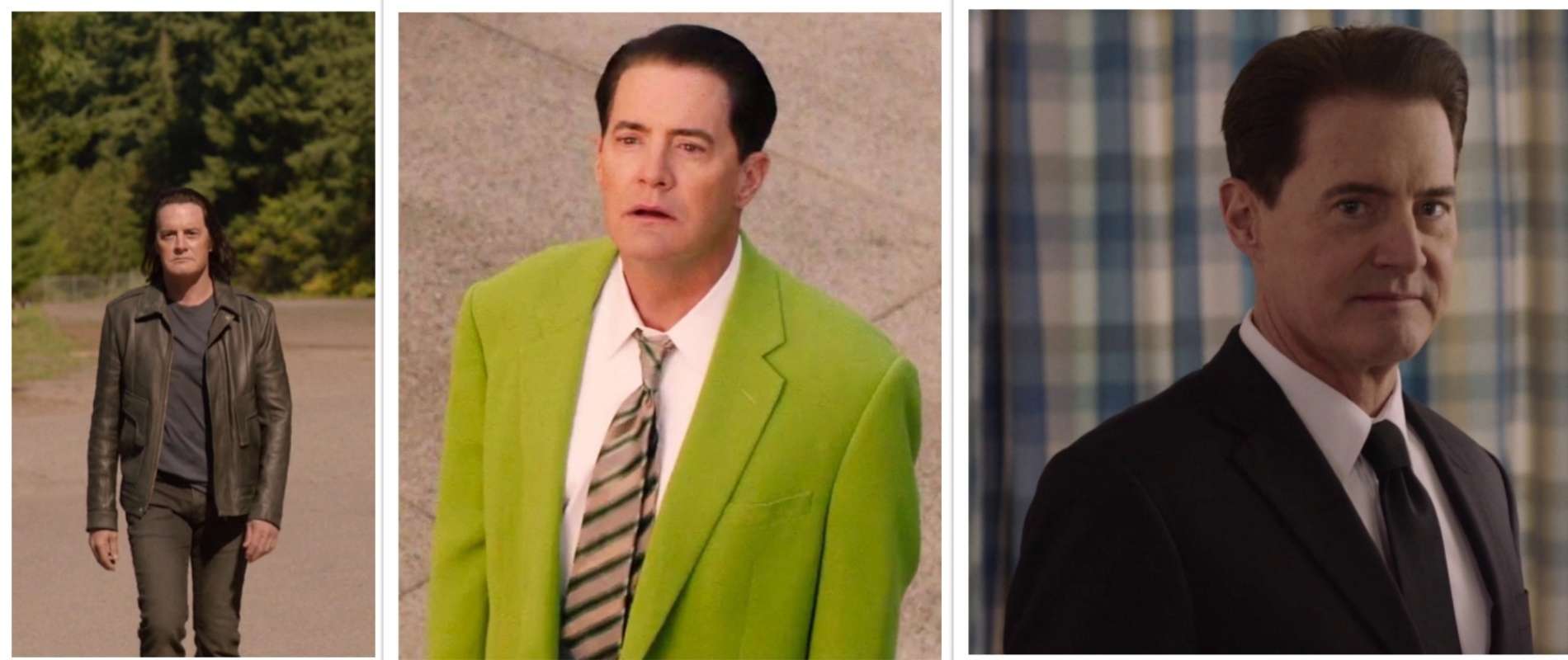
(Okay, so I'm aware that the photo I used isn't technically Dougie, but it is his suit, so just take note of it.)
But is that the real Dale Cooper?
Or have we only ever seen what he wants everyone to see, including himself?
The Return is filled with odd vignettes that, at first, seem unrelated to anything else. One of these takes place, between two drug addicts named Chloe and Ella. One girl begins the conversation with the odd remark that a zebra is out. The other ends it by referencing a penguin, to which they both laugh. Both animals contain black and white, as did the previously mentioned skunk (if it was a literal reference and not Jerry Horne's marijuana use) loose within the Great Northern (possibly in Cooper's old room?). It is likely here, though, that the girl's are referencing a suit. It is also interesting how this scene takes place only a few episodes after Dale's escape from the Lodge and his return to wearing a dark suit after being saddled with Dougie's vibrant wardrobe.
The zebra is out again.
In any case, the women are laughing and disdainful at whatever is dressed in black and white and it is hard not to associate it with Cooper's wardrobe.
Is it indicative of Laura's earlier whisper somehow? An abstract thought still trying to return within the same mind, although Laura is now absent from the Red Room?
But where did Laura Palmer go?
I theorize that, just like the zebra, she was let out too.
The question is as what?
~No Longer Welcomed~
The first time Laura whispers and is hastily stolen away from the Red Room, I theorize that Dale Cooper expelled her to save his vision, his mind, basically altering his dream. And I believe, he modified it to better suit, as a direct consequence of her whisper, how he now felt about her.
As the Log Lady posited in the introduction to episode 9: "Does our thinking affect what goes on outside us, and what goes on inside us?"
It is in this moment, I feel, that Dale twisted his idea of the deceased version of Laura as an entity of light, a tortured victim worthy of sympathy, turning her into something dark and vengeful instead, connecting her in some way to the female counterpart of BOB: the entity known as Judy.
But this is where things get tricky for me.
There are two possible solutions within my mind for whom Laura as Judy is.
And both make logical sense from wherever I stand.
First we must examine the main flaw in the creation of Judy inside the world of Twin Peaks.
It would appear to be one giant retcon.
Which, if it is, then there is no possible way to make sense of it.
If we look at FWWM there is nothing that seems to indicate that Judy is a gigantic supernatural force of evil. All we have to go on, anyway, is Phillip Jeffries reference about not talking about her and a monkey that bafflingly whispers the name before the infamous shot of the plastic shroud being pulled back to reveal Laura Palmer's dead and peaceful face.
The Missing Pieces make it even more confusing. Jeffries wants to know if Judy is staying at his hotel. He receives a note from her and the concierge just calls her a young lady. Jeffries then will say to Cole that Judy's positive about something and he found something at her place in Seattle.
Hardly the reactions one expects of a terrified human being to a frightful and ancient supernatural foe.
It is conceivable that this might have been altered by the dreamer however. A shifting within the dreamscape. It could explain Phillip's sudden attitude towards Judy from when he is introduced, to the much later exposition Gordon Cole's delivers that Jeffries was on to what Major Briggs had labeled as an "extreme negative" entity.
Or maybe it is equally possible both men had different points of view on Judy, the Major seeing her as evil while Jeffries saw her as something else. It could be Cole's own perception which makes him assume Jeffries' Judy was in nature the same as Briggs'. For Gordon Cole, afterall, he would have remembered anything Jeffries has said about her, including the vague reference at the Philadelphia FBI Headquarters, before Briggs own darker revelation months later in Twin Peaks. We're still hazy over when exactly Jeffries came from, only that he seems shocked to learn what year it is, indicating it very well could have been the future.
This uncertainty regarding Phillip Jeffries also kind of creates a question of which timeline he's from, the possibility of different realities broached within The Return, as witnessed when the Double R Diner customers mysteriously change.
Something else confusing about the whole business is exactly when Briggs told Cooper and Cole about Jowday (as Judy was supposedly initially called) if it was the good Dale or the bad one, and if it was the latter then how Dale Cooper seems to know all about it, sharing his dark side's goal to find Judy and kill two birds with one stone by the end of the series.
Unless all Coopers are more or less the same and each shares whatever knowledge they possess with the other, making the question pointless.
But in any case, Judy herself remains problematic, yet inexplicably connected to Laura Palmer, as will be hinted at and then fully revealed in Part 17.
I'm going out on a spindly sycamore limb here, though, and ready to state my belief.
I don't believe that there is one Judy.
I think there are two.
Two Judys.
Just as there are two whispers.
A twinning just like the titular peaks.
Okay, so there seems to exist some unstated connection between the white mask/face and those whom are possessed. At some point, Leland Palmer, Dale Cooper and Sarah Palmer were all on screen with the mask/face, or some form of it.
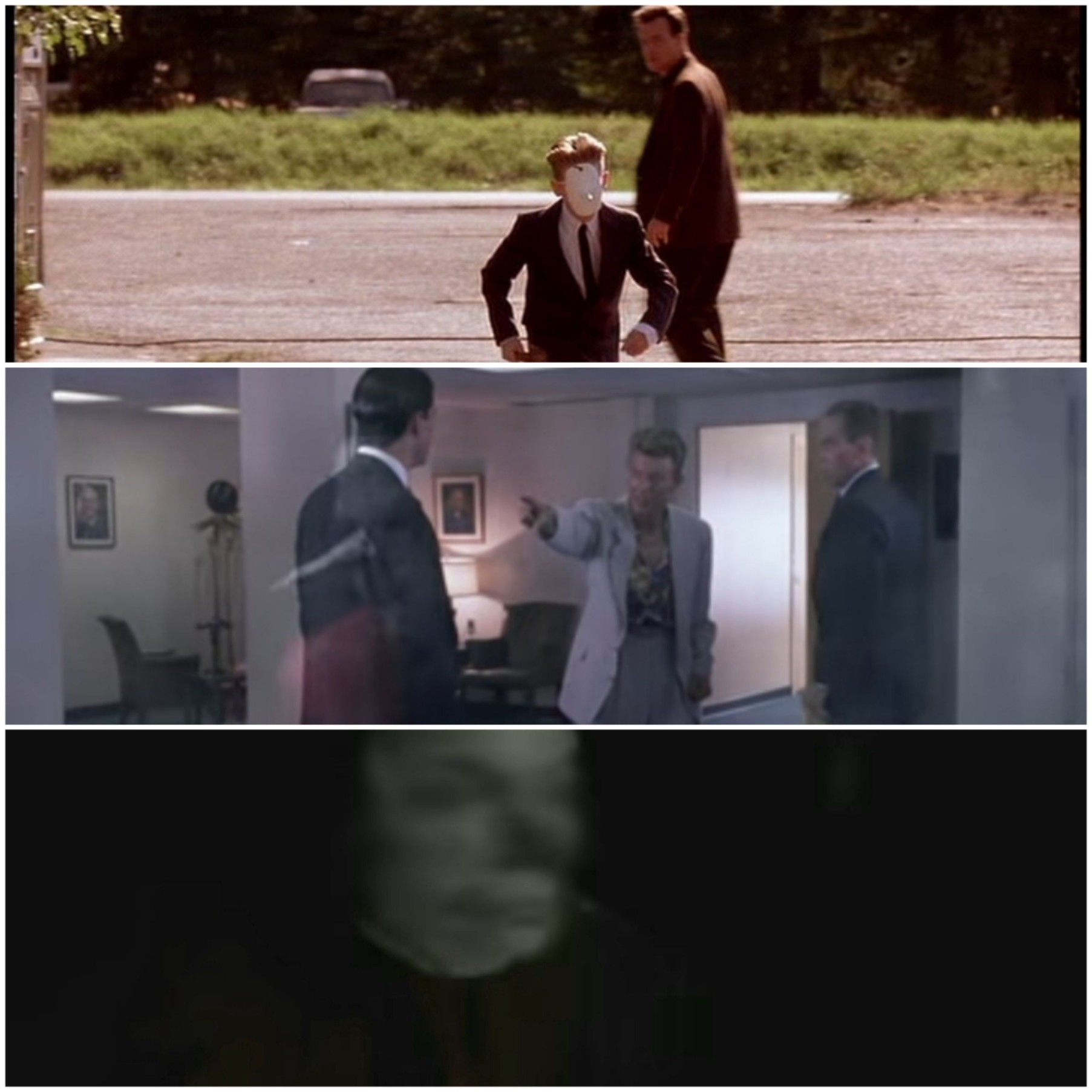
All three characters were known/assumed to be possessed during the story.
A mask is a pretty straightforward and ancient symbol for possession.
And getting back to the monkey, it was also seen hiding behind the grandson's mask during the convenience store meeting Jeffries witnessed. Oddly enough it was seen without it following Laura's death, linking it directly to Laura, whom was in danger of being possessed but by dying averted it.
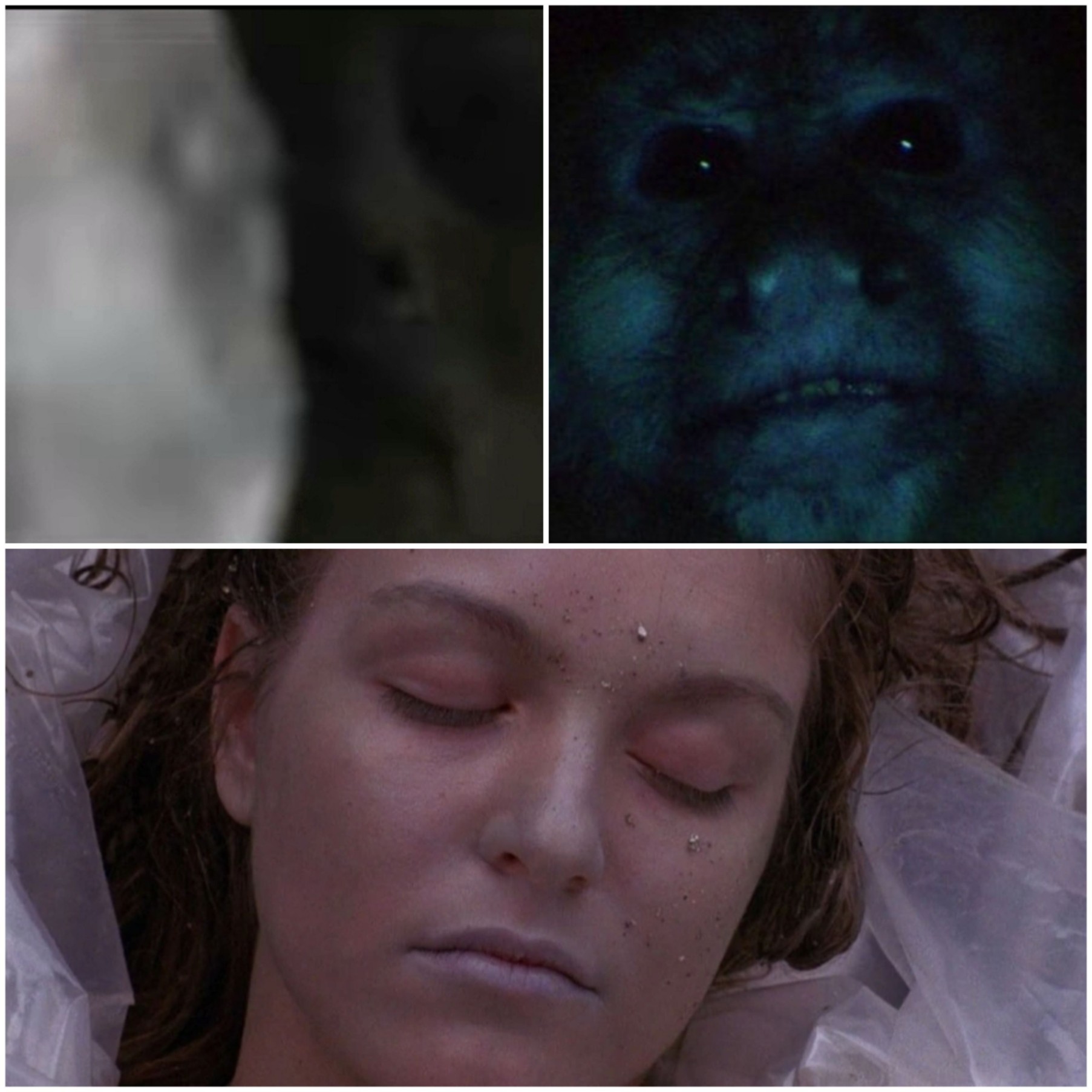
That was when the monkey whispered "Judy" establishing early some relation to Laura Palmer.
But in which way?
If we accept Judy as some transformed version of Laura Palmer, are we to take it to mean that the monkey represented the aspect of Laura in danger of being possessed, and it being blue and maskless meant this threat had died, insinuating "Judy" was Laura possessed and alive.
Or does it whispering "Judy" and Lynch showing us Laura's corpse mean that Judy is a name associated with her death?
It could go either way.
However, in my mind, both are possible.
As confusing as it might sound, Judy is both Laura Palmer alive and Laura Palmer dead.
Or as she said, "I am dead, yet I live."
~No Exit~
After Laura's disappearance from the Red Room, Dale Cooper sees the red curtains part for the first time, revealing a black emptiness, save for the Chevron floor and a white horse, echoing the murderous helper of BOB, the Woodsman's, words from part 8: "The horse is the whites of the eye and dark within."

make tv GIFs like this at MakeaGif
This event, a void created within the Red Room (or one finally glimpsed), would seem to back up Cole's earlier statement, though, that Judy is an extreme negative force, especially if Laura's absense somehow involves her.
Straying from the room, Cooper encounters Mike and the Arm and a curtain barricaded off with accompanying sounds of electricity.
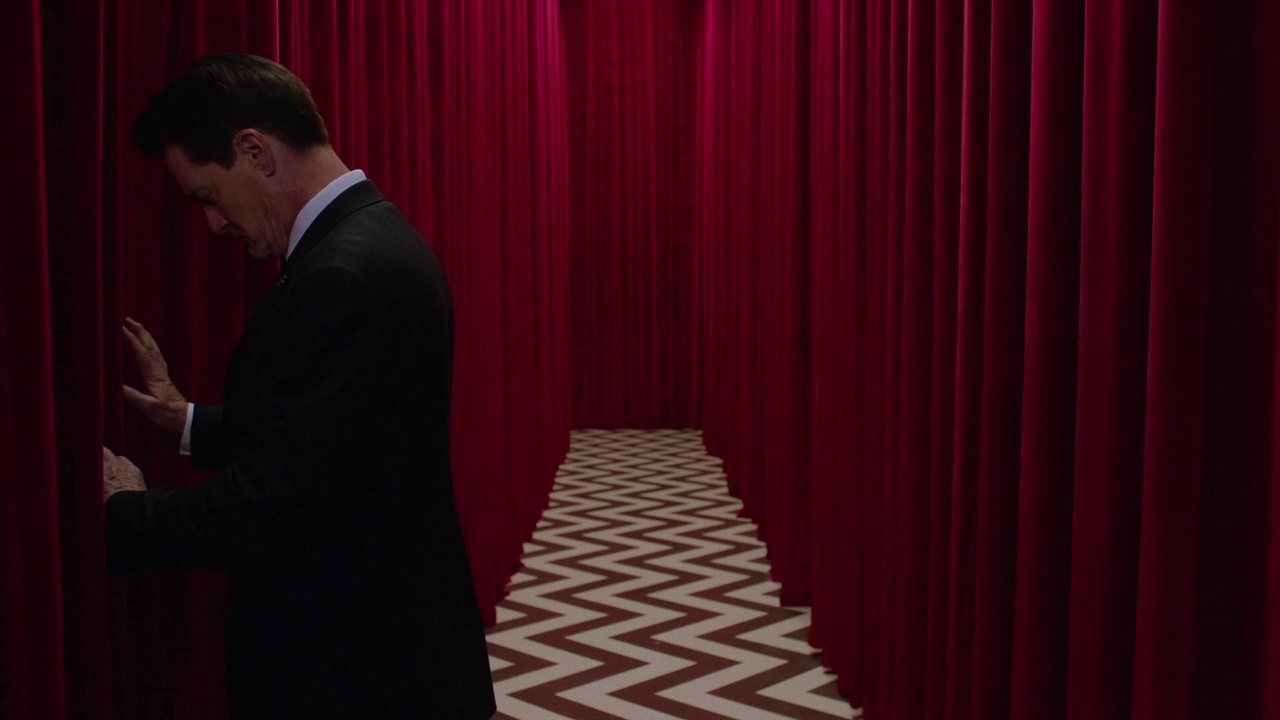
Cooper eventually finds Leland too, whom implores him to "Find Laura" and then looks down rather sadly, no longer looking at Cooper.
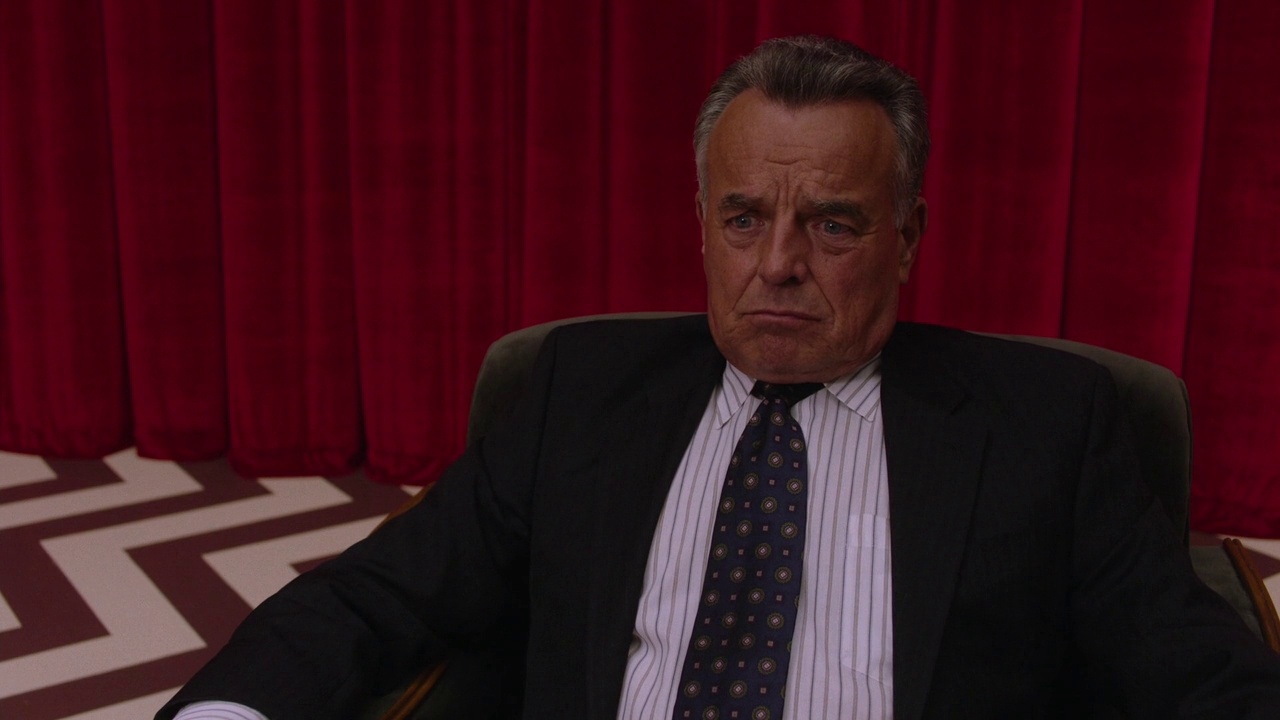
This is the first time we have encountered the deceased Leland Palmer, and not his doppleganger, within the Red Room and I wonder if he is aware of his daughter's new absence from the Lodge. Does he request Cooper find her because of it, or does he sense she is no longer Laura but something else?
When Cooper leaves the room, there is more electricity, but this time it allows him entrance.
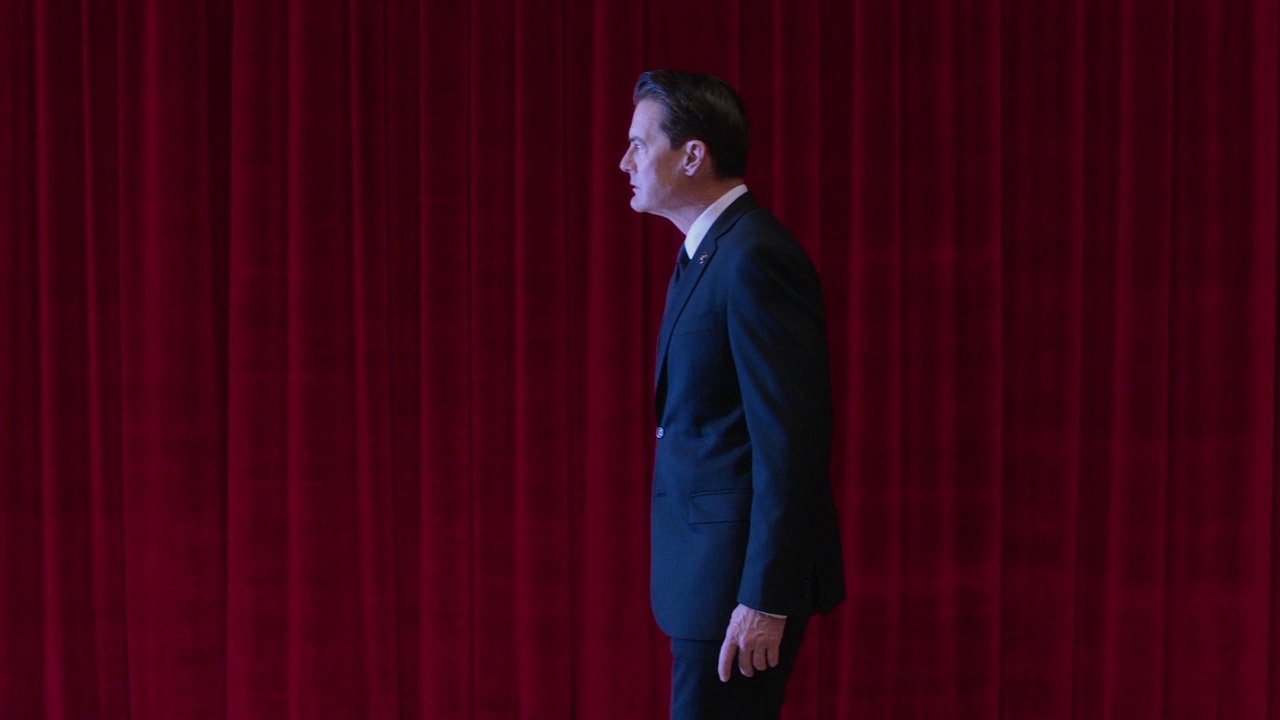
The electricity is reminiscent of how Dale described dreams to Harry S. Truman and Lucy, following his first one of the Red Room: "Acetylcholine neurons fire high-voltage impulses into the forebrain".
Dreams are essentially believed to be electrical signals.
Dale Cooper is simply switching dreams, his brain going in one direction and not the other.
While still trying to find a way out from the Red Room, Cooper opens the curtain only to see footage of his Doppleganger driving down a road in the outside world. Soon after, the Chevron floor starts to shift and he encounters, or is confronted, by the Arm's doppleganger, whom screams at him in a confrontational manner, "Non-exist-ent".

make tv GIFs like this at MakeaGif
The words hearken back to the darkness seen earlier, but also seem to hint that something is wrong within the world of the Red Room for the first time since Cooper entered it 25 years ago. Either something has threatened it or, perhaps, the doppleganger is merely trying to tell the dreamer Dale Cooper that everything he is seeing is virtually a fabrication of his mind and really does not exist.
It would be an interesting probability then, if this were the case, that the dopplegangers have only spoken the truth to Cooper within the Red Room of his mind. This is a possibility that would make logical sense if we think about it. If a doppleganger, a shadow self, is what we hide from others and ourselves, it would likely be representive of a truth. We do not try to repress a lie, but rather something that is true that we do not wish to face or for others to know. And the truth so strongly repressed would equally, forcefully, wish to come out.
In its wrath, the Arm's doppleganger is trying to taunt Cooper with the fact not to trust what he has just seen because none of it, not even the Red Room, really exists, either because of something Cooper has or will do or because it never really existed at all to begin with.
Surely enough, the Chevron floor of black and white, with its ups and its downs, opens, causing Cooper to fall through it into darkness, leaving the Red Room behind.
~Dreaming Inside and Outside the Box~
Eventually Dale Cooper ends up inside a mysterious glass box we've seen being filmed in NYC.
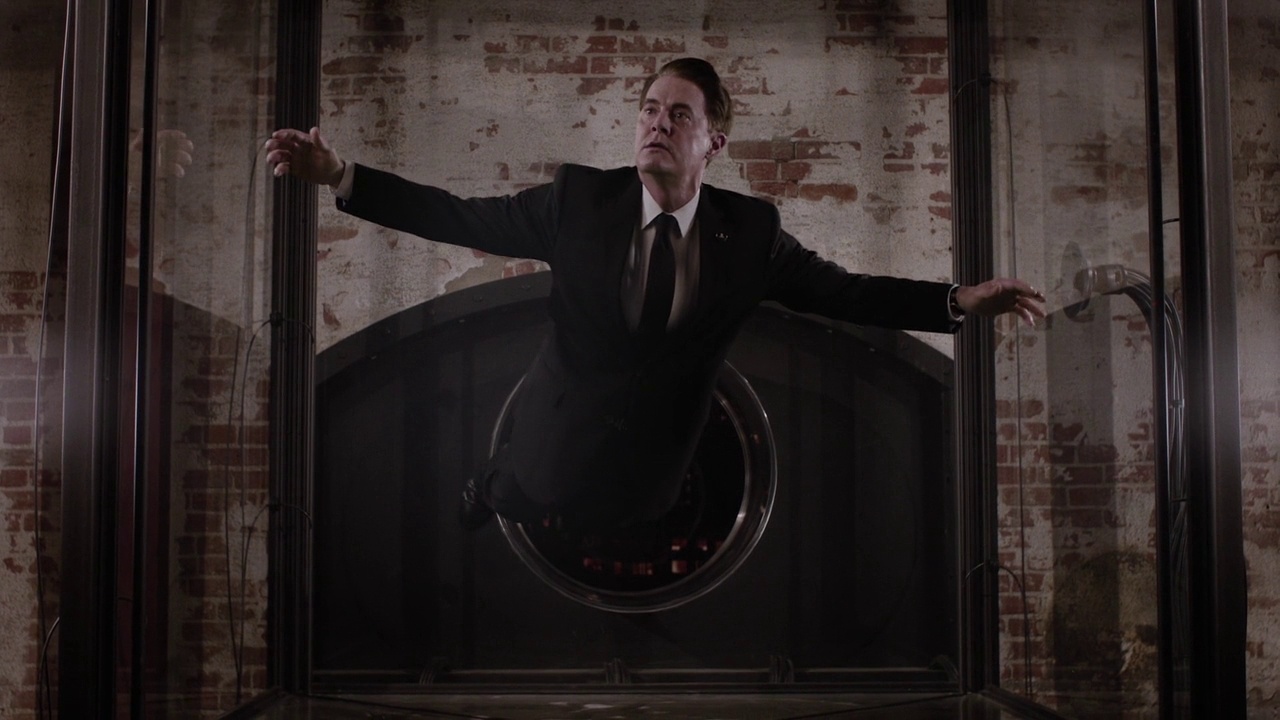
He floats in it for a while before disappearing as the box repeats itself over and over again, in a seemingly never ending cycle of repeats, at one point backing in on itself, before going back to create more boxes spiriting him away.

make tv GIFs like this at MakeaGif
To me, this event inside the box, represents the act of Cooper dreaming.
Later in the series, we learn that Gordon Cole habitually has dreams of Monica Belluci; it happens to the point that Albert knows all about them. Dreams often reoccur, or instead you may find many dreams contained within a single one when the dream suddenly shifts to become something else, not unlike a Russian Nesting Doll or the layers of an onion. I believe, this is symbolized in the form of the glass box in that instant when Dale appears in it and then vanishes amidst the many boxes: sometimes our mind create a new dream, sometimes it revists an old one, but, regardless, Cooper is losing himself inside of his collection of them.
~The Invited Trespasser~
Is it only a coincidence then that, soon after Cooper disappears, the experiment model shows up and completely destroys the young couple (now returned to the room) making love, as if Dale's appearance has somehow conjured it as well?
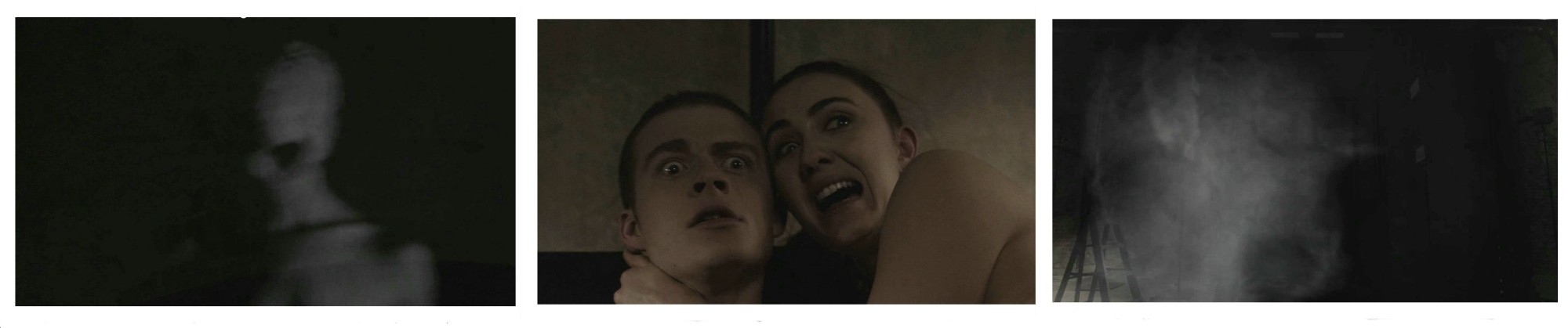
I doubt it.
Nor do I believe that the "monster" is a stranger either.
I think we intimately were given the chance to know her, all as Dale Cooper investigated her murder.
The Experiment Model, I believe, is the Laura Palmer that Dale Cooper subconsciously vanquished from the Red Room, her appearance integrally linked to the fact that we have just seen her exiler moments before, the scene playing out in linear time in The Return Part 1.
Both Cooper and Laura have now exited the Red Room, but I theorize that, while Cooper tries to hold onto the vision of himself as a hero, he has recreated Laura Palmer in the image of the enemy.
Having tarnished his earlier dream with the hint of the truth in a whisper, no longer is Laura the sweet, flirtatious and playful creature of white from the Red Room; Now she has been banished from it, transformed into a new dream, or nightmare, becoming the Experiment Model that appears within the darkness of the glass box in NYC.
Laura is now Judy.
The first Judy.
And this Judy is extremely pissed off.
~The Prodigal Daughter's Spiritual Journey Home~
And why shouldn't Judy, be?
This is all of Laura Palmer's rage and need for revenge brought about by a whisper which taunted a man trying to pretend he was innocent.
Judy kills the young couple innocently having sex, perhaps reminded of the sexual abuse she endured for years, or because they were supposed to, in essence, be symbolic of whatever truth lay behind Dale and Laura's relationship outside of the dream.
She then possesses and torments her mother, taunting her about the car keys, harkening back to another Missing Piece from FWWM. Meanwhile, she also watches violence on tv all day as she drinks endless Bloody Marys.
Eventually she will show off a vast darkness, then a newly corrupted spiritual finger, to go with Laura Palmer's famous smile as Sarah removes the mask of her face (and we can recall Laura's words in one of the found missing pages of her diary "I sure didn't need a mask today").
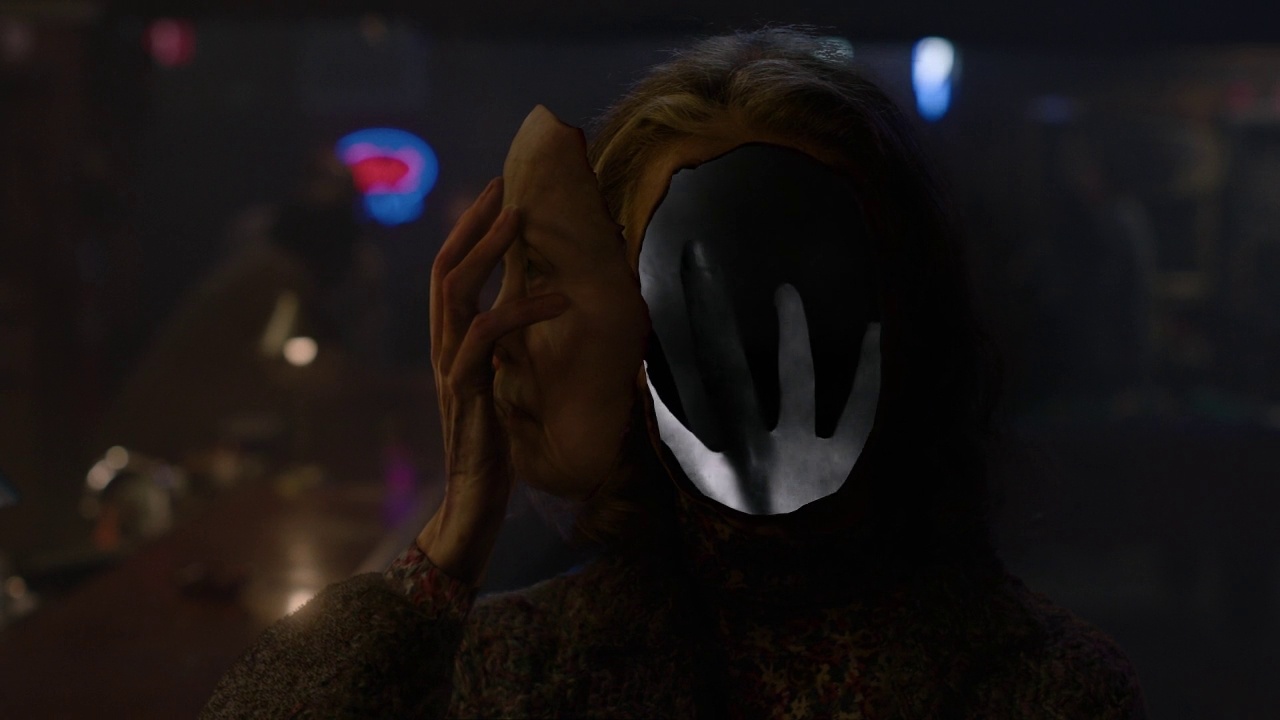
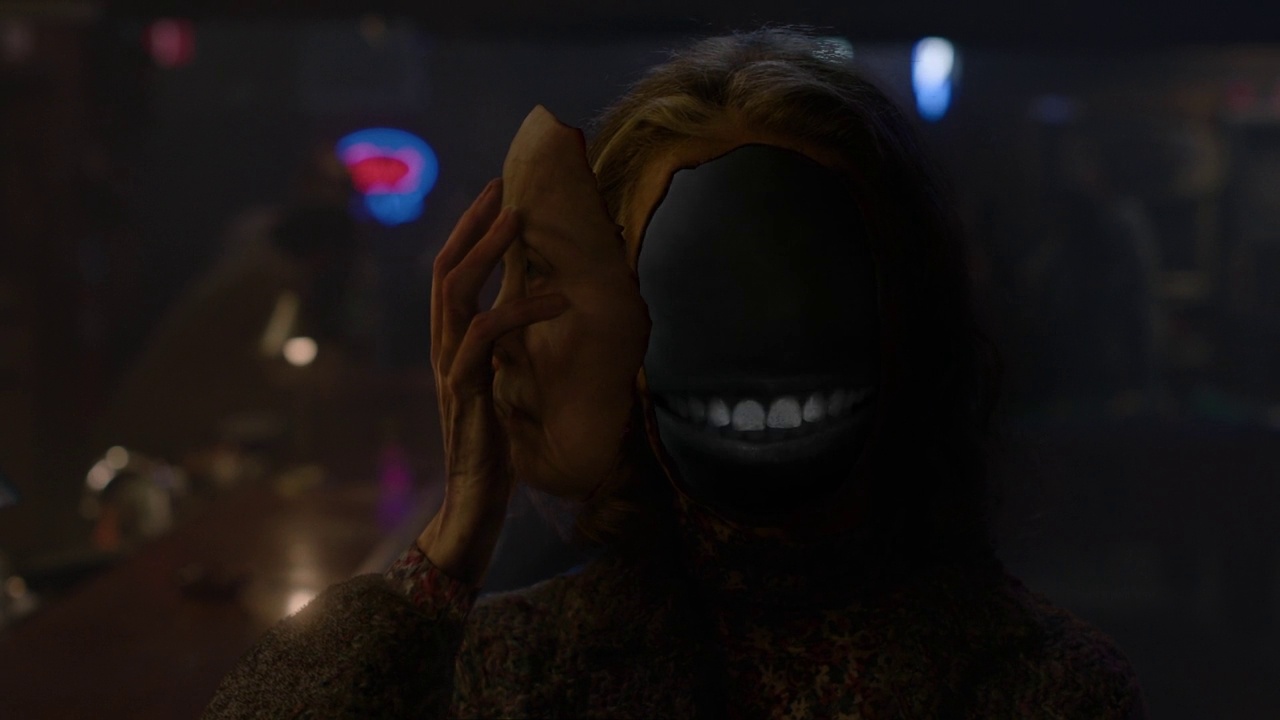
Which contrasted sharply with the white behind the face of the Laura in the Red Room.
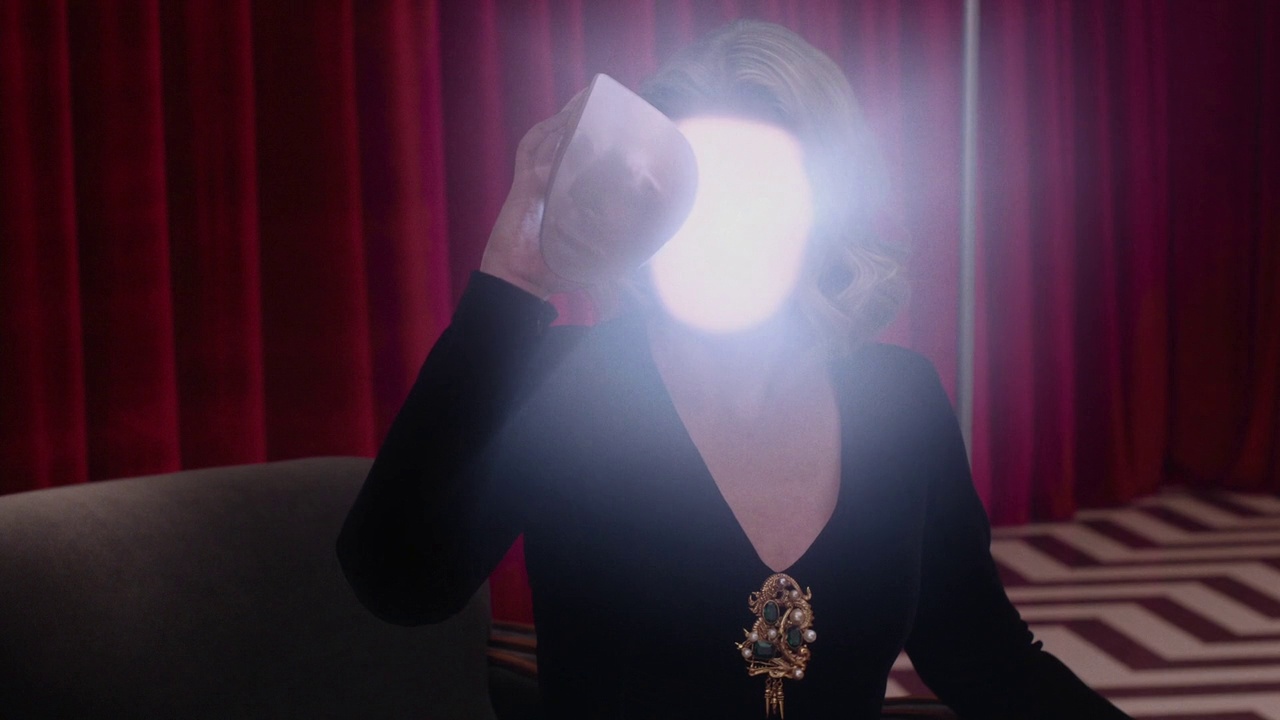
The new visage of Laura is shown right before Judy rips out the throat of the man at the bar, a man whom likely reminds her of all the truckers whom used her selfishly in exchange for drug money. She even snidely asks of the man, "Do you really want to fuck with this?" before she murders him.
BOB wanted to possess Laura Palmer to kill for him and now she seems to relish that possibility all on her own.
She has become warped.
Evil.
A demon, just like BOB, one whom needs to be defeated.
Laura Palmer is now the black of the Red Room floor, not the white, inside of Dale Cooper's mind.
~The Floor Stepped On~
A common trait of the mentally ill is something known as splitting. The person suffering from the mental disorder, in order to protect their fragile sense of ego, will see others in simple terms of good or bad, black and white without the complicated and varied shades of gray.
These feelings of good (white) and evil (black) flip often within the person's mind, up and down, peaks and valleys.
Like a Chevron pattern, if you will.
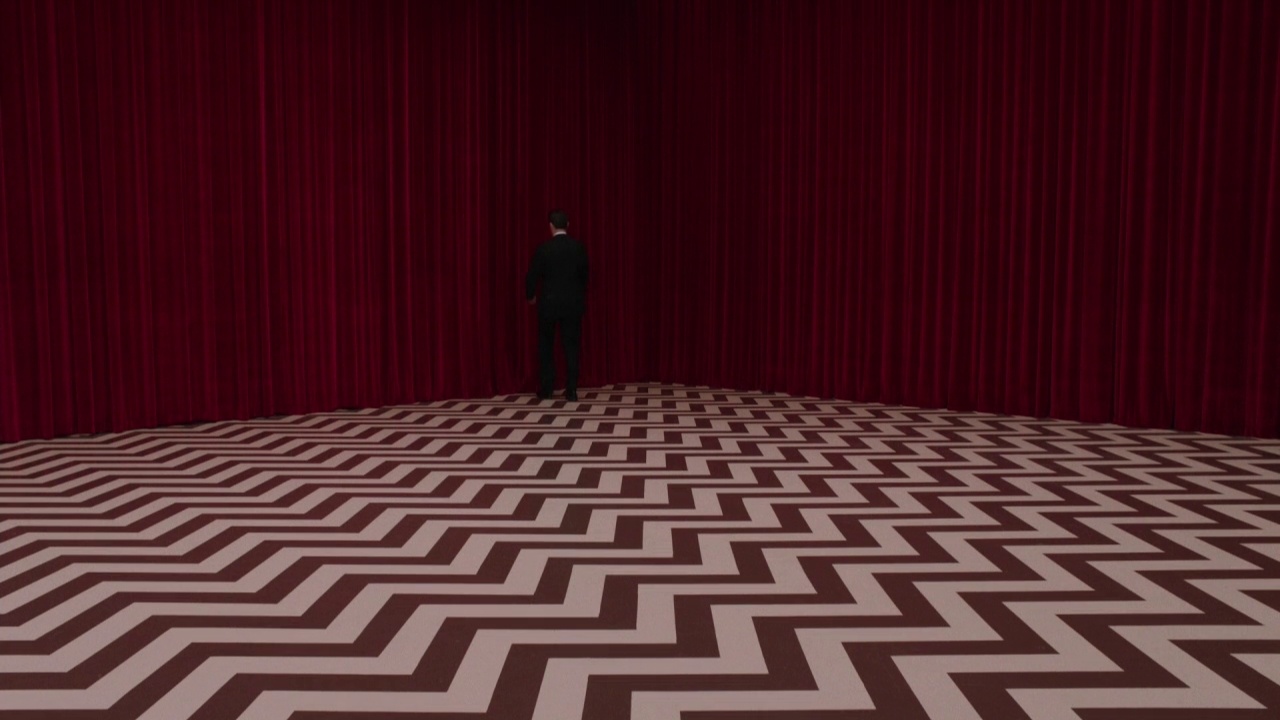
Now contrast the two visions of Laura Palmer seen throughout the series: the kind goodhearted girl trying to help others (Meals on Wheels, Tutoring Johnny Horne etc...) and the darker one whom sought to corrupt others (getting Bobby to sell drugs, using sex as a manipulation tool). It was often laid on so thick infact, it became impossible to believe. The poor girl seemed hardly able to juggle both sides of herself, with all the things the writers gave her to do, besides being abused at home on a nightly basis. That she was able to sleep and function at all was inconceivable for any real person.
Warp it even more, in the most fairy tale of ways, and carry it through to how we see Laura in The Return, if infact she is whatever is possessing Sarah Palmer.
Her demonization is as evident as her beatification.
The fairy tale stretches even farther back to the very creation of BOB.
We first see the supposed origin of the evil being when the atomic testing of Trinity enables the female Experiment to come through dimensions and basically vomit him up, sending her own son down to earth, all on her own, and without the benefit of a mate.
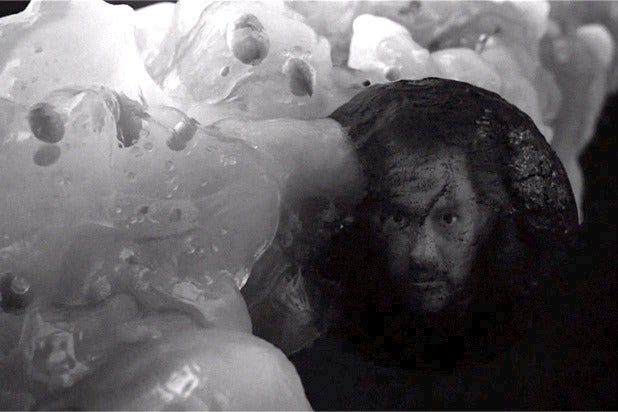
As a direct response, the far more wholesome couple of the Fireman and Senorita Dido (oddly, the Fireman and Dido have an old phonograph, similar to how the Palmers have their own record player and the Fireman often wears a housecoat, as we have seen Leland wear on occassion) create the golden Laura orb - shining full of pureness and constructed from the liquid which marks the portal to their home, whereas BOB is of the flammable oil which marks the gateway to the Black Lodge- sending it to earth to help combat BOB.
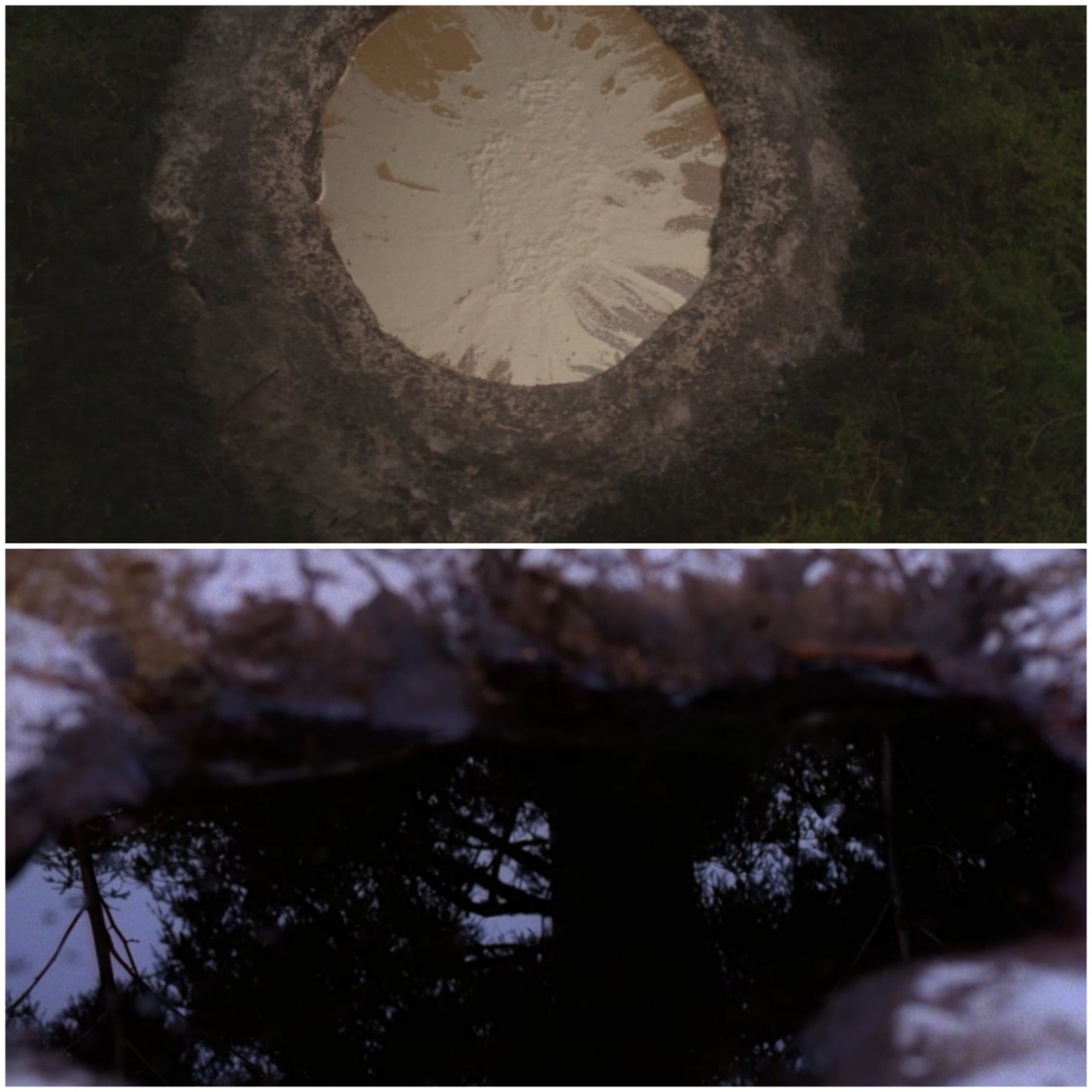
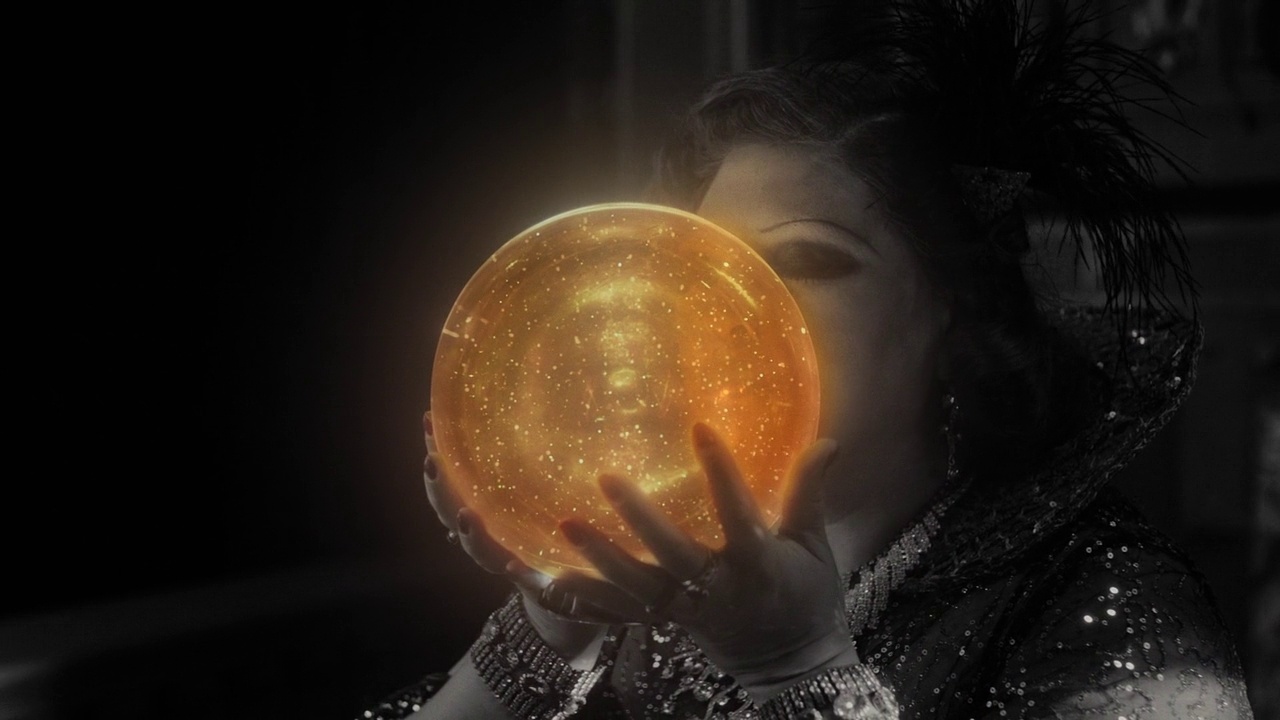
Laura is an ultimate force of goodness here.
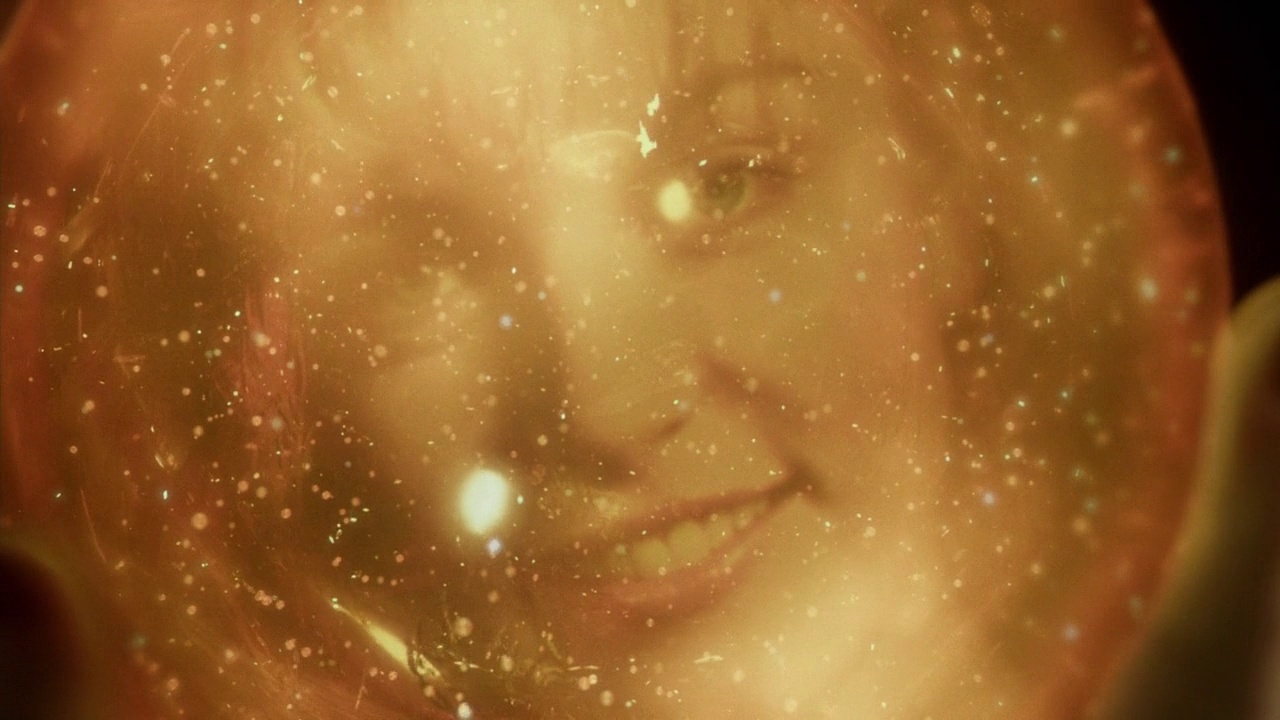
But what follows throughout the story of Twin Peaks, if we dare look a little closer, will beg a disturbing question: was Laura sent to earth to defeat BOB or to somehow balance him out and save him? Was she somehow the ying to his yang? Was Laura Palmer, within the dreamer's mind, made for BOB? Were they, in effect, equivalent to the Red King (representative of masculinity, sulphur, fire, and aggression) and the White Queen (symbolic of femininity, mercury, inflammable and submission) of alchemy, their union desired by the magician.
Seeing as we never actually see her attempt to physically destroy BOB within the series, how that was entrusted to a British boy with a green gardening glove, it would suggest Laura was somehow more entrusted to emotionally, spiritually, battle with the creature, potentially to destroy him with her love (and BOB did become unnaturally obsessed with her as we saw). The theme song to FWWM, afterall, is a variation of a song entitled "She Would Die For Love".
Unfortunately, did Laura Palmer "fail" in her task, when, in Cooper's mind, she did not live up to his impossible expectations of her and she did not rescue him from himself?
With that one little whisper, which brought back a reminder of his true self and not hers, Laura disappointed Cooper and so he resorted to the defense mechanism of splitting, unconsciously transforming her into a demon, a corruptor, one which needed to be defeated instead of the ultimate shining force of good which could purify.
Laura Palmer's smile stays the same, afterall, be it in the golden orb, or in the darkness behind the mask of Sarah Palmer.
~From Nursery to Bedroom~
Touching on this subject of mothers, it is interesting to note that the Experiment, which "births" BOB, is not the Experiment Model from the glass box. The Experiment Model's hands are not backwards, for one thing, plus several other differences can be seen if looked at closely. But they remain very similar, as if the second was informed by the first.
In the series, Cooper's relationship with his mother is not discussed. A biography was released, however, where they seem very close. It is possible, however, that the relationship Dale Cooper describes he had with his mother in his autobiography (which might or might not be canon) is fabricated. Perhaps his mother was essentially absent from his life, virtually spitting him out into the world and then leaving it, or was infact abusive, as Frank Booth's in "Blue Velvet" is hinted to have been.
In any case, Dale Cooper reinvisions Laura Palmer in the form of his mother, another woman, the first infact, to fail him in some way. And he subsequently has her go on to possess/infect her own mother, whom in turn had failed her daughter.
Most men suffering from imbalanced personalities also suffered from either incredibly strained or unnaturally close relationships with their mothers which prevented them from maturing emotionally as they should and forming healthy relationships. They grow up to usually project this onto all women they meet, harbouring a misogyny because of this initial wound.
Within this twisted scenerio, where Judy and BOB have become each other's evil equals, Cooper's belief that Laura and BOB were meant for each other may still exist, wherein this tarnished version of Laura is still trying to find her soulmate. It is a mystery whom tells Mr. C, afterall, that he is going back into the Lodge tomorrow and "I will be with BOB again." It can strongly be believed it is the possessed Sarah Palmer however. And if the thing possessing her is infact her own daughter, it would indicate she yearns in some way for her tormenter.
[Friendly Neighborhood Sidebar Here: there has always been some debate over whom speaks through Sarah Palmer in the original series finale, relaying the message to Major Briggs "I'm in the Black Lodge with Dale Cooper. I'm waiting for you." The Closed Captioning states it is Windom Earle and that honestly could be it. However, it would be interesting to consider the possibility that Sarah is possessed by the good Laura here, not the corrupted one, trying to get the Major to come and rescue Dale. We will shortly see Laura in the episode with Dale Cooper and the same sentiment of them being together repeats itself in Laura's dream in FWWM, when Annie Blackburne warns "My name is Annie and I've been with Laura and Dale. The good Dale is in the Lodge and he can't leave. Write it in your diary". In both cases, Dale might have dreamt this pure Laura was trying to save him, both cases being before his vision of her soured involving her attempt to do this.]
In a bit of research, I discovered a childrens' primer from decades ago called Bob and Judy. It is greatly similar to the Dick and Jane series, where the two children are great friends and have many (if simple) adventures together.
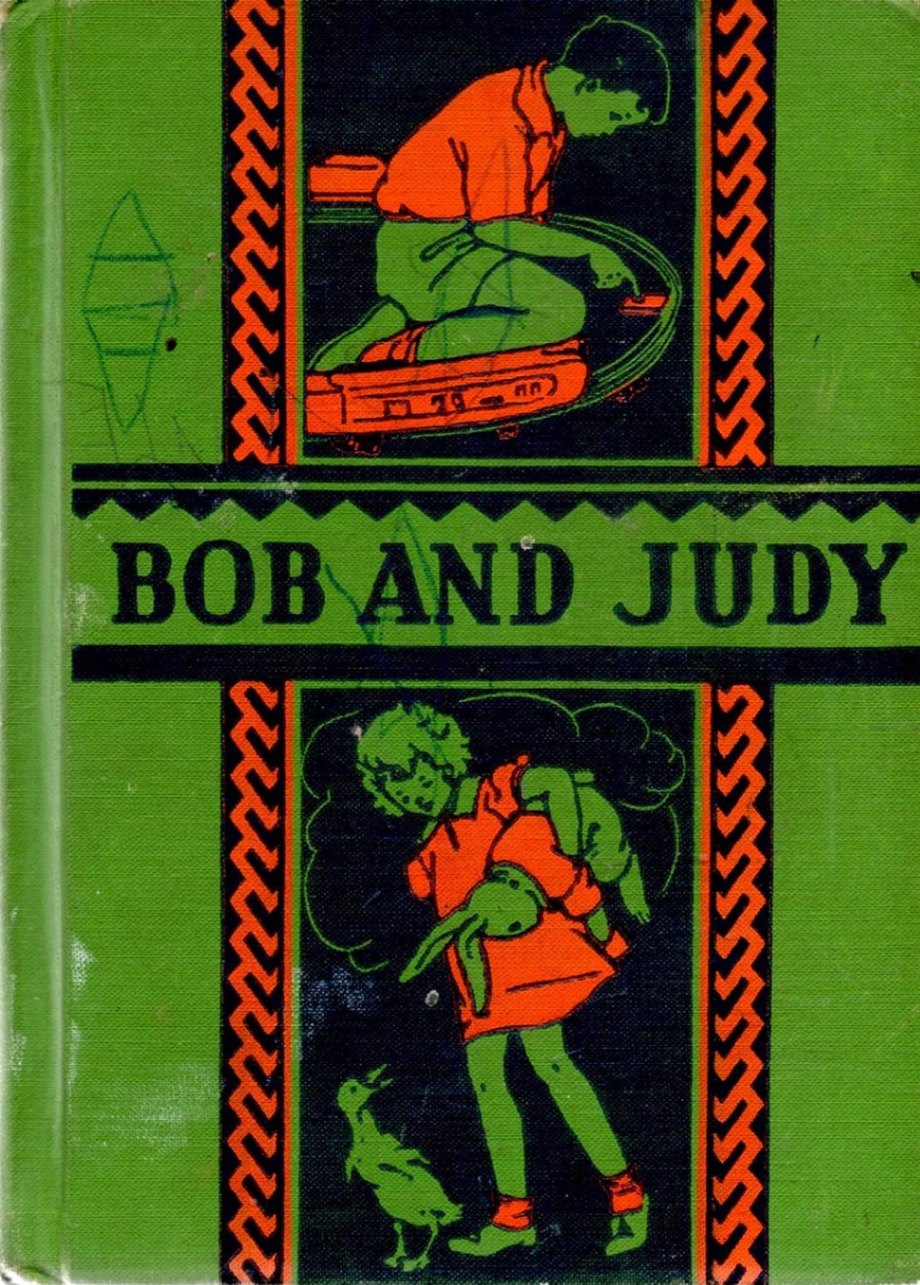
Judy and BOB together would be the stuff of true nightmares.
A union any noble hero would try his best to stop.
The dream now shifts, becomes one designed to stop this unidentified Judy, and whatever evil she is planning, rather than the decades past one to achieve justice for Laura Palmer.
However, because of the nature of the beast, both are forever entwined, something Dale Cooper will never be able to ultimately forget.
~Necessary Repairs~
Both Coopers at the end of the spectrum, his dark side and his light side, at one point or another in The Return, go in search of a set of coordinates, those which are supposed to lead to this Judy. It is a suprise and revelation then, that instead of leading to some monstrous enemy or to the Palmer house itself, they lead Cooper straight to Laura on the night of her death.
Or rather, it is a surprise for the audience, but not to Dale Cooper, who seemed somehow aware of where he was going, having warned his gathered friends before he left: "Now, there are some things that will change. The past dictates the future."
How did he know that? The Fireman has always been incredibly cryptic with his clues to the Agent, and the usual statement from the Lodge members is that they can only reveal so much.
From his supposed talks with Major Briggs then?
It is still confusing in regards to when, and which Cooper, it was and Briggs never seemed to indicate Judy was in any way related to the girlfriend of his son, Bobby. How could Cooper have gathered any information to possibly discern that he was supposed to go into the past to save Laura or that she had any connection to the mysterious Judy?
Yet, he intuitively knows it.
I suspect because a part of him still deep down understands what Laura whispered to him, knows what he turned her into after that whisper, and now hopes he can defeat the monster "Judy" by ensuring that Laura Palmer never dies to become her.
He attempts to kill two birds with one stone.
With the word electricity (recalling how dreams are transmitted again as well as how Phillip Jeffries seemed to travel in FWWM) Cooper appears on a night in the distant past, close to where Laura will stray from safety and will move steadfastly towards her death. While Laura talks to James Hurley, Cooper hides and watches from the woods, as the tormented girl discusses with her secret lover the division within herself and how the "ideal" Laura is gone. Here we learn that when she screams (at least during this iteration) it is at Dale Cooper, not her father, once more echoing her doppleganger's reaction to the man in the Red Room.
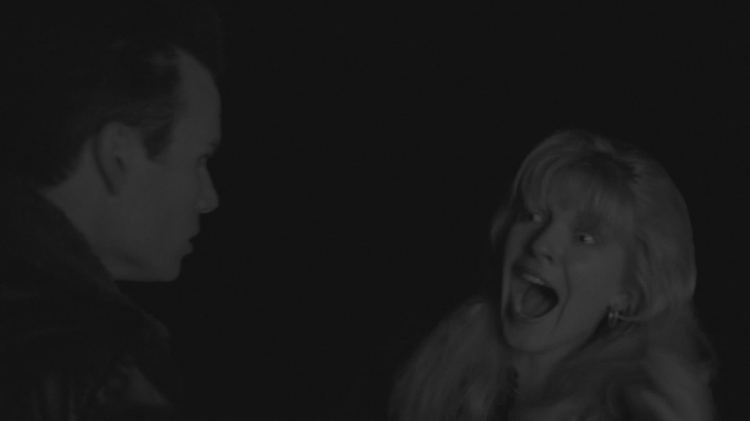
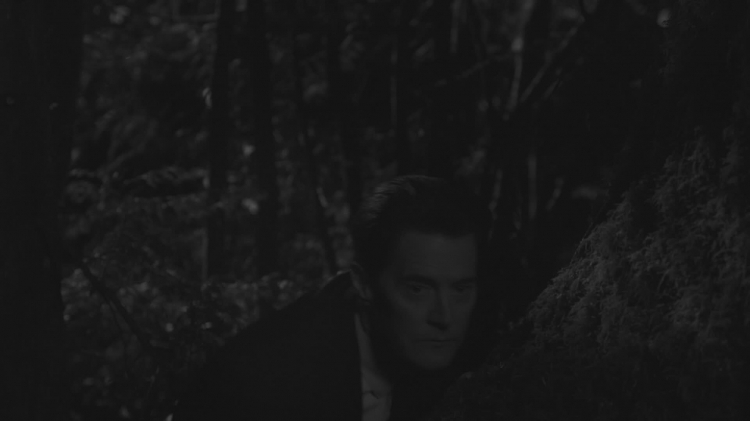
When she leaves James, however, Laura will not realize this initial reaction as she soon encounters Dale Cooper. Quick to seize upon a savior in what she feels is her lowest moment, and remembering she has met him before in a dream (a word she will even repeat), Laura feels only relief as the "good" Dale tries once again to do what he could not do before in that same dream where he instructed her not to take the ring: he tries to save Laura Palmer.

make tv GIFs like this at MakeaGif
The only problem is...
Well, this is just a dream too.
He can never save Laura Palmer.
Something he knows deep inside himself.
~Trap Door~
It must be said, for a man so seemingly devastated by the loss of the love of his life, Caroline, Dale Cooper seems awfully obssessed with the notion of saving a girl he supposedly did not know, willing to even travel back in time to save her. Why not rescue Teresa Banks whom came first? If he wanted to save Maddy, it would even make more sense, since that one he had some control over and could have prevented.
But why Laura?
Why even repeatedly return to a case he supposedly solved when there are presumably many other "Blue Rose" cases he never did?
There is supposedly no guilt he should feel in regards to Laura's death; he had no control over it.
Or did he?
What if Cooper held the sole responsibility for her murder and now his dream has desperately shifted once again, doubling back to his failed attempt from FWWM with the ring, hoping to ensure the destruction of the bad Laura, "Judy", by returning the angelic Laura to her "home" at the Fireman's place, found via Jack Rabbit's Palace?
In his mind, it is perfect: If he plays hero and saves Laura, she lives and Judy is not created, he kills two birds with one stone and reaffirms his belief in his goodness, something threatened by her previous whisper.
However the dream cannot sustain this.
First it is placing him around Laura on the night she was murdered, a fact too close to reality for his fragile mindset.
Secondly, and more troubling, it creates a paradox he can't even reason away: If Laura does not die, then he will never come to Twin Peaks, there being no call for an FBI agent to come into town to investigate a murder that never happened.
The dream will never begin.
The Twin Peaks he knows and loves will not exist.
This he knows somewhere in the back of his mind.
As the original dreamer of Twin Peaks, David Lynch himself even said once in an interview, Laura Palmer was only ever supposed to be a dead girl.
Cooper previously told his friends, as he was preparing to leave for the past, that he hoped to see them all again, every one of them, all as an image of his distressed face told us "We live inside a dream."
The sad truth is he will not see any of them again.
If Laura lives there is no need for their creation.
Worse than dying, they will never exist, just as the Arm's doppleganger screamed.
And there is still that troubling whisper that Cooper cannot erase from his mind.
The truth behind the lie he has invented.
While taking Laura to the Fireman's, scenes from the morning the high school girl's body was meant to be discovered play out, this time without her being there, without Laura being dead.
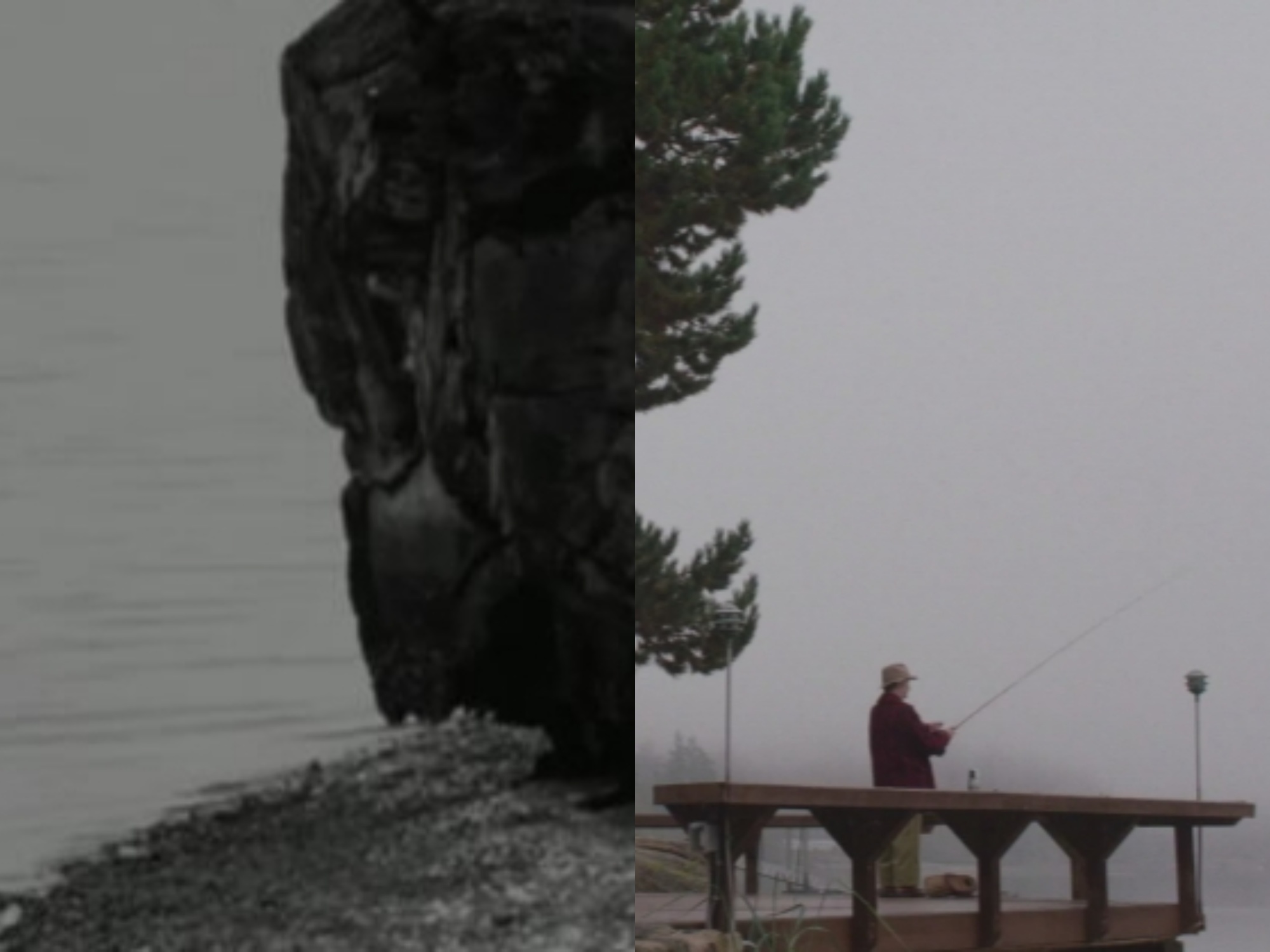
Whatever plan Dale Cooper hatched seems to have worked...Laura won't die.
And seemingly back in the interupted present, a Sarah possessed by Judy is in a rage. She grabs the famous photograph of Laura Palmer and tries to smash it but is unable to.

make tv GIFs like this at MakeaGif
Interestingly, this scene can work on two levels with what is happening and what we will see later. First, we can see it as the dark Laura's anger at her lighter side. It is the same photo placed within the golden orb of the idealized Laura Palmer afterall. Yet, after what we are to see by the end of The Return, Sarah Palmer also might have her, not to mention every one else in town's and Laura's as well, own best interest at heart in wanting to see her own daughter dead.
Meanwhile, back in 1989, everything seems to be going all right for the older man and the young woman he is trying to rescue.
Laura's hand is linked with Cooper's.
They make their steadfast trek through the woods.
But there is a sudden problem within this seemingly triumphant moment of hope.
Laura suddenly, inexplicably, disappears.
One second she is there and the next she is gone, without much visual aid of how or why, just a sound Cooper and the audience were instructed to listen for. It is a sound not easily identified but could be anything from electricity, a needle on a record free gramophone or a simple scratching away. Whatever it is, when Dale Cooper hears the odd noise the Fireman told him to listen for, he turns back and finds Laura really is gone, just like her earlier words to James.
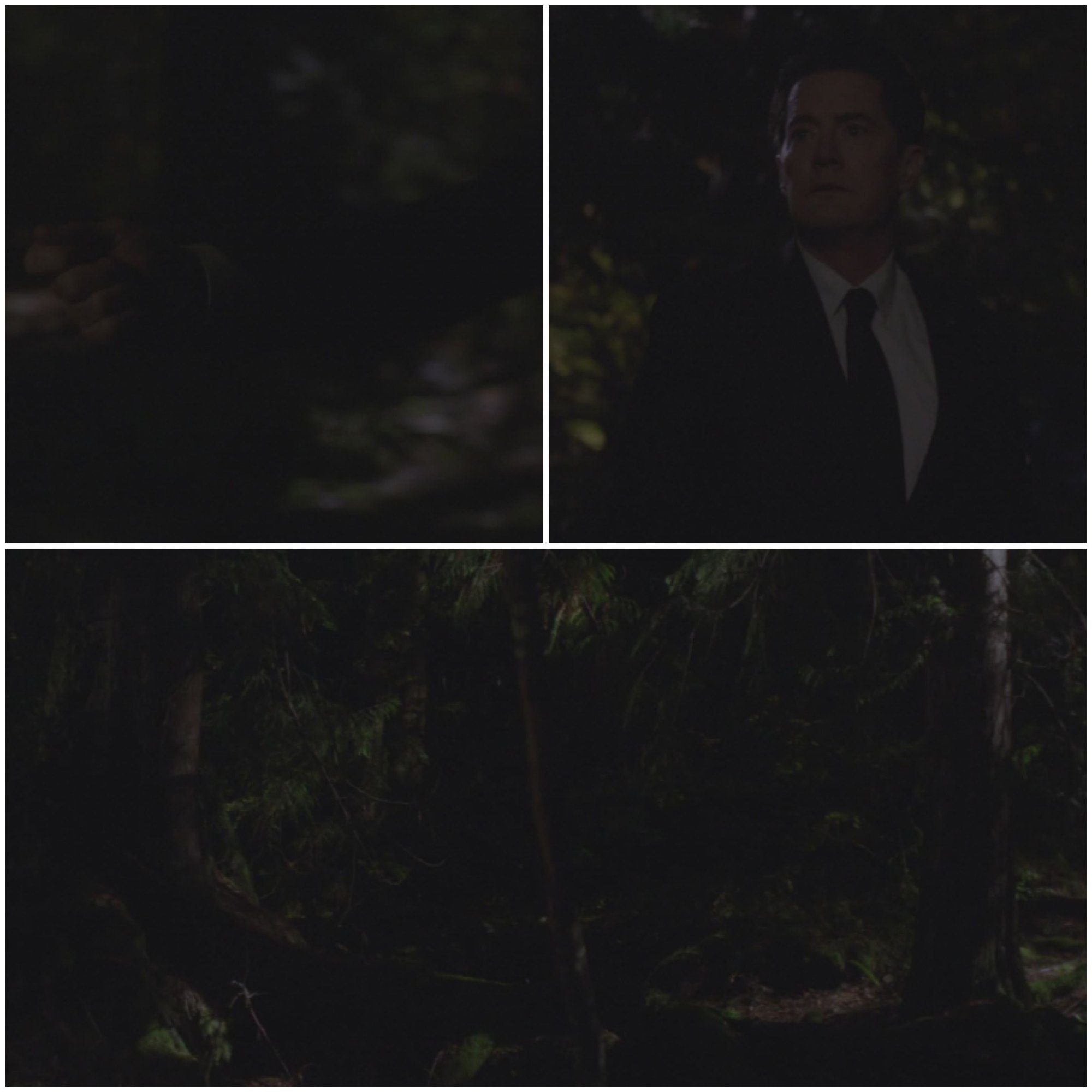
The sound of Laura screaming is then heard, plus the sound of the curtains in the Red Room flapping frantically, both sounds taken from the moment she had been torn from the Red Room after her whisper to Dale.
Now many theorize that it is Laura who has disappeared.
But what if the truth is the opposite?
What if Dale Cooper was the one to disappear?
Or not so much disappear, what if Cooper simply returned to his own time, 25 years later? What is more likely, afterall, that Laura was the one taken, when we see no other signs of a supernatural presence, not even an owl, and when she has no clue what is going on and is in her natural time, or that Dale Cooper simply was forced back to his own present, very much like Phillip Jeffries is in FWWM and the Missing Pieces?
This is indicated by Laura's Red Room scream, which happened in his present future and not in her past.
~Back to the Waiting Room~
We will hear that scream and see the scene of Laura whispering reenacted for another time in the final episode. However, this time around, Cooper sounds like he is saying "unhuh", as if he is closer to understanding what she means, if not any closer to actually accepting it, as indicated by the same banishment of Laura Palmer from the Red Room.
Perhaps, like the protagonist of Edgar Allen Poe's "The Raven", Dale expects her to whisper some new thing to him, but just like the bird's devotion in repeating "Nevermore", Laura Palmer only ever whispers that one same and unnerving thing to him.
Now when Cooper encounters Leland, the man still implores him to find Laura, however, this time, his gaze, stays on Dale, looking somewhat less impressed than it did before

make tv GIFs like this at MakeaGif
Finally, Cooper is allowed to go out the curtain which had forbade him to before. Infact, feet away from it, he is already turning something like a doorknob to help open it, as if he knows he can now get out this way.
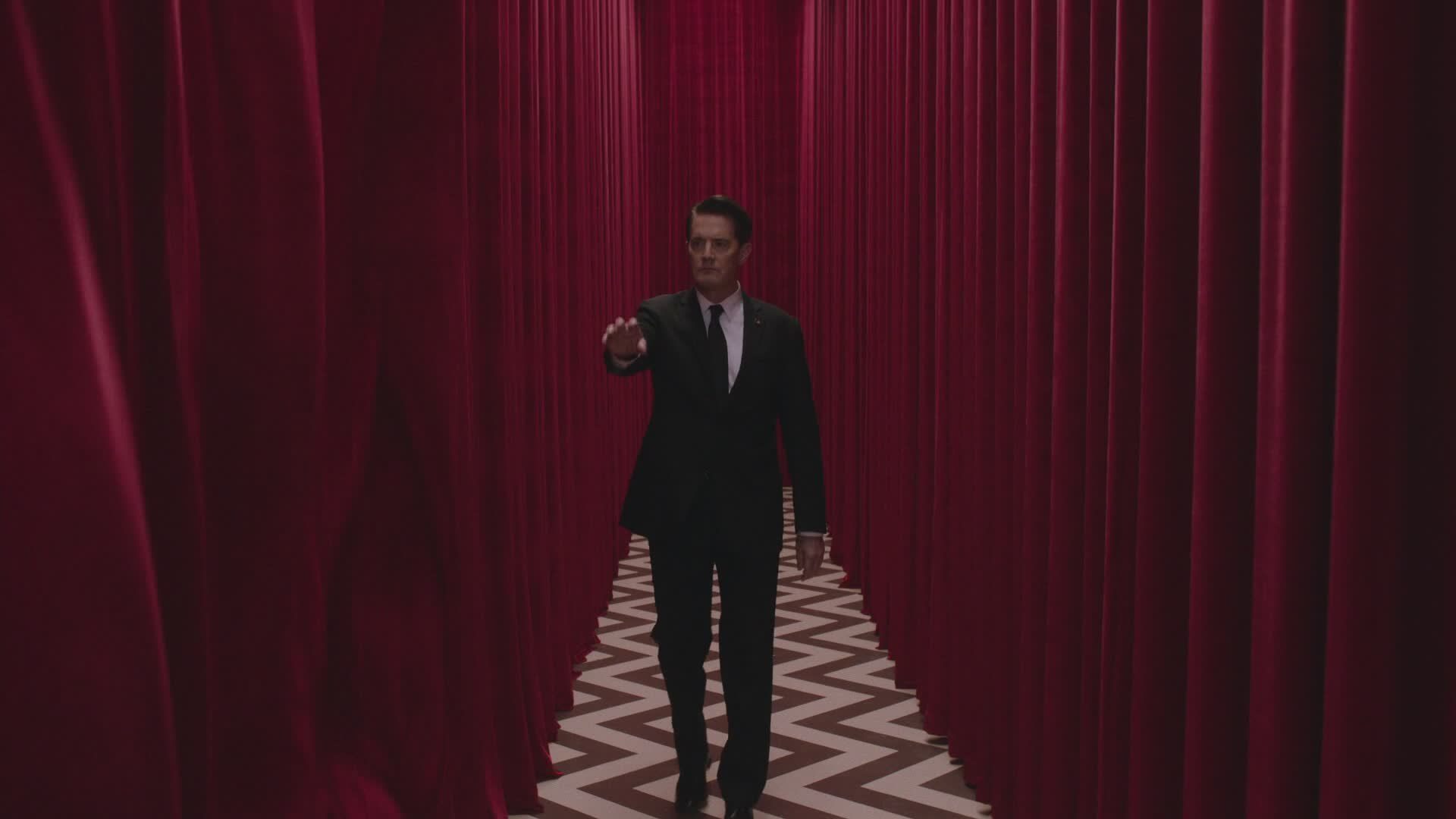
This time the electrical signal of the dream permits him, just as in a dream a locked door can become unlocked without any explanation.
~Passageway~
What follows next would seem just as inexplicable as Dale's knowledge that he should go to the past to save Laura.
The only clues the FBI agent possesses have been garnered from the Fireman in a conversation we aren't sure when it happened. During the conversation, though, the Fireman warned him about the noise which coincided with the vanishing of Laura, stated vaguely "it is in our house now", addressed he could not say certain things aloud now, told Coop to remember the number 430, Richard and Linda and two birds with one stone.
One has to wonder, though, were the Fireman's words instructions or a warning? He ends it all by sternly saying Cooper is far away after the FBI man has claimed to understand it all.

make tv GIFs like this at MakeaGif
But from these mysterious words, we see Cooper start off on his tireless mission to find Laura.
Does he remain in Twin Peaks to find her, gathering clues and information? No. Instead he instintively, not to mention bafflingly, goes in a different direction altogether. In the company of his lover/secretary, all around Girl Friday, Diane (whom seems more than a little concerned and doubtful herself) Cooper travels 430 miles out of the way to cross over in a desert, a far cry from the lush Woodlands of Twin Peaks we know and love so well.
Thus begins Dale Cooper's strange odyssey to find the missing Laura Palmer.
During his journey to Odessa Texas, Dale will go to sleep in one motel and awaken in another, lose his companion, become a Richard, stop to have a coffee he barely reacts to at a place called Judy's, get violent with some of the patrons and eventually locate a waitress whom works there, one whom looks EXACTLY like the middle aged Laura Palmer whisked away from the Red Room.
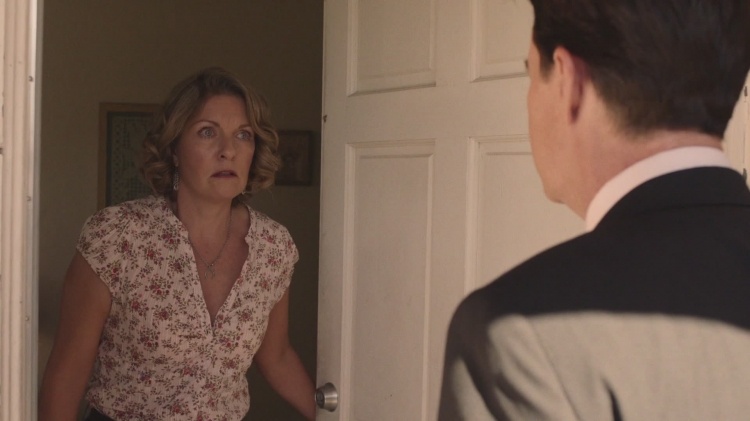
What a great stroke of luck, it would seem for our hero!
Sure, she has a dead man in the living room, one that both of them seem to be aware of but neither want to acknowledge, but this is ultimately inconsequential to Cooper/Richard's grand mission to take Laura Palmer home.
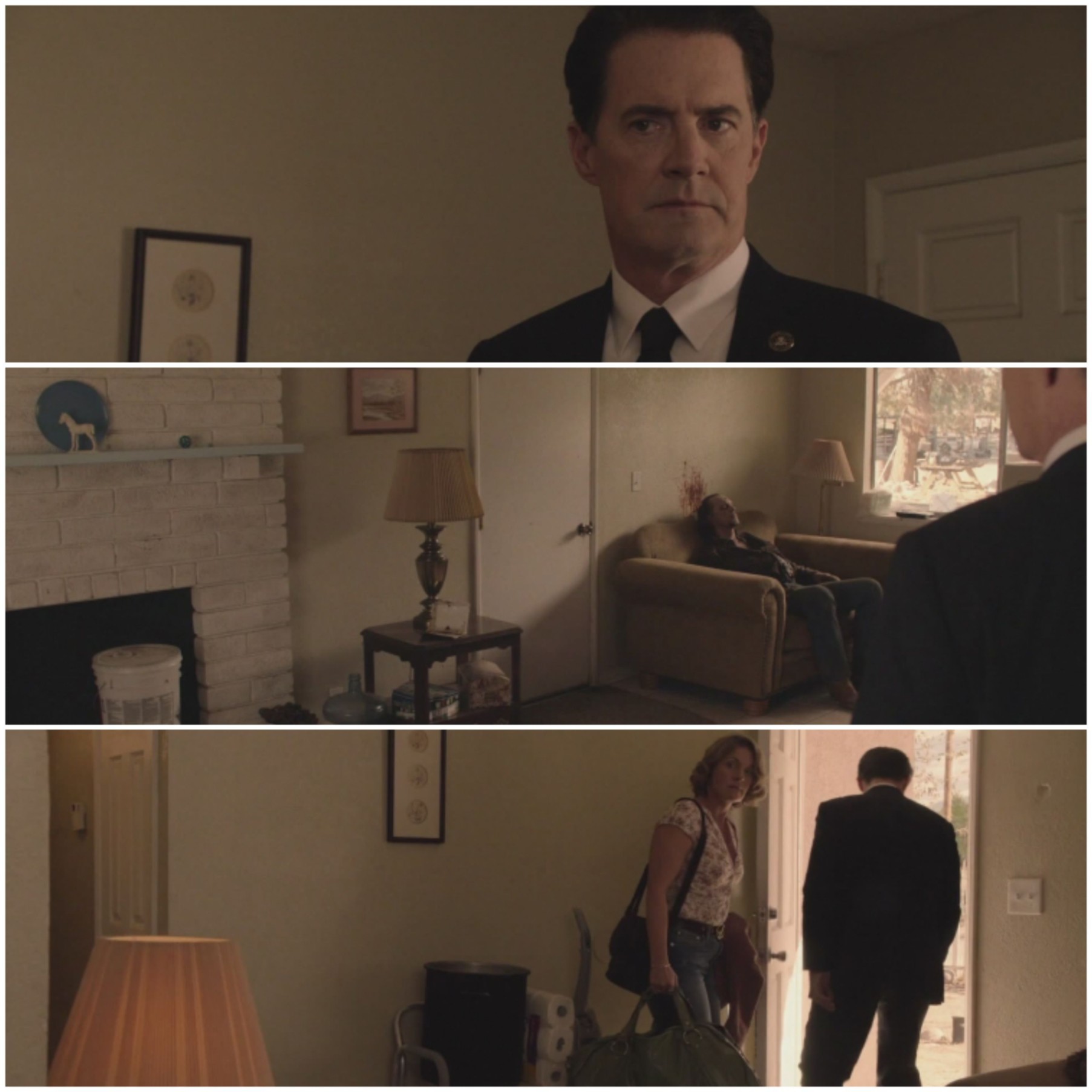
Carrie seems not to know this Laura, nor her father Leland, but reacts to the name Sarah. She agrees to go with the FBI man, mainly because she needs to get out of there quickly, not because she, per se, knows what the heck he is talking about.
Desperate times call for desperate measures, I guess.
Still, this seems like everything is falling into place for Richard and his quest.
They travel to Twin Peaks with little conversation, only the momentary fear that they are being followed (which they aren't), Page's confession that she tried to run a clean house where she kept everything organized back in Odessa, and later a vague, but possibly hopeful, comment, as she falls asleep no less, that it is a long way and how, back in those days, she was too young to know any better.
In this close to dreaming state, is Carrie Page close to touching upon her forgotten state as Laura Palmer?
Only the destination will tell.
Or will it?
~Can't Go Home Again~
Once in Twin Peaks, however (Richard seemingly aware of how the town might disturb his new companion but not particularly caring), Carrie fails to recognize anything and it is odd that no longer is the FBI Agent trying to take her to the Fireman's but instead marches her right up to the front doorstep of her old house instead, the site of much of Laura Palmer's trauma.
Knocking on the front door, and expecting a mother and daughter reunion, Richard/Cooper's plans hit a very big snag indeed. See, although Sarah Palmer's name still seems upsetting to Carrie, they discover from a woman named Alice Tremond (the house's current resident) that Sarah Palmer is definitely not living in the infamous house of white, nor was she the previous owner either.
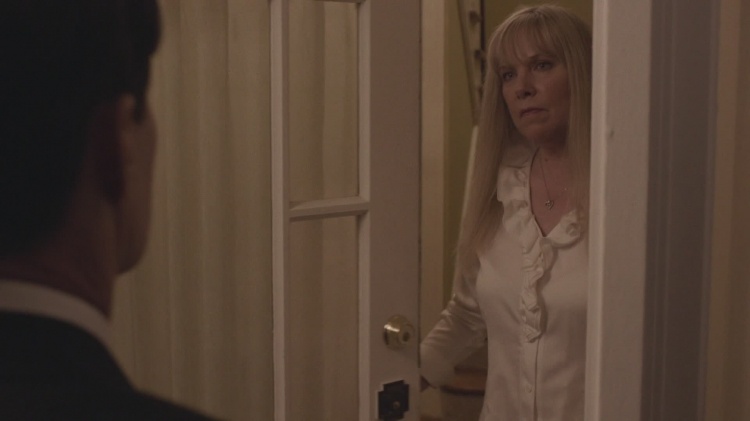
Oddly, Richard never thinks to ask the new owner exactly how long she and her husband have been there, but politely apologizes for the trouble and decides to stop asking so many questions and just go.
Both Richard and the silent Carrie leave the house, walking down the front stairs in strange unison.

make tv GIFs like this at MakeaGif
Standing in the middle of the vacant street, Richard turns back to stare at the house, while Carrie divides her attention between both the house and the man whom has inexplicably brought her to it.
This is where things...change.
Suddenly Richard seems to be hit with some realization. He stumbles forward, looking close to literally grasping onto some truth.

make tv GIFs like this at MakeaGif
He asks the question "What year is this?" seeming genuinely confused.
Carrie, equally touched by some fact as well, as if directly influenced by her companion, looks to the house which we associate with the face she possesses. We begin to hear Sarah Palmer calling for Laura on the morning of her death.
And this does it.
Carrie Page begins to scream, as Richard looks to her, the lights in the house all going off in a bright electrical flash before darkness claims the screen.

make tv GIFs like this at MakeaGif

make tv GIFs like this at MakeaGif
We eventually return to the scene of Laura whispering to Cooper, but in the dark now, as the credits roll.
The End.
~A Door Slammed Shut~
This is the ending that fans were left with after waiting over two decades for the good Dale to get out of the Lodge and it was no more of a comforting and satisfying ending than the first.
Sure, right, someone that looked like Dale Cooper did manage to bring someone whom looked like Laura Palmer to a place that looked like her and Sarah's old home, but nothing went as expected, ending the series off with a literally shocking scream and cut to black, as the lights literally went out on everything.
But what did it mean exactly?
We can defintely connect the lights going off in a blast to the lights similarly going off in the Log Lady's cabin when she passed on, that is for certain.
And likewise this would appear to be the death of Twin Peaks, one way or another.
Yet there are two strong possibilities that can be found within this ending.
While David Lynch's work is often compared to "The Wizard of Oz", I believe, Twin Peaks is much closer in spirit to "Through the Looking-Glass" by Lewis Carroll, from the use of mirrors, twins, and the ground being a chess board of black and white, akin to the Red Room's Chevron floor.
In that book, there's a sequence where Alice encounters the Red King, whom stays asleep, dreaming for the entirety of the novel. Alice and the Tweedles get into a rather philosophical and existential discussion over it infact.
“He’s dreaming now,” said Tweedledee, “and what do you think he’s dreaming about?”
Alice said, “Nobody can guess that.”
“Why, about you!” Tweedledee exclaimed, clapping his hands triumphantly. “And if he left off dreaming about you, where do you suppose you’d be?”
“Where I am now, of course,” said Alice.
“Not you!” Tweedledee retorted contemptuously. “You’d be nowhere. Why, you’re only a sort of thing in his dream!”
“If that there King was to wake,” added Tweedledum, “you’d go out — bang! — just like a candle!”
The final chapter, "Which dreamed it?", features poor Alice still questioning whom is the dreamer and what is the dream. It ends with Carrol asking us, the reader to decide, "Which do you think it was?" and likewise ends everything off with the line, "Life, what is it but a dream?"
Should we overlook the fact that it is an "Alice" Tremond that is living in the Palmer house now, or is it a clue to the larger scope of things, another throwback to the earlier question Monica Belluci asked in her dream, "But who is the dreamer?"?
In both possibilities for what the ending of Part 18 means, I think that question can simply be answered as Cooper.
Cooper is the Red King in two instances: firstly in his most evil form (BOB) in its regard to alchemy and then secondly as the Red King from the fairy-tale.
Dale Cooper is the dreamer.
Or whomever he is meant to represent.
And to find out the answer to the ending we were presented with we must simply follow where the dream would naturally take him.
~Breaking and Entering ~
For the question posed, "What year is it?" I think we mustn't bother ourselves too much with an answer. We should instead ask ourselves, "What year did poor Cooper think it was?"
He called Carrie Page, a girl named Laura Palmer, when she was obviously a woman. And, once again, he didn't seem to bother asking how long the Tremonds had lived in the house, or the Chalfonts before them. He seemed to be working off some preconceived notion.
I believe, Dale Cooper throughly believed he was still in 1989, because he was still working on the assumption that it was Laura whom had disappeared in the past and not that he was the one whom had simply been sent back to his present. Working on this belief, he'd just blindly gone about his purpose until he finally clued in outside of the house that should have been the Palmers, but obviously wasn't, that he was in the wrong decade.
There is a flipside of this, of course.
Perhaps, the dreamer has always been in 2014 but has only ever dreamed himself back in 1989. It was an oddly specific set of years he was to be trapped inside the Red Room, 25, afterall, not really pertaining to anything related to the phases of the Saturn we see inside the waiting room.
Look then to the 1989 that we witnessed through the original series and movie. It seemed far too retro to be believable, far more like a pulp magazine actually. As Kreider states in his article, the teens acted more like they thought they were in the fifties than the 1990s, and many things were tinged with jazz more then the grunge movement that was on the way in reality.
It seemed more like someone's idealized vision or daydream.
Maybe the dreamer consciously wished to escape the current year he was in.
Maybe that was why he could not accept Carrie Page as anything but a teenager.
And maybe his mind reeled at the intrusion of the very real seeming present thrust so suddenly upon him.
This coming back to his senses, or the correct time, seemingly affects Carrie too, whom suddenly begins to recognize the house.
That leads us to two distinct possibilities in my way of thinking, but two which can contrarily exist side by side as well. They are separate but not entirely exclusive.
~A Wall~
The first possibility for what has happened is very simply this, existential as it is:
When Richard takes Carrie, the last Page in Laura's story, to what should be the Palmer house but isn't, we are to understand that this isn't the Twin Peaks we know and love and never will be again.
Having saved Laura Palmer, the dream has altered, taking away Laura and everyone we and Cooper would be introduced to through her death. That was the dream of Twin Peaks afterall inside Lynch and Mark Frost's mind: that through one girl's death they would fashion a show to tell various other stories.
The Log Lady said as much in her intro to the Pilot for the original series:
"It is a story of many, but begins with one – and I knew her. The one leading to the many is Laura Palmer. Laura is the one."
She will echo that in Part 10.
But more disturbingly Margaret will also tell Hawk, "Electricity is humming...but in these days, the glow is dying. What will be in the darkness that remains?" as well as, "Now the circle is almost complete. Watch and listen to the dream of time and space. It all comes out now, flowing like a river. That which is and is not."
Her words certainly are remembered in the finale, what with both the electricity and darkness, that which is and which certainly isn't any longer. And in such a way, we can muse on the song that played after her words and the repeated sentiment of Laura being the one, and can then associate it with the emptiness of space Cooper glimpsed within the Red Room following Laura's disappearance within it: No Stars.
All the stars familiar within the space of Twin Peaks have been extinguished.
We can look at Laura's escape from death as a huge negative force, another link to her being Judy. On Hawk's map there was a strange symbol under the moon and over Blue Pine Mountain, the same place Cooper led Laura. When asked about it, Hawk told Frank that he never wanted to know about it.
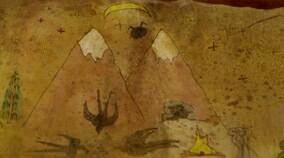
Later, the Log Lady would also warn Hawk about it before her death, telling him to watch out for "the one under the moon on Blue Pine Mountain" she had told him about. The usage of the term "One" is synonymous with Laura, even if Margaret alludes to the discussion haven taken place in person. Laura also had specifically written in one of the missing diary pages Margaret helped Hawk discover: "The moon has been high in the sky for hours now," tying her to the moon.
The same symbol on the map is what Coop's doppleganger is looking for, as he makes clear when he shows it to Darya on a playing card.
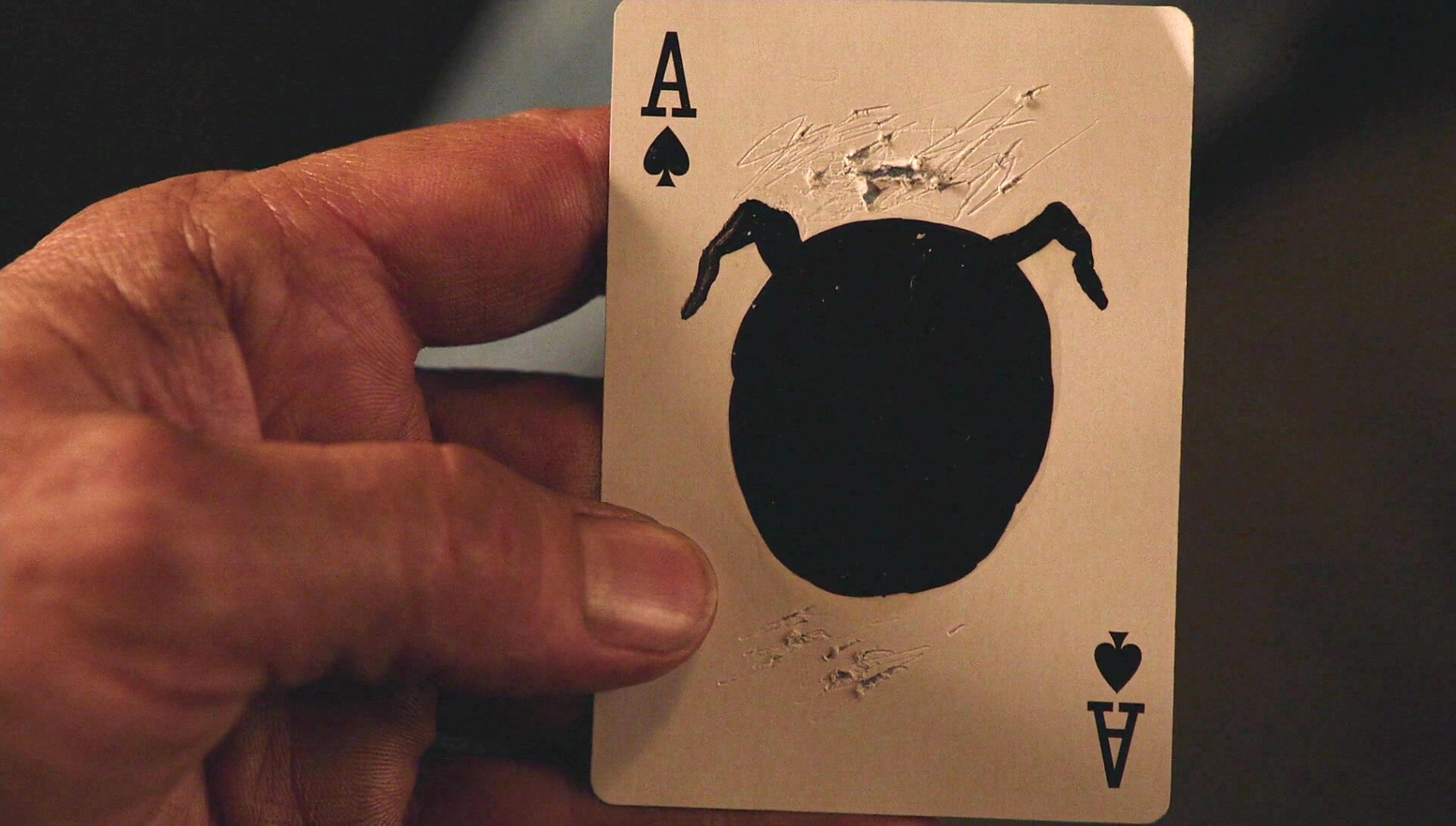
Look closely at that symbol.
It is basically the one found in Owl Cave, on the ring and which Phillip Jeffries turns into the infinity symbol to send Cooper into the past: the one with the Twin Peaks framing a diamond.
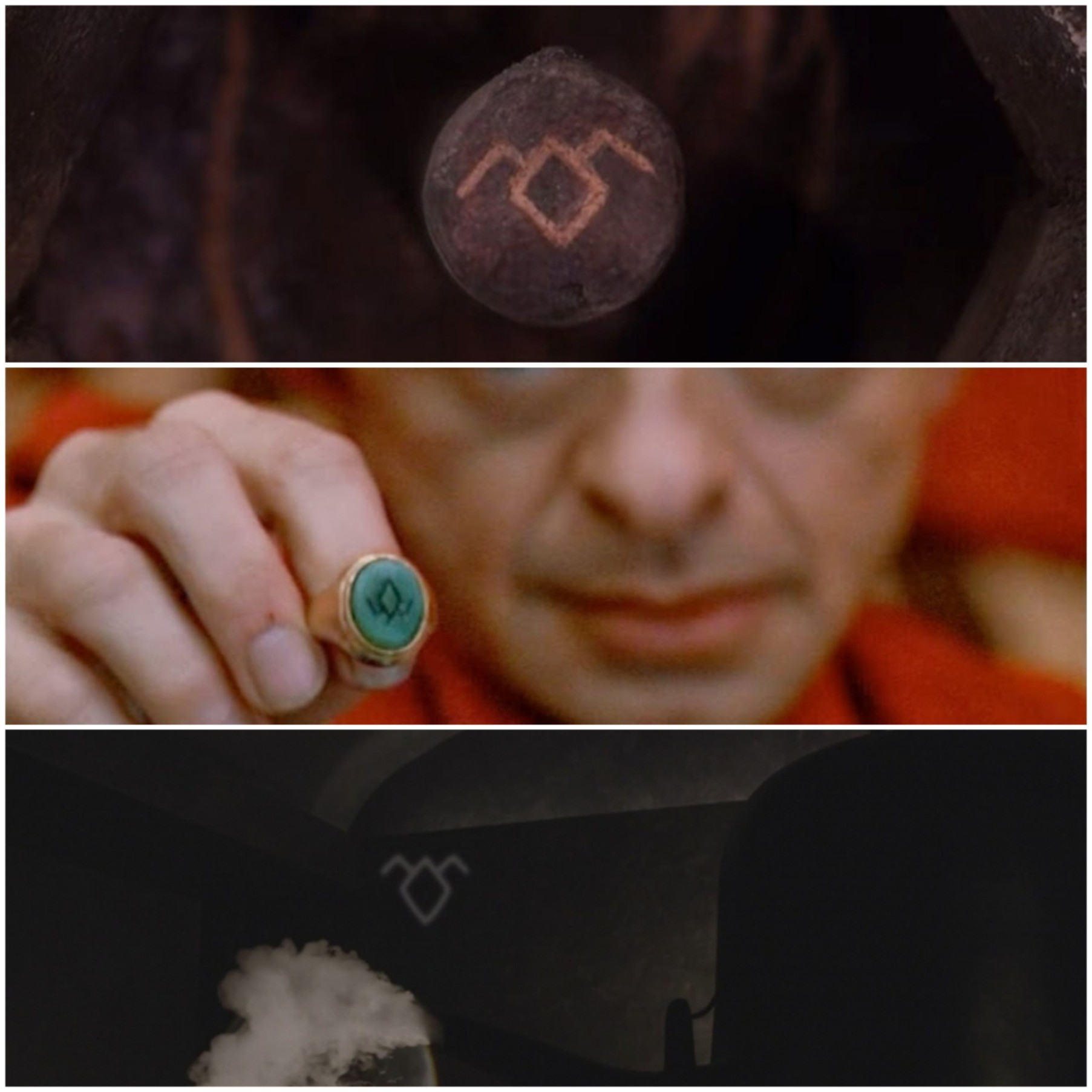
However, instead of the diamond, this symbol essentially has a black hole, an abyss, a void, the carbon before the gem is formed, at its heart.
Essentially, by trying to avoid the truth of Laura's whisper, Cooper has been led to commit the destruction of his dream.
Cooper had hoped to kill two birds with one stone and most certainly he did: he killed Judy but he also killed Twin Peaks, including Laura Palmer herself.
Richard/Cooper is figuring this out as well. His dream is failing him yet again, which leads to another two possibilities within this scenerio.
As Carrie hears a brief snippet of the original dream, a return to the past, she screams and the power goes out with a violent blast to darkness.
Like the bang of a candle going out.
Or in our modern television age, like electricity.
The dream is over and the dreamer awakens, there is no need for Alice (Laura Palmer) anymore, it was the Red King (Cooper) dreaming all along.
Although, I theorize the other option here, one which recalls the Matryoshka pattern that the glass box in NYC became: dreams upon dreams, some overlapping. Granted, this might actually be closer to something known as the Droste Effect, wherein an exact image is repeated inside the same image to infinity.
In this theory, I reason that Dale Cooper is prepared to start the dream all over again, this time hoping to get it right, despite there being signs that he might have attempted it several times already, each one unsuccessful. Because, unfortunately, he always winds up right back at that house with someone whom should be Laura Palmer but isn't, prepared to defeat a Judy, whom is not there because he wiped her from existence by saving Laura from death, or alternately helped create her by letting her live.
Which also erased the Twin Peaks he loved and everyone in it.
Which, actually, we all should have seen coming because, if the world of Twin Peaks has one universal law, it is that Big Ed Hurley and Norma Jennings will never be happy.
Just kidding.
I think.
Okay, so that is the first possibility.
Onto the next.
~The Fan on the Ceiling~
The second one is even darker in its way, depending on how you look at it.
The second involves the dream, always transforming itself to stay alive, the image of the Matryoshka again, and what became of Laura, if it really was Dale Cooper and not her whom disappeared that night she was meant to die.
What if through Cooper's questionable intent, BOB was finally given what he always desired: the opportunity to possess Laura Palmer?
The original series already conveyed and maintained how much BOB wanted Laura. FWWM cemented this fact. Through his possession of Cooper, placing him in the Red Room, BOB was already once able to try to change the past when Dale, in a dream, told Laura not to take the ring which prevented her possession, although this eventually failed in the long scheme of things.
Could he have used Cooper to try to help him, for a second time, get what he wanted? Willingly letting himself be sacrificed to Freddie, knowing his destruction in the future would lead to his eventual success in the past, leading to a present BOB desired even more?
A willing sacrifice during a game of chess (one he knew would only end up being reversed anyway), all so he could, at last, claim the queen?
Making BOB an even better chess player than Dale Cooper or Windom Earle.
As Cooper closes his eyes and is transported to the past, afterall, we hear the ceiling fan that Laura always associated with BOB's abuse of her. We will see it as well, hammering home the implication.
If Cooper was the one to disappear on Blue Pine Mountain, it would have left Laura completely vulnerable back in 1989. She would have been alone, unsure of where she was and how to get back out of the woods, all while BOB was tracking her down. BOB had once referred to Leland as a figurative "babe in the woods" now Laura, his host's daughter, would have been a real one.
The shot of a BOB possessed Leland watching Laura flee on the back of James' motorcycle featured in the sequence of our return to the past, being extended from what was shown in FWWM.
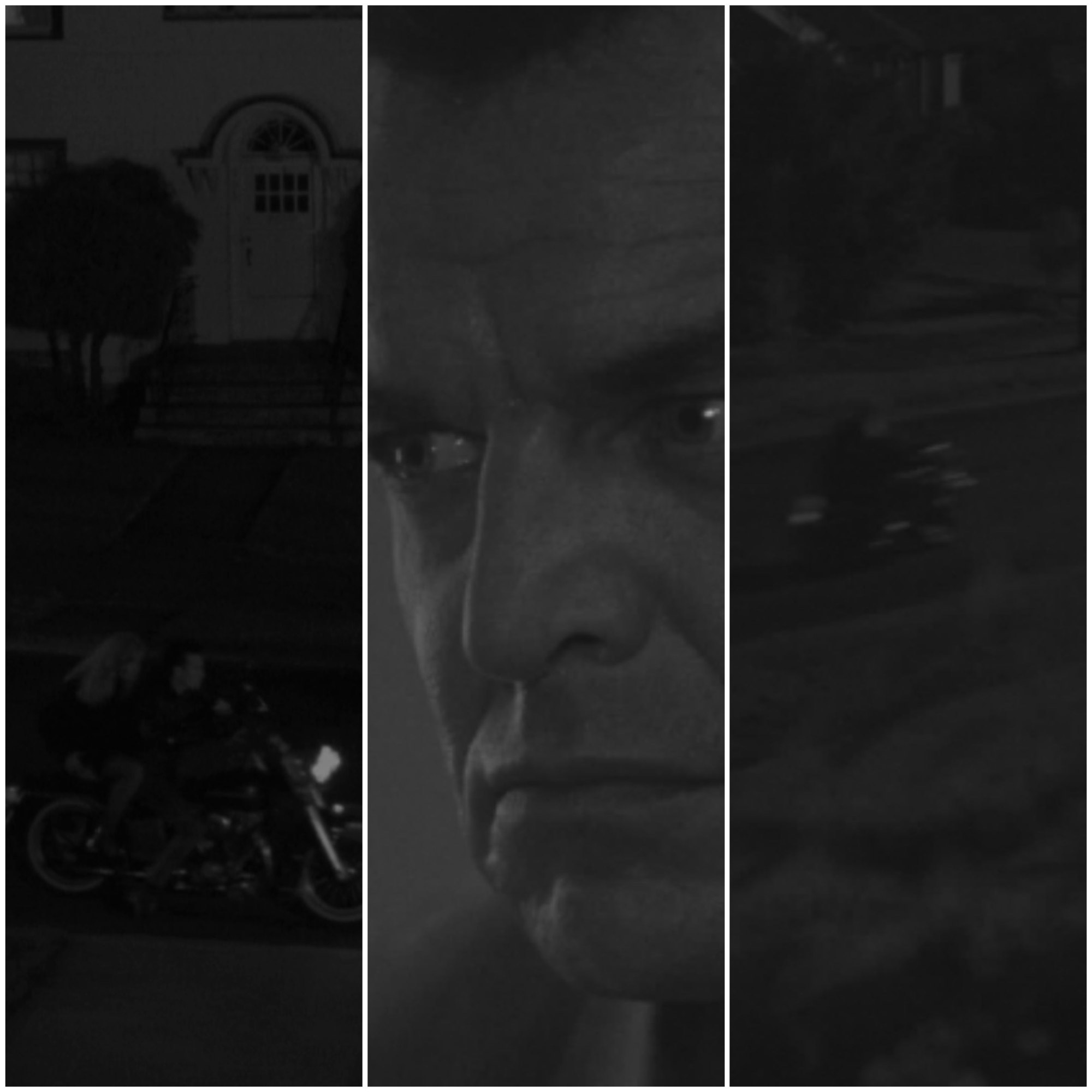
From it, were we to be reminded that BOB was tracking his desired next host down? He was not going to the cabin, but rather was led there because he was following Laura afterall. That night he was her shadow.
If Cooper had vanished, Laura would be alone, without anyone to help her, not Ronette with her prayer and her saving angel, or Mike, whom might not know where to look. Certainly, BOB would not be distracted this time, which allowed Laura to take the ring and wear it. Laura, not even partly high from the many drugs consumed at the orgy, would also be even more vulnerable to an attack, her senses not dulled.
She would have neither the strength or protection this time to deny the possession and would likely let BOB in, especially after her "hero" had failed her so horribly.
But Cooper was never supposed to fill that role in her life.
The beauty of FWWM was that Laura basically depended on her own intincts rather than having someone think for her and make her decisions as well. Laura became her own hero. A constant theme in The Return is Dr Jacoby, now Dr Amp's, constant refrain that it is up to us to shovel our way out of our shit. We saw through Nadine that the philosophy did indeed work.
God helps those whom help themselves and heroes are those who don't depend on someone else to save them.
That's why they are the hero.
Laura did this the first time around, as confused and frightened as she was. The choice to take the ring was one never forced on her. However, with showing up to "save" her, basically trying to control/guide her actions, Dale Cooper took away her agency, by asking her to take his hand and depend on him. Sadly, the truth might be, that when Laura's hands were tied behind her back, she had more control for she saw more clearly and knew what she needed to do: sacrifice herself so that BOB could not have her.
With Cooper suddenly gone that night, and her senses turned more into a lamb to be shepherded than a savior taking up the cross, Laura was right where BOB wanted her.
The portal to the Fireman's house was also nearby, with the poor, stray, spindly sycamore by it, the same sycamore that is the same shade those open to possession turn when they are opened, just as we saw Leland colored when BOB used his fear of having killed his daughter to open the Red Room at Glastonbury Grove and Laura at Harold's when she invoked the invitation "Fire Walk With Me" and then mumbled about trees.
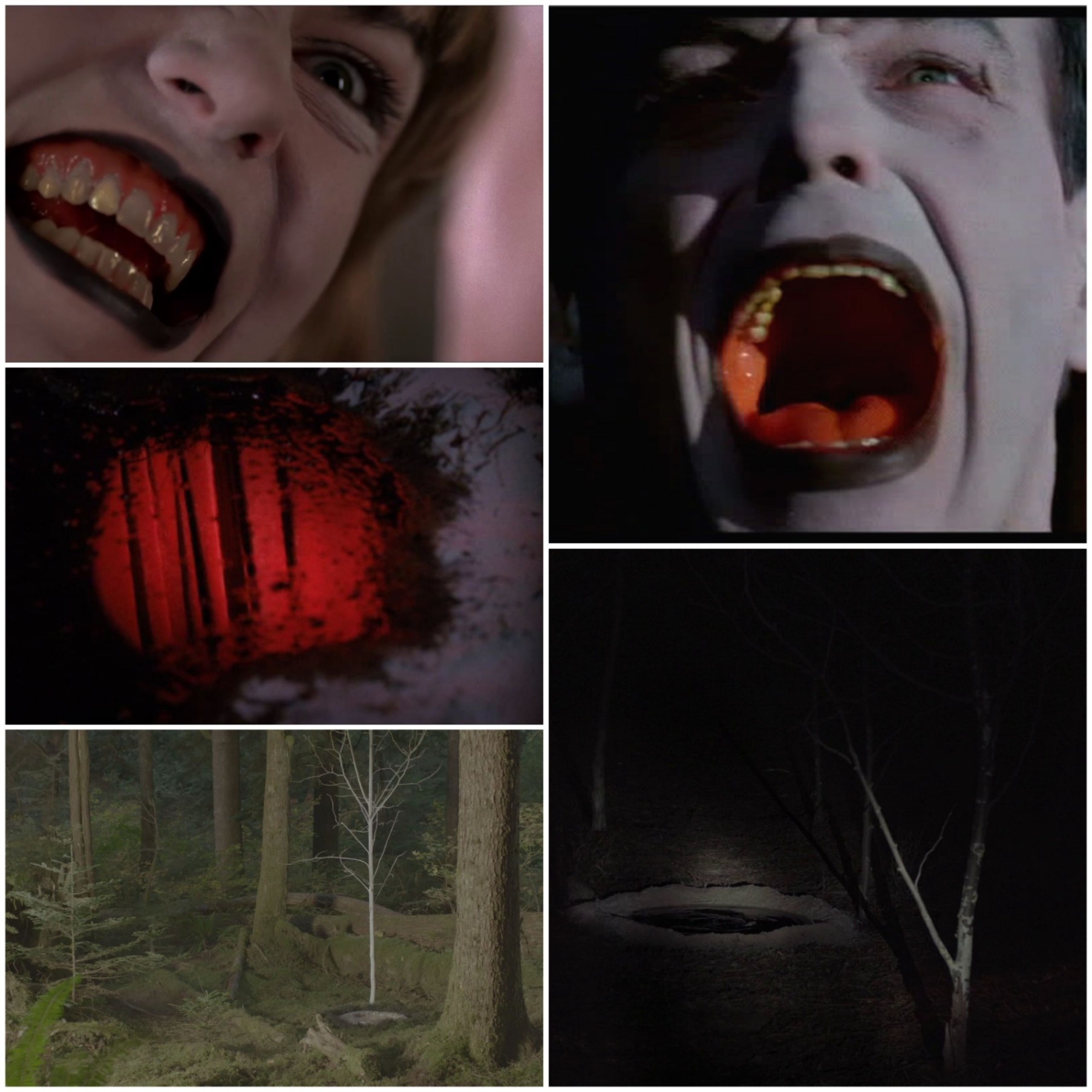
So closeby, could BOB stop himself from going to his enemy's house, the creator of the Laura orb, and gloat over his victory?
Follow that through to the Fireman's claim that "It is in our house now".
If BOB killed Leland to transfer himself into Laura and then went to that portal immediately afterwards, invading the Fireman's house with the victory over his newly possessed host, the Giant's wording would make complete sense.
BOB possessing Leland would be a "He", both spirit and human male. If Judy possessing Sarah had gone there, it would logically be she.
But a male demon possessing a human girl.
That would be both sexes, or in this case an "It".
The same could be said, if it returned to the Palmer house.
In this possibility, we can understand the constant use of Sarah calling " Laura" throughout the dreams and why it terrified Carrie Page. We can also remember the strange vision Gordon Cole had of Laura at his hotel room door, crying violently as Sarah called for her in the background.
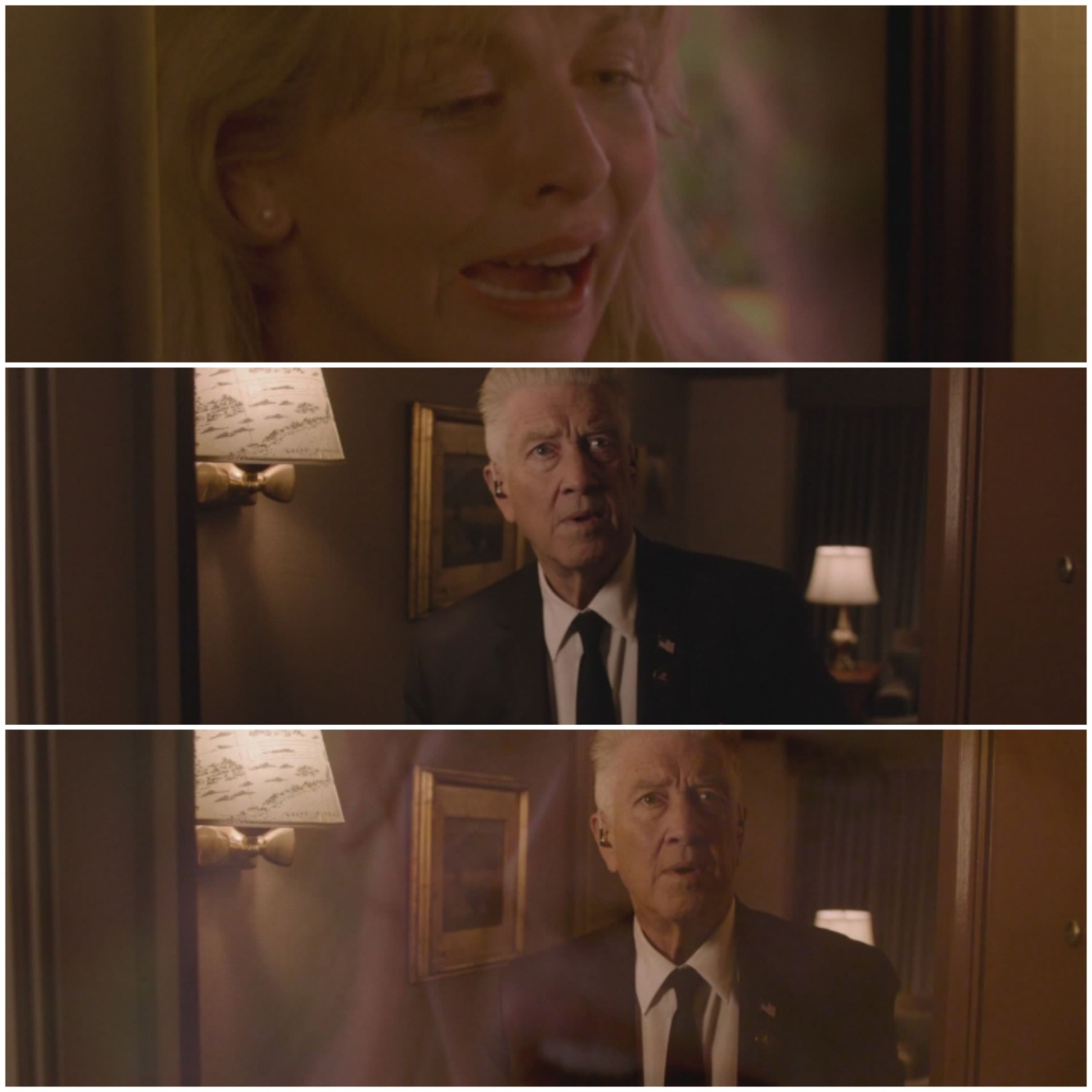
If Laura Palmer had died, like she was meant to, she was never supposed to hear her mother calling out for her. Her room was supposed to be empty.
However, what if in this new timeline it wasn't?
A BOB possessed Laura went home to her bedroom and slept until the morning.
She was alive to hear that call.
She awakened to a new dream...
A nightmare.
As did the dreamer.
One where Laura Palmer was BOB.
~The Marriage Bed~
Unfortunately, the whole series becomes a truly warped story of love, one about BOB's obsession for Laura, where he was willing to do anything and everything, even die in one existence, as she did to escape him in another, just to be with her.
The song "My Prayer" is heard twice in the 2017 series, and it's lyrics can come hauntingly back to us now, to strike us with its true meaning.
"My prayer is to linger with you,
At the end of the day, In a dream that's divine,
My prayer is a rapture in blue,
With the world far away,
And your lips close to mine...
My prayer and the answer you give,
May they still be the same,
For as long as we live,
That you'll always be there,
At the end of my prayer."
Compare this song to "Questions in a World of Blue" from FWWM, which references blue and shows a contrasting image of a lover left on their own. This song is musically similar to another instrumental composition in the series, as well, entitled "Audrey's Prayer", which could be the link between them.
It would unfortunately seem that BOB had his own prayer answered.
Or a wish, if you look at it that way.
We can be reminded of the eerie scene following BOB's defeat in the International Pilot's ending. MIKE supposedly kills BOB and yet as MIKE falls to the ground, all as Harry Truman seems concerned and Cooper indifferent, the dead man's former partner tells BOB to wait for his turn, as if he still lives. Cooper turns his attention to the fallen BOB. We then get a shot of the 12 candles circling the mound of earth with Laura's locket (the whole setup reminiscent of the sycamores surrounding the oil pit outside the entrance to the Black Lodge), hearkening back to the locket in the traincar with the incantation " Fire walk with me" written in blood. Cooper then somewhat darkly instructs someone, maybe even himself, to "Make a wish".

make tv GIFs like this at MakeaGif
Sure enough, the candles go out, casting Cooper in darkness.

make tv GIFs like this at MakeaGif
Which all in a way is similar to the ending of Part 18 if we look at it.
But I reiterate, Laura Palmer was BOB's wish and, this time around, he received her. He just had to be patient and wait for it, I guess.
And it is uncomfortably hinted at that a part of Laura wants to be with BOB also in some disturbing instances in FWWM and the Missing Pieces, and if we recall what might have been Judy's earlier claim that "And I will be with BOB again."
She has a bad case of Stolkholm syndrome, if you must.
Infact, in FWWM, there are signs that Leland willingly was trying to betray his role as BOB's host to save his daughter, possibly believing she would be so horrified by the truth she would turn away from BOB altogether, and not be seduced by him. As stated before, there are hints that the mask wearing boy is some representation of him and it was this boy whom alerted Laura that BOB was going for the diary, which made her run for home only to discover the connection between BOB and her father.
Aware that being host to BOB was a fate worse than death-being forced to do things that you did not want to do-Leland was trying to save her from the horror he was forced to constantly endure.
And it is a fate that the good Laura actively dreaded. She desperately did not want to be BOB, fought against it and eventually even died for it.
This is why Gordon Cole saw the vision of Laura at his door weeping while Sarah calling for her could be heard in the background.
She did not want to be her abuser.
She did not wish to hurt others.
Laura did not want to kill.
But the Laura we met as Carrie Page had a dead man in her living room that was left unexplained.
And a distinctly strong reaction to the name Sarah Palmer.
[Another Friendly Neighboorhood Sidebar: It is interesting, in regards to this theory, to recall Carrie's ambivalence to her father's name being Leland. There is a possiblity that the possessed successfuly blocks the memory of the host whom introduced them to BOB, as well as BOB's actions in their body. Leland states that he knew BOB from his summers as a small boy at his Grandfather's cabin up on Pearl Lakes. He makes no reference to a Grandmother. And yet we see a Grandmother and her grandchild in the original series and FWWM, the latter work hinting at a connection between the grandchild and Leland/BOB, both even on screen together. To further elaborate on the connection, the boy wears a mask, just as BOB uses Leland's face as one, and he seems aware of BOB's actions. Connect this to the monkey we also saw with the mask, when Laura lived, and free of it when she was dead. It wouldn't be too perposterous of a conclusion to see BOB as having possessed Leland's grandmother first (as an intermediary host) before possessing Leland and then wanting Laura next. This could likely then be the thread Mike screams will be torn, intentionally using Leland's last name: the thread of BOB possessing grandmother, grandson and then his daughter, all within the Palmer family.]
What if Laura's first victim as BOB was her mother, in odd symmetry of Judy, in the alternate timeline, claiming Sarah as her host? It would explain Carrie's distraught response whenever Sarah Palmer is mentioned. That could also explain why Sarah is no longer in the house. If it is 25 years later, it is seeable that two different people have lived there afterwards.
Perhaps BOB/Laura murdered Sarah, BOB potentially sick of the woman and wanting to start a new life with only his precious Laura and himself. Other options include that he could have thought Sarah could tie Laura to Leland's murder and didn't want to risk it, or wanted Leland and Sarah's death to be considered a murder suicide, giving Laura another way out of scrutiny and suspicion.
Laura then, supposedly on her own, lived in the condition her father had before her: with BOB ultimately in control but keeping his actions hidden from his host on a conscious level, all while tormenting them with the knowledge on a subconscious one.
This is where Richard/Dale found the woman in Odessa, Texas (just about a six hour drive from the Trinity testing in New Mexico, BOB needing to be close to a place that reminded him of dear old mom apparently). Laura had forgotten whom she was in order to become Carrie Page (carrying the last page of the story of possession over from her father), and, from all the evidence, been making good on BOB's claim that he wanted to kill through her, if we take into account the dead guy in the living room.
Of course, there is the chance that this isn't Carrie Page.
Just as she no longer is Laura Palmer.
All we have is the woman's word that that is her name.
I find it strange that she is working at a place called "Eat at Judy's" but we never actually meet a Judy. That there is a younger waitress who works with her there too, reminds me of the whole Norma and Shelly dynamic at the Double R Diner.
There is also a white horse seen both outside of the restaurant and inside Carrie Page's house:
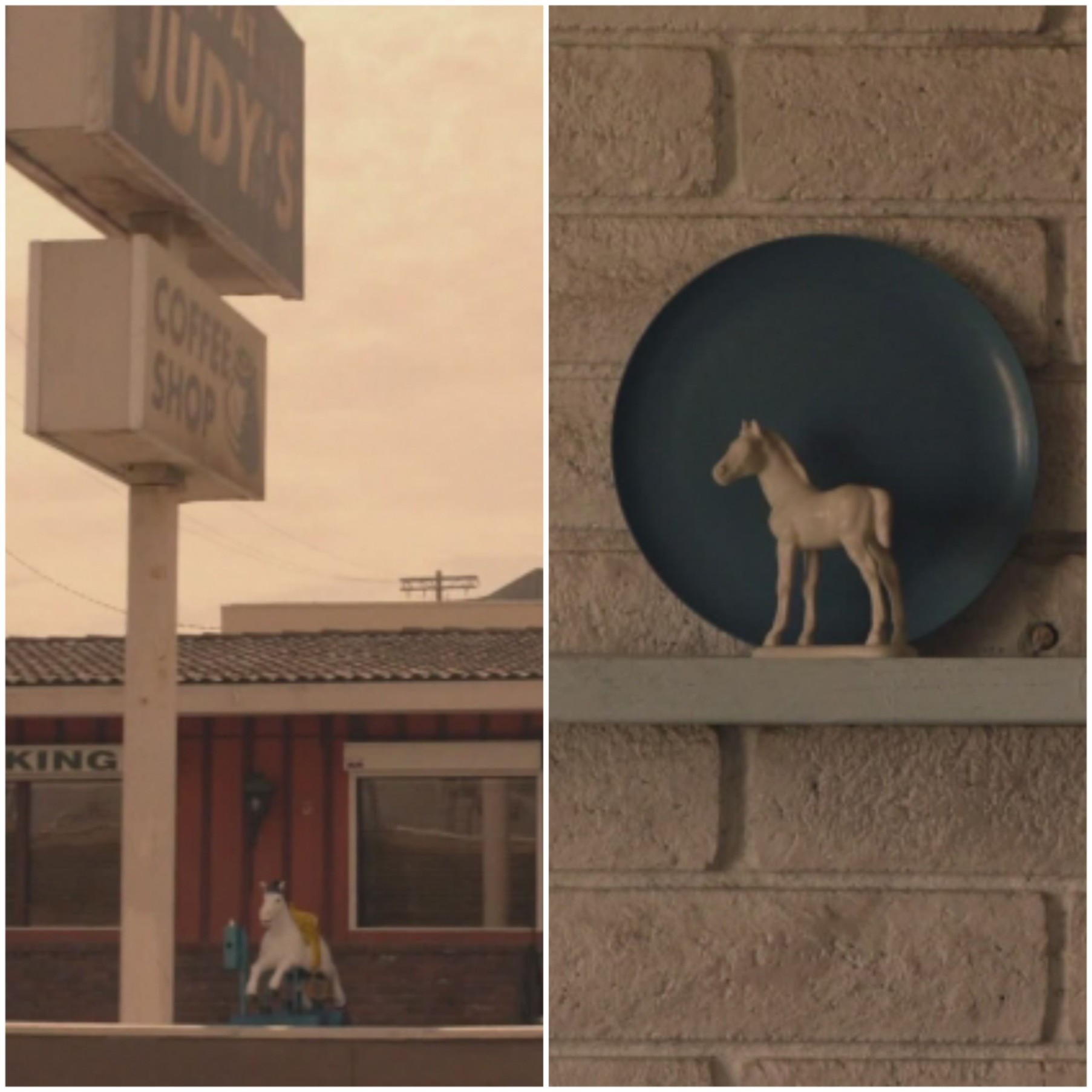
I have to wonder if the woman Richard finds, as skittish and on guard as she is, would willingly give her name to a stranger.
I theorize that this Laura is really Judy.
The second Judy.
Representive of Laura Palmer alive and possessed, just like the first represented her dead and as the possessor.
In any case, Richard takes the woman back to her home, but while she initially doesn't recognize it, the more she is exposed to the house some memory threatens to come back, some feeling. Specifically, it is Sarah calling for her daughter on the morning when her corpse should have been discovered by Pete Martel which triggers the displaced identity of Laura Palmer within her. On a deep, inward level, she remembers that she was possessed by the entity whom destroyed her childhood, and in return possibly recalls that she killed her own mother directly afterwards in an act of matricide (signalled by the lights going out with a blast).
Her scream could correlate to the same anguished one Leland unleashed as BOB used the man's fear and pain over his forced act of filicide to enter the Lodge.
The daughter is possessed now just as her father was.
The circle is complete and we are back to the start of Twin Peaks, but with a new beginning, one where Laura Palmer did not die.
Or, from another vantage point, the beginning of a new dream to help prevent the dreamer from needing to wake up.
Back to the nesting box of dreaming, which is just another escape route.
The question is will Dale Cooper attempt to fix this as well, the hints still there that he is stuck in some sort of a loop where he constantly returns to the past but never accomplishes what he desires? Like a holy fool, Cooper keeps on trying to correct the past, repeating his dream over and over again: first to find out who killed Laura Palmer, then to save her and finally to find her.
But what if Dale Cooper has it all backwards?
Maybe the underlying truth of this new dream, or any dream he has ever had infact, isn't the facade of trying to find Laura's killer, or Laura or Judy or anyone else in his life.
Maybe what Dale Cooper really needs to do is to find himself again.
~The Eternal Visitor~
After Laura disappeared on the night he was attempting to save her from her death, Dale encountered Mike and the Arm for an altered take on his earlier meeting with them inside the Lodge. This time the arm asked Cooper "Is this the story of the little girl who lived down the lane?"
Afterwards he even emphasized the question by reiterating, "Is it?"
This same question was posed during Audrey Horne's argument with her perpetually sleepy husband Charlie, after he'd threatened "Now are you gonna stop playing games or do I have to end your story too?" to which the unhappy wife replied, "What story is that, Charlie? Is that the story of the little girl who lived down the lane? Is it?"
The conversation was strange, seeming to hint that Audrey was inside of a dream or someone's fabrication, the word "story" being a rather interesting choice of words.
Is she the little girl who lived down the lane?
Or is it Laura, whose death introduced us to Audrey in the first place, and whom we saw brought back to the house where she lived at the conclusion of the whole Twin Peaks story so far?
But what if it is not Laura's story either?
She is not the dreamer.
As Pete stated, she's dead.
But Dale Cooper is alive
And this is his, or whomever he is behind the mask's, story.
Think of Gordon's dream with Monica Belluci again and what she informed and then asked:
"We are like the dreamer who dreams and then lives inside the dream. But who is the dreamer?"
Cole uneasily followed Belluci's gaze behind him to see the scene replay from FWWM where Cooper discussed a dream he had with his boss. Remember also that Dale Cooper is present during the actual dream Gordon has with Monica, but Gordon makes it a point to inform Albert and the audience, "but I couldn't see his face."
Cooper, or whoever this man is, has ultimately forgotten himself in order to escape what he has done, trapping himself in the Red Room of his mind and within the various, multiplying dreams and stories which follow, as well as the different versions of his own identity, fractured and needing to be dealt with, redeemed, freed or destroyed, like the shards of a broken mirror.
Like the one we were left with on the original series' finale when Cooper's doppleganger literally smashed his head into the mirror in the Great Northern Hotel Room.

make tv GIFs like this at MakeaGif
This returns us to the psyhcological act of splitting.
It has little to do with how the person doing it actually sees someone else: it has everything to do with how they ultimately view themselves.
The mentally imbalanced individual "hasn't developed a stable sense of self and this leads to them being unable to balance good and bad at the same time. They frequently switch between idealization and devaluation, or split, as a way to rectify any feelings of uneasiness they experience in themselves."
When the person suffering the imbalance sees someone in terms of black and white, alternately sanctifying of villifying the person, they are projecting their own inability to see themselves in shades of gray.
In other words, they'd rather not take a good, hard look at themselves for too long, but rather focus all attention and energy on other people and how they view them instead, projecting their own conceived shortcomings onto someone else.
Cooper does not need to find Laura, he needs to find himself.
Consider the sequences for Dale's search in this final episode and where he is particularly led, though he pays no attention to the directions, as they are.
First we have Leland imploring him to "Find Laura".
However, once Cooper crosses over and transforms into Richard, we have Linda (most likely Diane) and her letter stating: "When you read this, I'll be gone. Please don't try to find me. I don't recognize you anymore."
This coincides with Diane's previous discomfort during sex with Cooper. He instructed her to first turn out the lights, obscuring his face. She was then unnerved by seeing what little of him she could, during the act, and tried her best to hide and cover his face completely. The scene was overall a little reminiscent of the one between BOB/Leland and Teresa Banks in FWWM, when he covers her eyes and asks "Who am I?" and she replies that she doesn't know, or the one opposite to where Laura tries to focus on BOB, to see what is being kept from her, and finally sees the face of Leland.
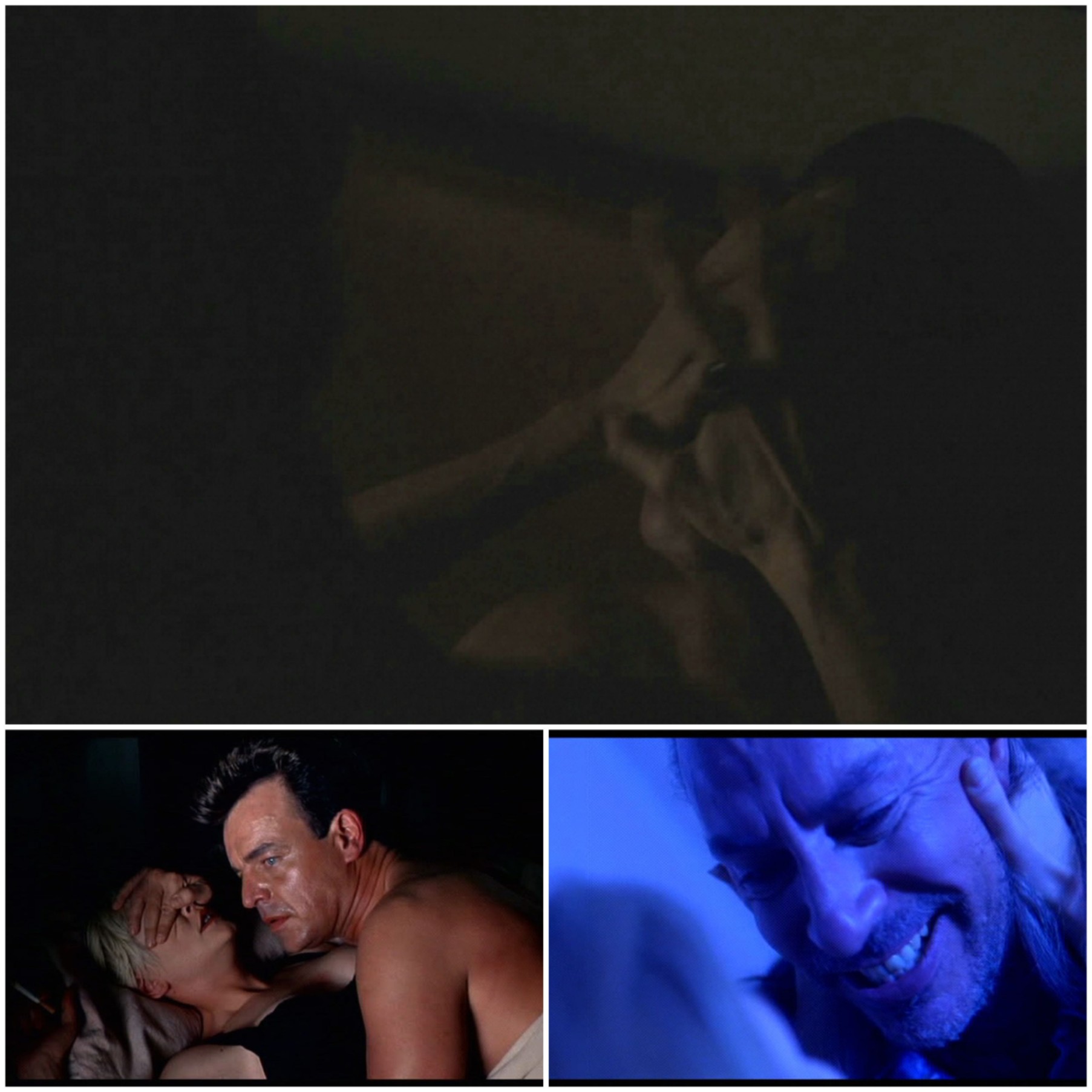
We can also connect it to Audrey's odd moment of not recognizing her husband Charlie before they head to the Roadhouse: "You, Charlie, it's you. I-I-I just never really saw you before the way I'm seeing you now. Like I'm meeting a different person. Who are you, Charlie?"
Diane seems to be seeing Cooper in some different light, also, while their bodies are joined and it is extremely unpleasant to her.
Her words as Linda are clear as is the message: Don't find ME. I Don't recognise YOU. Go find who you used to be.
With the statement in the letter, the real mission Cooper should be on is truly hinted at: he shouldn't try to be looking for her or anyone else, especially not some unknown woman in need of saving or defeating, the person Dale Cooper really should be looking for and trying to save he carries with him always.
Finally, we have Carrie Page (whom looks exactly like the missing Laura Palmer) and her subtly telling first interaction with Richard when he comes knocking on her door.
Carrie: Who is it?
Richard: FBI.
Carrie: Did you find him?
Richard: Laura.
Carrie: You didn't find him?
Richard: Laura.
She, like Linda/Diane, is suggesting he find someone whom is not her, stating "You didn't find him" after he has addressed her as Laura.
By focusing still on "Laura" it is clear that Cooper is on the wrong trail.
After he does it for a second time, Carrie straight up tells him, "You got the wrong house, mister."
She eventually does go with him, of course, but maybe her words were more accurate than anyone could know.
Cooper should not have been looking for the Fireman's Place or the Palmer household, intent on taking Laura Palmer somewhere that was either her spiritual or earthly home. He should have left her in the past, where she belonged to him.
The start of Part 6 featured heavily on the process of Dougie/Cooper being returned home, but not knowing where that was, except for its red door. Once he is returned to the Jones' house, however, doors still play a role, the one to Sonny Jim's bedroom being focused on for a while.
But, though, he is accepted by Sonny Jim and Janey, this is not Dale Cooper's family nor is it his house.
Like the tulpa Dougie Jones relief at walking through his front door, Dale Cooper, or rather his true self, needs to take himself back to his real home.
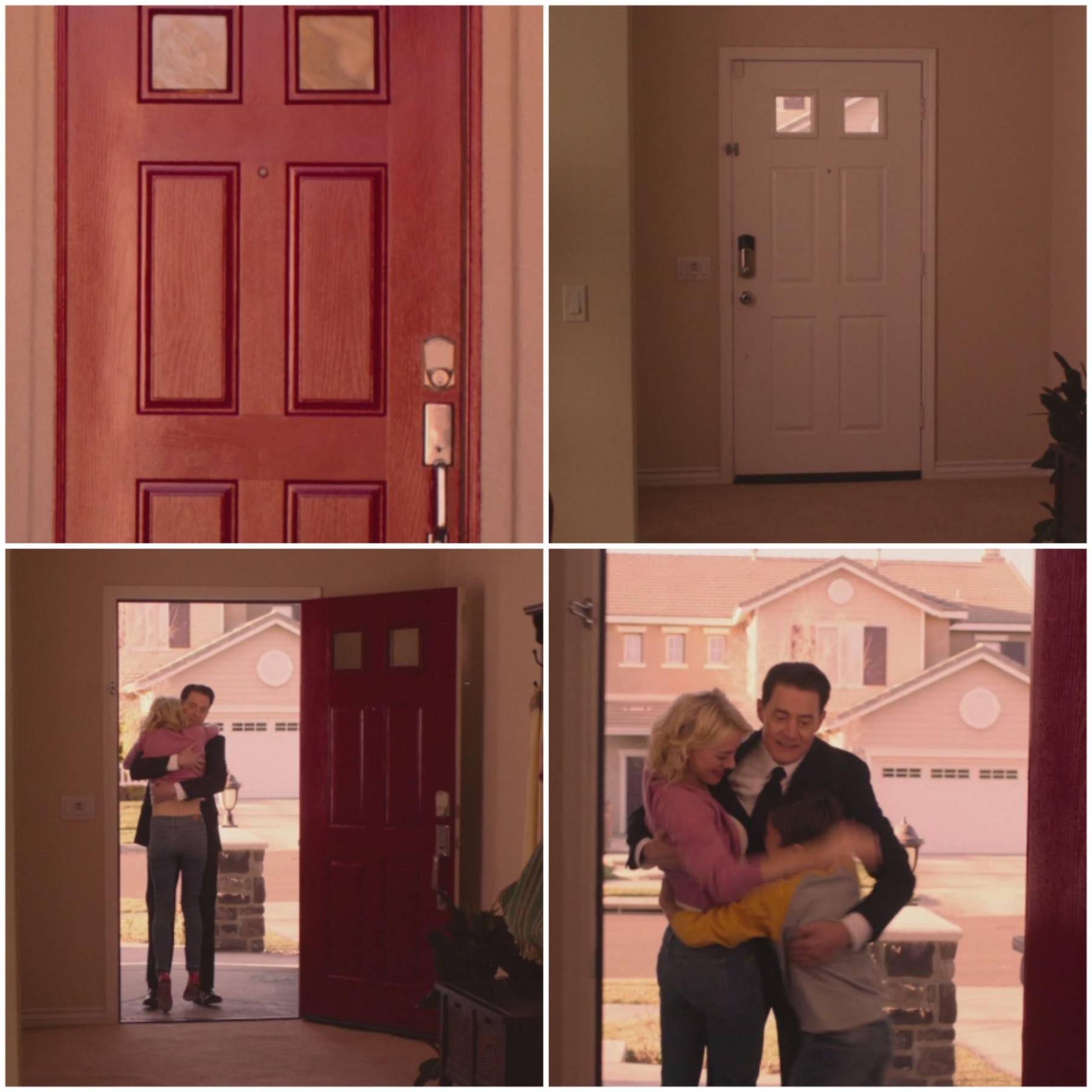
~The Guest Whom Wouldn't Leave~
Wasn't that the story The Return was supposed to be?
Isn't that what the fans all truly wanted and waited patiently for?
Cooper finally getting out of the Lodge?
Cooper finally returning to Twin Peaks.
Instead viewers were frustratingly sidetracked with Mr. C and Dougie Coop's storylines. And when Cooper finally returned to Twin Peaks, he became so distracted with the impossible, saving Laura Palmer, that the audience spent virtually no time whatsoever, over the course of 18 long episodes, on Dale Cooper being home.
The only problem was, and Lynch, no doubt, realized this...Twin Peaks was never Dale Cooper's home.
We don't where his home truly is.
From most of what we have seen, Dale Cooper is a transient in his own life, a visitor but never a resident. For most of Cooper's screentime, we watched the man as a tourist in other people's town's or cities. We had just watched him living another man's life in Las Vegas for The Return, while his doppleganger had travelled the world. The majority of Twin Peaks also found Cooper visiting the town of Twin Peaks to solve Laura's murder, but he spent the whole time practically staying in a room at the Great Northern Hotel.
One of the major plot threads in the Return even features the hotel key to the same room where Cooper stayed. The room number is 315 which technically makes 9, one number short of 10, the sign of completeness.
There is something else off about the key, though: It inexplicably bears the same demand Cooper had for a hotel before he'd even heard of the place: "Clean place, reasonably priced".
It would seem that the Great Northern was literally Cooper's dream come true.
And yet, when he returns to Twin Peaks, Cooper does not actually use the key on his old room but instead takes Gordon Cole and Diane to the basement of the Great Northern Hotel where the key unlocks the Furnace room there, the same room which has been emitting an odd humming noise for episodes.
Furnace.
Heat.
Fire.
The furnace room in the basement of the hospital was coincidentally the first place where Dale Cooper met BOB in his dream. Why does his hotel room key open up the door to the same sort of place? And why is Mike, BOB's former accomplice, waiting for him there too?
Another baffling vignette in the Return finds a girl named Ruby waiting at the Roadhouse for someone whom doesn't seem like they are ever going to show up. When two men remove her from the booth where she sits waiting, she crawls on the floor, not standing to walk, but crawling forward past the legs of those dancing on the main floor, staring at their feet on occassion, and looking horribly lost and sad. Suddenly she stops and screams and we, the viewer, have no idea what it was all about, despite feeling deeply unnerved.
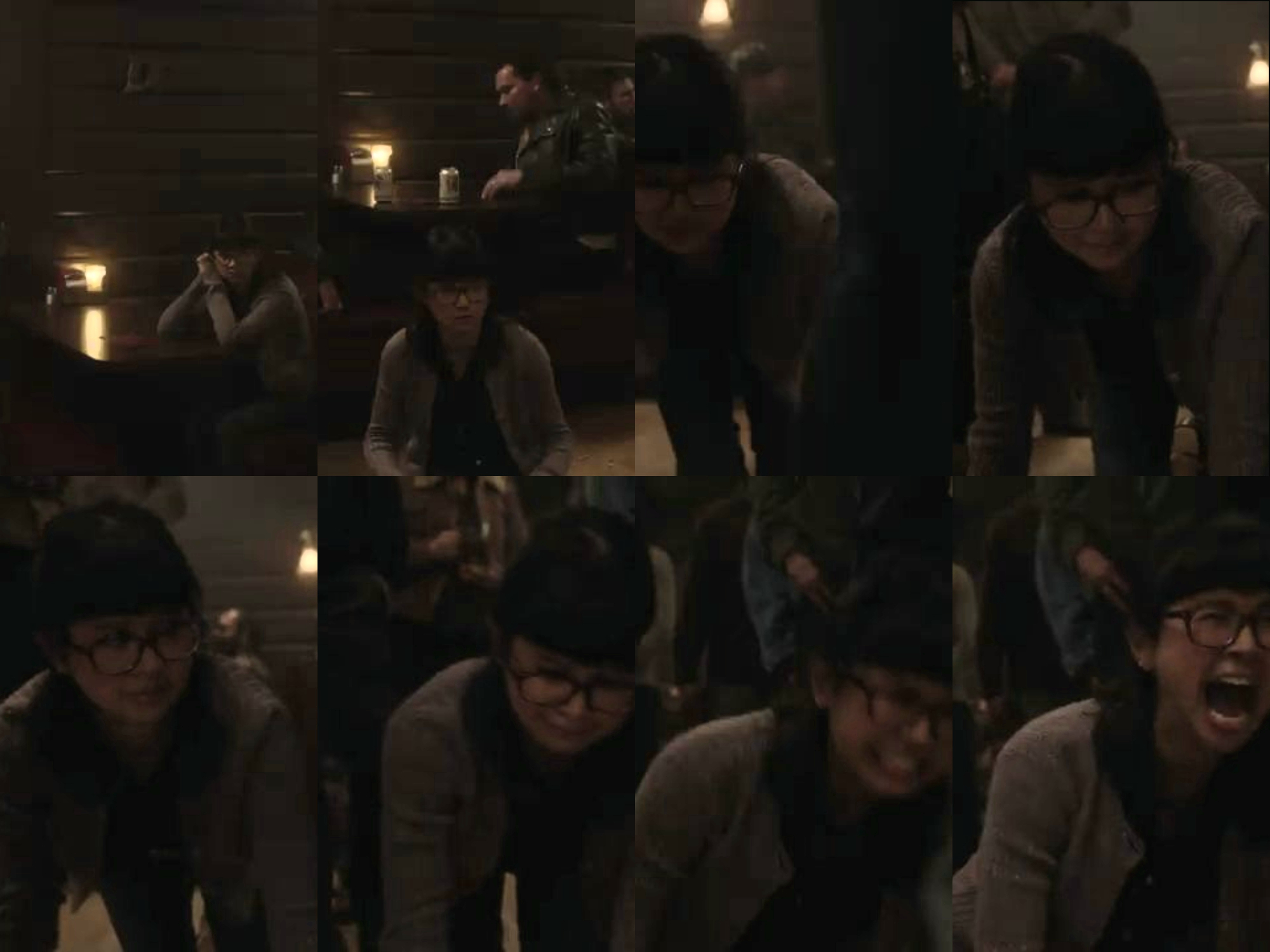
Now, I will invoke the memory of The Wizard of Oz and a certain pair of ruby slippers. While Dorothy feverishly wanted to go home, the Ruby of the Twin Peaks Roadhouse sits abandoned, waiting for someone whom will never come because he does not wish to go home and leave the dream. Unlike Dorothy, he is aware that on the other side of the rainbow things will be far worse.
Afterall, if the dream is left, Dale Cooper will have to face what he has done, and maybe even worse, who he is.
But who is he really?
This answer, I tentatively argue, has already been placed within the 2017 Twin Peaks series, in concealed yet also remarkably clear view.
~Professional Squatter~
When Cooper's Doppleganger had become weak (set to return to the Lodge but sending the decoy Dougie in his place), he ran his car off the road and was eventually arrested. On the fingerprint card created some seemingly simple facts are blatantly wrong. For date of birth, for instance, it lists 08/15/1973, while his place of birth is Buckhorn, South Dakota.
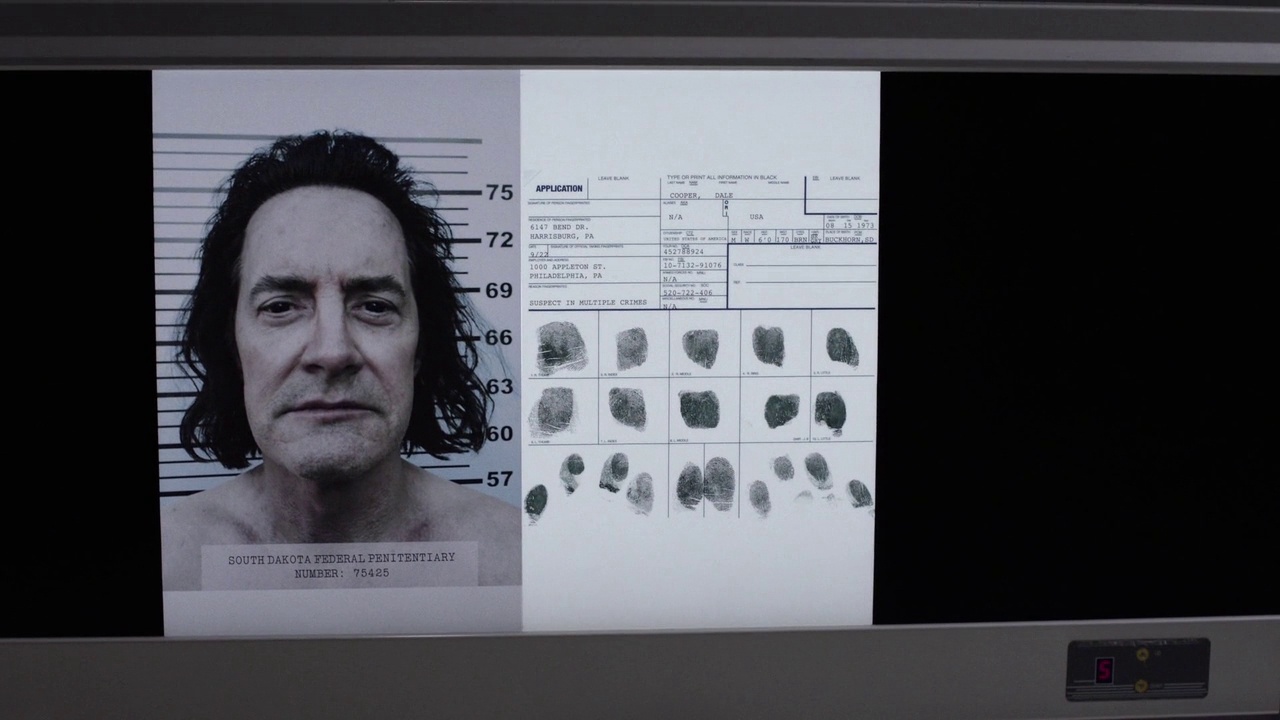
Which brings to mind the drawing Gordon Cole drew, before his vision of the crying Laura, of an elk with pronounced horns and either holes or spots throughout its body, with an arm (presumably the Fireman's?) reaching out for him.
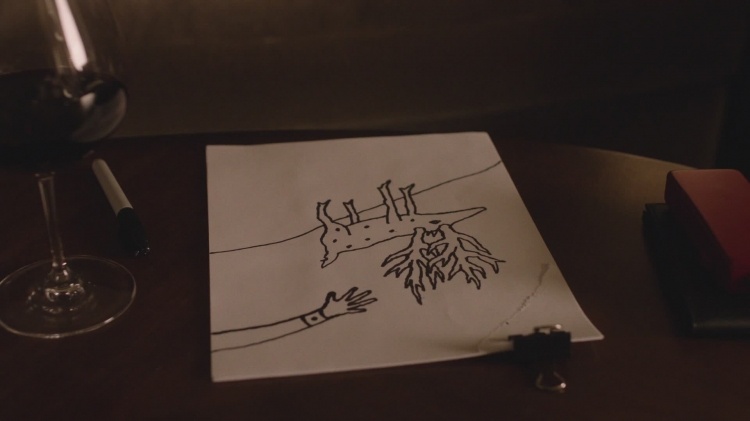
Also, Cooper Doppleganger's obviously black hair is confoundingly stated to be brown gray.
This is confusing but would be even more confusing if we couldn't link the information to someone else we have already been introduced to.
This guy.
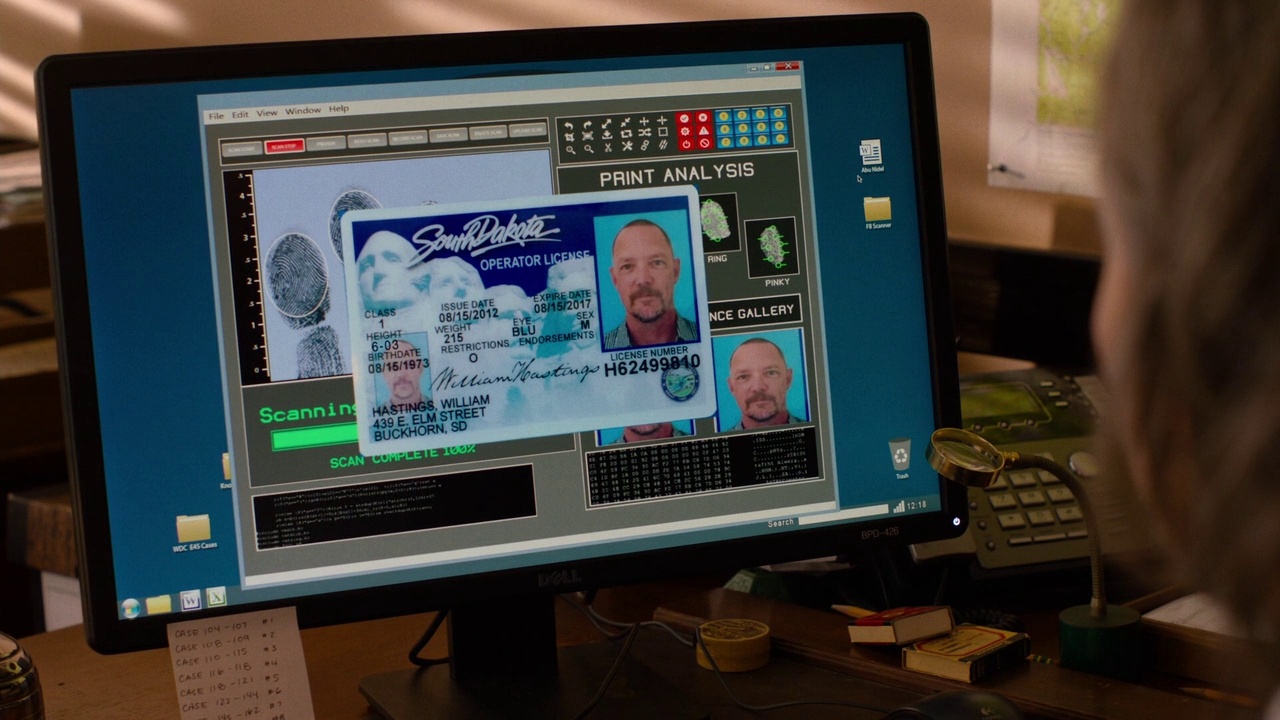
William Hastings.
William, you see, is one of the many, many Bills we see (or don't see) running around Twin Peaks The Return. Okay, we have William here, resident of good old Buckhorn, Bill Shaker from Las Vegas, whom helps lead "Dougie" to his "home", Bill Kennedy from Philidelphia, Billy the trooper from South Dakota, Bill from Carl's new Fat Trout Trailer Park, and the mysterious Billy of Twin Peaks, Audrey Horne's elusive lover whom might or might not be the Farmer with the stolen truck.
The way the name keeps repeating, when it hadn't before, seems indicative of something, as well as its sudden omnipresence throughout the landscape of our story.
William Hasting's own story is a little strange. He seems like a normal enough guy, the happily married principal of the Buckhorn High School. Only, he isn't so happy. Or so normal. William's marriage is riddled with infidelity on both sides, his wife sleeping with their Lawyer (hmm same profession as Leland Palmer) George Bautzer (umm same first name as the Twin Peaks High School's principal), and William having his own ongoing affair with local librarian, Ruth Davenport.
Oh, and William spent his early years knee deep into Science Fiction stories and the like.
We watch as Hastings' mental state deteriorates as he seems to be framed for Ruth's murder, wherein her head was found on top of another man's body in her bed at her apartment. While, initially stating he didn't know the woman all that well, the truth soon comes out: They were having an affair, but besides that, shared an interest in alternate realities and other freaky things.
Problem was, things got a little too freaky when Ruth found a certain file (she was good at that sort of thing, since she was a librarian, I guess) which said that at such and such a time, if one went to 2240 Sycamore, they'd wind up in a place they nicknamed "The Zone".
I'm thinking they watched too much Rod Serling, or at least, William did.
Anyway, when Bill and Ruth went to 2240 Sycamore they were infact taken to the Zone where they met dear old Major Briggs, whom was in hiding or "hibernating" as he supposedly put it. He said people were after him, and so he needed to move to a set of coordinates, and would these two strangers, whom he had never met in his life, want to break into military security and get them for him.
Kind of a big task to entrust two civilians with if you ask me.
William and Ruth agreed, however, the latter using her skills yet again, and they eventually returned to the place, Ruth having written the coordinates on her arm. Once delivered, why, the Major's head floated right up from his body, saying "Cooper, Cooper" and it was just about the most beautiful thing old Bill Hastings had ever seen.
It was beautiful anyway until people came, pushed him to the ground, demanded his wife's name, then left, leaving Hastings to find poor Ruth dead, all so he could hold her body and lament the fact that they would never go scuba diving together, like they both wanted.
Only he woke up at his home afterwards, believing the whole thing to have been a dream.
Until he was arrested and questioned for her murder.
But looking closely at William's story...some things seem out of whack.
So, he claims that many people were at 2240 Sycamore. We assume those are the Woodsmen, for they seem to be following Hastings around, sitting in a nearby cell even. But these Woodsmen also seem to be closely associated with Cooper's Doppleganger and BOB. They seem to heal the former, afterall, after Ray shoots him. If they killed Ruth, why not get the coordinates that Cooper's Doppleganger desires so badly off of Ruth's arm while they were at it?
And if Cooper's doppleganger killed Ruth (like he eventually will shoot Phyllis) why didn't he get them himself?
It seems likely either the doppleganger or an associate was involved, because of the connection we'll see between Phyllis and him (tying in with the demand for the name of Hastings' wife) and Cooper's dopple spends an inordinate amount of time trying to frame Hastings for Ruth's murder and then George for Phillis'. But why? It all goes really nowhere and why focus on all this nonsense when he could have just gotten the coordinates he was so obsessed with at the time and then gotten the heck out of there? They'd never know of his involvement, not too many people in Buckhorn knowing of the evildoer to begin with.
What would his motive have even been in their eyes?
Why spend so much time messing around with harmless William Hastings' life?
What's this bit about the principal's assistant Betty too, that also goes really nowhere? Ray claims he can get the coordinates from her but we never even see her. Still she's important enough to be murdered through more of the doppleganger's machinations? Hastings claims to have driven Betty home after a faculty meeting at 9:30, the night Ruth was murdered, because something was wrong with her car...but planting a bomb on her car is exactly how Cooper's doppleganger and company kill her. And yet, when William had been talking about there having been something wrong with poor Betty's car, that was the precise moment he stated he needed his lawyer and became very distressed.
Not when he was lying about his involvement with Ruth and her apartment, but when he was discussing the never seen Betty.
The deal with that apartment is confusing as heck too.
Okay, Hastings caims that he wasn't at Ruth's apartment on the night she died, that he dreamt he was at Ruth's apartment but was not actually there. But why did he dream he was at her apartment? When? In the story he told FBI Agent Tammy Preston, he mentioned going to 2240 Sycamore, where everything supposedly occurred, and where Ruth's naked body was discovered. But Ruth's head was found at her own apartment, where he'd said he'd been in the dream. How'd Ruth's head get there?
Who killed Ruth Davenport?
And why if not for the coordinates? And then why bother with Hastings?
One thing for certain is that his fingerprints were found all over her apartment and what is really, really strange is how when the Buckhorn Police run the prints through the computer we are given a really good glimpse at William Hastings' information and only a few episodes later, when they run Cooper's Doppleganger's fingerprints through a computer, we see them again, without one comment being made about the misinformation.
There has to be a connection and this is the obvious clue.
Too obvious, you might argue, but so is Gordon Cole's much later observation of "He's dead" when he finds poor Bill with the top of his head imploded in the back seat of a car, while the principal's fishing partner, Detective Macklay, was just sitting oblivious in the front seat.
Which was kind of intetesting when we think of where this all happened.
Outside of the place where William claimed to have met the Major.
For some reason the Woodsmen thought it would be a great opportunity to sneak up and squash poor Bill's head there.
Even though they could have also done it the night they killed Ruth or when one was hanging out two doors down from his jail cell.
Maybe Hastings could not remain that close to the area he knew was strongly connected to a lie, just like Cooper "saving" Laura Palmer on the night he was supposed to really have killed her only led to a big problem.
Maybe his head imploded from the fact more as an escape route and overload more than anything else.
Examine too that it is a state trooper called Billy whom found the unconscious body of Dopple Cooper and became sick after smelling the doppleganger's vomitted up cream corn (pain and sorrow?) and engine oil. It never states the other trooper's name, nor does he go up to the car or become sick.
It's only the one named Bill whom is clearly identified.
One of the legion of Bills David Lynch and Mark Frost introduced us to, many spanning over the country and most seemingly irrelevant.
Yes, I admit most names repeat in the Twin Peaks universe, from the two Mikes and Bobs to the Invitation to Love's and prostitute Jades, but this was really redundant.
And lest we forget to connect the Bills to one of the shows oddest mysteries during season 3: the identity of Audrey's dream lover Billy. As I said before, it's likely he was the farmer, but why is he yet another Bill and why are people seeing him bleeding from the nose and mouth after William Hastings met his own bloody demise?
Why is Audrey seemingly captured in her own dream, her removal from it, or shifting to another, accompanied by another sound of electricity?
I believe that Audrey is no different than Diane, another woman Cooper cared for whom was raped by his doppleganger and then appeared to put into another conciousness. Diane became Naido. It's possible that Audrey was, likewise, the "American Girl" from the Mauve Zone, the same place Cooper climbed into the window to access.
And yet Audrey was still Audrey, off in a dreamworld, with a husband she didn't love and a lover she was crazy for and idealized (just as she had Dale Cooper), even though he was seeing someone named Tina too.
So much infidelity, just like Hastings" marriage.
But something Charlie says strikes me as a little peculiar. When his wife is comparing him to the missing, cherished Billy he simply states, "Well, I am Charlie and he is Billy." It's almost as if he's straightening out the personalities, as if both are him, different versions of him. He could have just as easily of said, "I'm not Billy" but he doesn't.
Maybe because both are him.
I think they are.
One to keep Audrey Horne in check and the other to have his fun with her.
I theorize that Dale Cooper, despite turning the high school girl down, was secretly very much in love with her. That was why his doppleganger went to see her and consumate the feeling even though Audrey was in a coma.
From that union, the man and woman had a son named Richard (just like the later incarnation of Cooper in Odessa), as evil as Sonny Jim was good, and making them the more warped and tragic version of the Jones family: father, mother, son.
Possessive of Audrey, despite his impending absence, I theorize that Cooper's doppleganger kept her in that coma for 25 years (mirroring Cooper's time spent in the Lodge), under his control and isolated, so she could ultimately fall in love with another version of himself, the mysterious Billy, while married to still yet another version of himself, Charlie.
Charlie, Billy and Cooper are all really William Hastings, Charlie seeming to be the one in control of the story, keeping account of the books, so to speak.
But that begs the question then...
Who is Audrey Horne?
She seems to be suddenly suffering from an existential crisis herself, stating things like this out of the blue in Part 13:
"Like I'm somewhere else and... and like I'm somebody else."
"Well, I'm not sure who I am, but I'm not me."
"Who am I supposed to trust but myself? And I don't even know who I am!"
And why does she share Ruth Davenport's lamp in her all too retro house, just as Dopple Coop shares Hastings info?
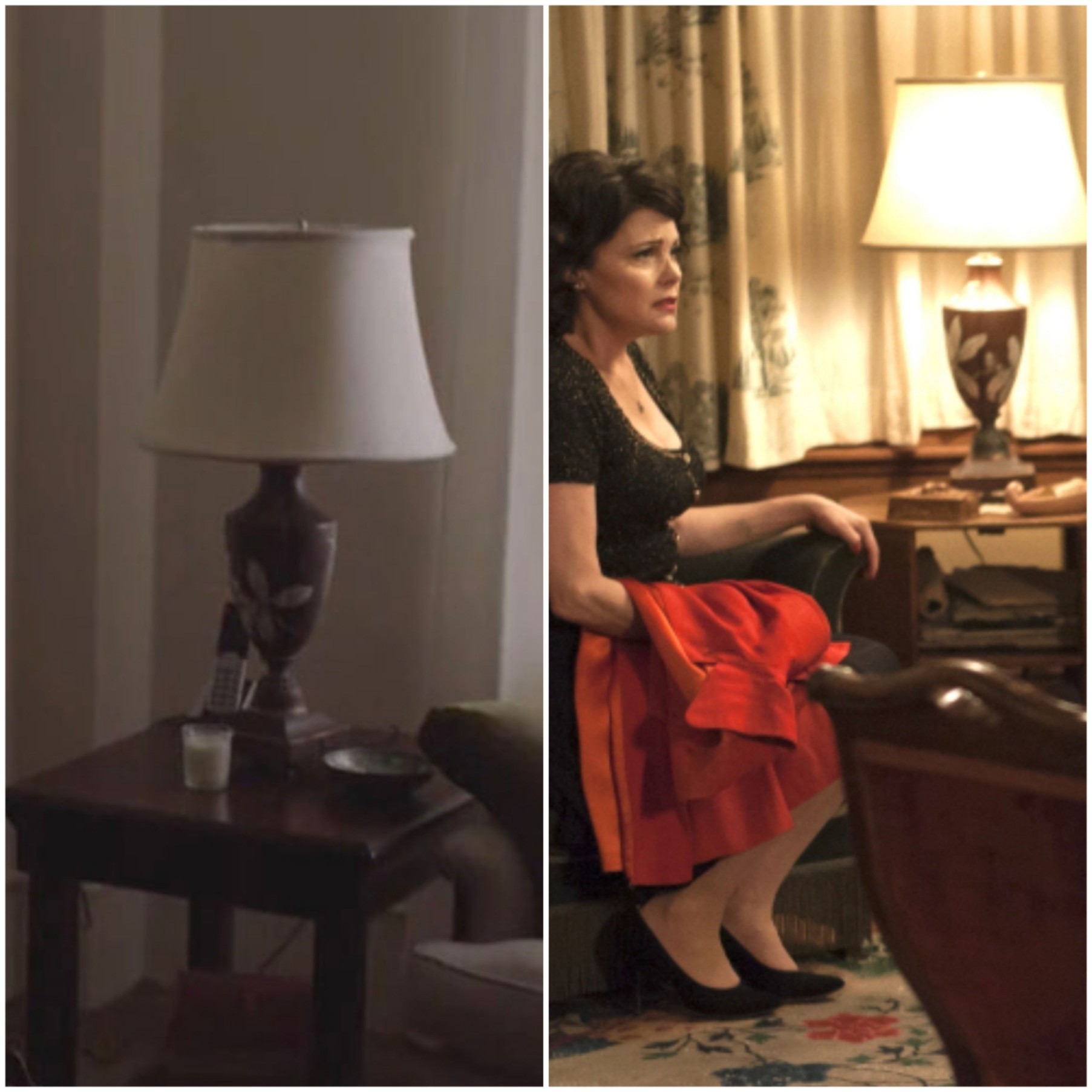
This might seem inconsequential, at first, but given the important clues found in the lamps from Lynch's "Mulholland Drive" you gotta wonder.
David seems to be fond of the theme of lightness and dark.
Gotta light afterall.
Diane was instructed by Cooper to turn off the light in the motel room, the lights in the Log Lady's cabin faded and the ones in the Palmer place virtually exploded at the end.
Which, speaking of, while Macklay was searching the back of William Hastings' trunk, his flashlight kept flickering ala the light in the hospital in the Twin Peaks Pilot with Cooper. And this was before an unidentified lump of human flesh was found, incriminating his friend. We never found out much about the flesh, one way or another. But it was under a bunch of fishing equipment, which sort of goes back to Pete's "Gone fishing" from that same Pilot too.

make tv GIFs like this at MakeaGif
And this all happens on Elm street, where William Hastings lives.
Yeah.
Hard not to make the connection to another famous "Nightmare", another entertainment property the impressionable young Bill Hastings would, no doubt, have gobbled up, what with his propensity for the unusual.
For a while there William indulged online with his interests and we were invited to interact with it. His website was up IRL, for a while to coincide with The Return. Funnily, the site never mentioned Ruth but Betty was referenced once as being "cool".
It claimed Hastings' became interested in Science Fiction after reading Robert Heinlein at the age of 10. The world of Heinlein, well, it is basically pulp Science Fiction, related to those Crime pulp magazines featuring the aesthetic I already mentioned plays an active role in the world of Twin Peaks.
Infact, Twin Peaks feels often like a mixup of the various pulps, what with their propensity for violence, camp, noir and exploitation.
That website also has some other interesting items, which might or might not have anything to do with anything since I can't find out either David or Mark's involvement with it.
But I certainly found it odd that a grandmother was mentioned obscurely and unsettingly in the guestbook: "my grandmother remembers this - she said you are real but you should …(not to say sorry.) and remember this is not my name! - so no one gets in trouble!"
And a boy even more disturbingly with fire: "H.V. … and B.H. … great video… but not the good quality. I couldn’t tell- was that light really fire? Was the boy burned? His face looked burned. When will you do the “thing”?
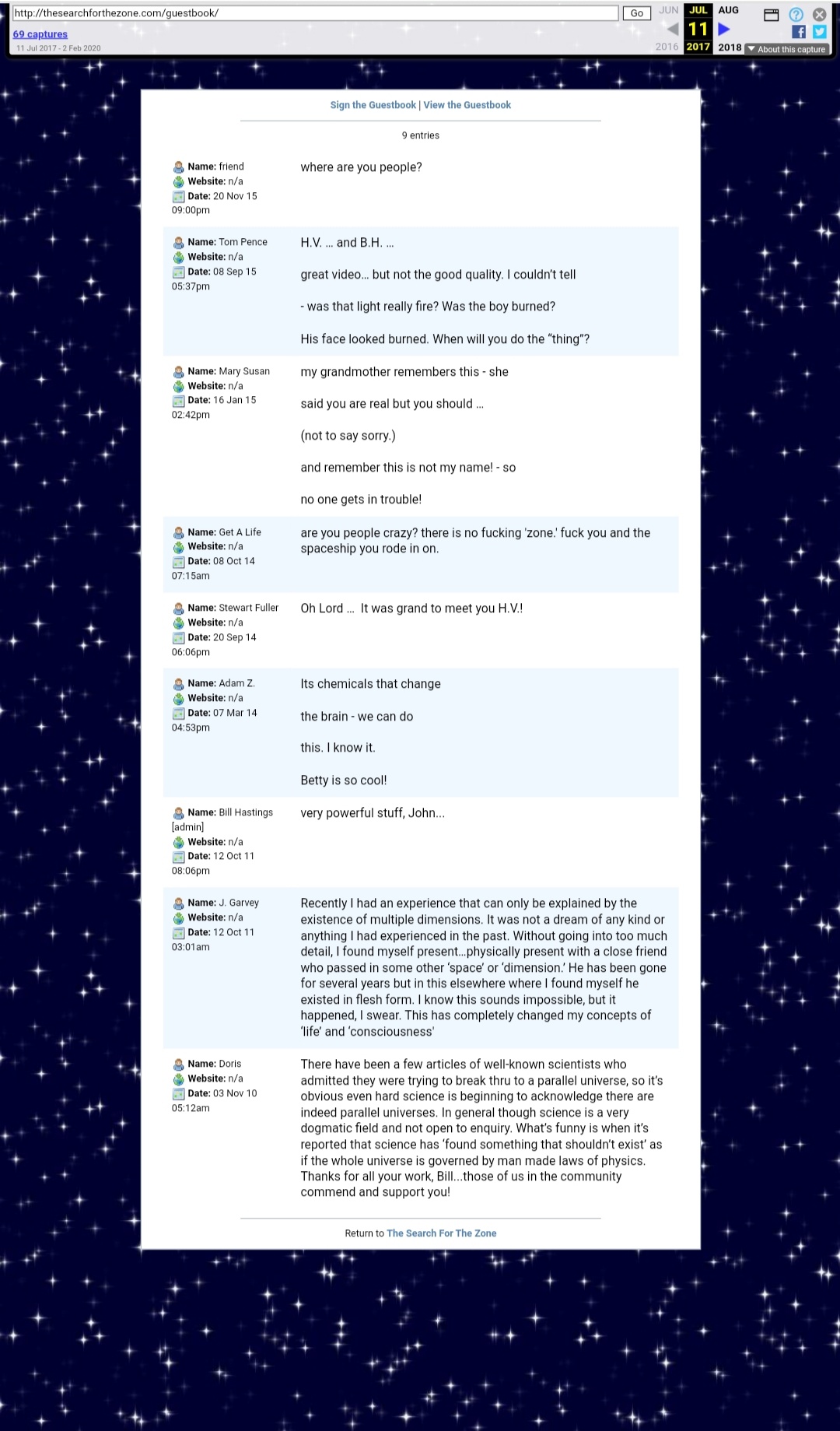
And JFK's assassination seemed to be an obsession of Hastings as well as it was of Cooper's: "We will have to reconcile with the question that if someone from outside our familiar world gains access to our plane of existence, what ramifications will that entail? There might be forces at work from deep dimensional space, or from the future…or are these one in the same? Think of the events that could have splintered time? The things that could have laid the seed for a starting point for this development? Perhaps technological innovations or the assassination of President Kennedy?"

To think that JFK's assassination could have splintered time is taking things a bit too far though, I think.
But it does link him to Dale, yet again, whom in the first episode of the original series pondered whom had really killed JFK and what he and his brother Bobby had going on with Marilyn Monroe.
~A Different White House~
All the Kennedy references did make me play around with the theory for a while that Bill is just another layer of the onion of the dreamer and this whole thing is really just John F. Kennedy or Robert Kennedy dreaming away what he did to Marilyn Monroe by casting himself as the FBI (which he had kill her), on what they say BOB (get it?) Kennedy instructed. Audrey is Jackie O (hinted at by the book Happy Times by Jackie's sister on her mantle) while Laura is none other than Marilyn Monroe herself.
Or maybe Audrey is just another Monroe too, what with the mole and the sex appeal and all.
This can be further amusing to contemplate when recalling that Twin Peaks originally began when Mark Frost and David Lynch came together to collaborate on "Goddess: Venus Descending" (think of the statues in the Red Room) a biopic of Marilyn Monroe, but Lynch wasn't comfortable with the subject since it was real.
Lynch's own girlfriend at the time of JFK's assassination was a girl named Judy...
So maybe he found a way to tackle the Marilyn story afterall.
That might be it too.
It might not be
Truth is, though, i don't really know what's going on.
I don't even know if the Laura Palmer we came to know throughout the series even exists. If the dreamer is Cooper, or someone transplanting themselves within the dream as him, then we can't really trust anything shown about her.
It could all be a fantasy.
The portrait of the perfectly tormented, tragic victim.
Like how the real Camilla seems absolutely nothing like Rita in Diane Selwyn's dream in "Mulholland Drive".
Even the fact that everyone was in love with this teenage girl, including a bird, could be nothing more than a lover's overly jealous mind at work. He could just of been incredibly possessive of her. Possessive...possession.
He wanted to possess her because she was nothing more than a possession in the dreamer's mind.
It could just come down to that.
But, in reality, the dead girl could have been throughly unremarkable save in her killer's eyesight.
In truth, Laura (or the victim) may be closer to Teresa Banks, a girl we never really are given a chance to know, whom we never see the family of and whom nobody came forward to claim: a virtual blank slate. All we know of Teresa really was that she was a young prostitute, the paid lover of men, some likely married, and a blackmailer.
That last bit is what we can tie most closely to what Laura Palmer whispered to Dale Cooper afterall: that she knew the truth he was trying to hide.
The rest is subjective, in question because it comes from an unreliable narrator.
Her name might not have even been Laura. Maybe that was only informed by the famous film about an obsessed detective. Perhaps it was really just the somewhat plain Judy. Maybe that is why Judy remains the same whether Laura lives or dies just like the whisper.
Our Laura's is gone or might have, infact, never existed.
But, then again, nobody really did anyway.
~Vacancy~
I've seen some fans rail against this in regards to the "it is all a dream" theory, and especially the "Cooper was the real murderer" one. They think it in some way subtracts from all that we've seen.
I think they have an obsession with the incest/sexual abuse aspect of the story, clinging onto it with what almost feels like a fetish or perhaps an inclination for misery porn they don't want to relinquish or admit. I was even a little disconcerted (although strengthened in my belief for many fans obsession with the subject) when I was reading up on what some believed Laura to have whispered to Coop and one theorized she was saying something like, "My father raped me since I was a little girl."
I'm sorry, but that would be horribly repetitive and unproductive since Dale Cooper was the one whom read through what could be salvaged of Palmer's Secret Diary, and stated the poor girl was abused on a nightly basis. Why have that brought up again unless it's to suit someone's own proclivities more than the actual story?
But that is how far the obsession goes, not unlike Harry S. Truman repeatedly holding onto the belief that Shelly shot Leo and put him into a coma.
I personally have always been disturbed by focusing on this aspect of the story and believing it was all simply Leland being the abuser. No, not because, I find it difficult to believe that a father would rape and murder his own daughter (and lest you believe the claims that the audience at the time wasn't ready for such a story, nor would the network allow it, I will remind any reader that during the period when Twin Peaks first aired the networks were filled with stories of incest, child abuse and parents murdering their children: Something About Amelia, Don't Touch, Little Girl Lost, Kids Don't Tell, In the Best Interest of the Child, Fatal Vision and Small Sacrifices all being well received on TV), but because I believe this viewpoint makes the whole Laura Palmer story incredibly offensive.
If it was simply the case that BOB was the evil that men do, and Laura was becoming similarly "infected" it would glorify the murder of a 17 year old girl. The series always portrayed Laura's death as a positive force, even the Log Lady intimating she needed to die. If it was just some cycle of abuse story, it would insinuate that the young woman needed to be mercilessly slaughtered to save her soul but her male tormentor could live to be in his forties and still have the daughter he molested and murdered welcome him into heaven.
And before anyone argues that David didn't do the episode featuring Leland's death, I must also flat out refute that claim by stating that, having been a fan of Twin Peaks since its second season, Ray Wise has been quite clear that David himself was the one to describe to him that Cooper would recite to Leland from the "Book of the Dead", Laura would come for her dad, and that the whole thing would redeem the character of Leland and be a "beautiful thing" as Lynch called it.
That's a very rancid and misogynistic pill to have to swallow if BOB isn't a separate entity from Leland and Palmer really wasn't possessed and forced to do things he didn't want to do.
But whatever a viewer believes, most feel it takes away from Laura's story to have it be anything other than what was shown. But I have to shake my head at that too, because it is all fiction anyway. All just stories and dreams. Laura Palmer was never real nor was Twin Peaks and there exist far better stories of incest and abuse which don't undermine the whole thing with some of the more fantastical elements (like the ring thrown into the train car) of Twin Peaks.
And since it was never real anyway, what's one more dream upon the next?
It would not necessarily detract from the previous one or negate it, since it is all from a writer's mind and not an existing person's. Maybe, when looked at it this way, the real truth of it is that David Lynch was the one whom really killed Laura Palmer.
And since Dale Cooper has always been stated as being his stand-in within the world of Twin Peaks, that brings even more credence to the theory that he killed her too.
Actually, instead of taking away from the show's narrative, the "Cooper was Laura's Killer" theory gives a nice gravitas to the overall show, no matter if Cooper is Dale Cooper or William Hastings or David Lynch or anyone else. The two major characters in Twin Peaks have always been Dale Cooper and Laura Palmer, and what more perfect balance could there be for a mystery if one was the killer, while the other the victim, the audience, as well as the killer never really knowing the truth about it, the clues present but without any real epiphany?
David Lynch would have ultimately acheived the ongoing mystery he had strived for and believed in since Twin Peak's creation.
That brings us to another critiscm of the theory however.
~Architect and Architecture~
David Lynch made two films after Twin Peaks which featured protagonists whom had killed their lovers and then sought to forget it, so many question why he would do it again?
In Lynch's direct followup to FWWM, he directed and cowrote "Lost Highway" wherein, for all the uncertainity, it looks as if Bill Pullman's character has murdered his wife after being unable to deal with her past sexual escapades. And in "Mulholland Drive" we find Diane Selwyn, whom dreams herself as the image of the woman she loves, only to wake up to the fact that she has had her murdered for rejecting her love.
Fans reason that Lynch would never be so repetitive as to tell the same story repeatedly (although many of the same ones are perfectly fine viewing both movies related to Leland being guilty or if Twin Peaks all turned out to be Laura's dream and she was just waking up to a life where she was still being sexually abused, virtually making it, in their reasoning, into the same story we already watched).
I argue that this infact gives the theory even more strength though.
The fact that the same theme emerged at least two times after Lynch had delved into the world of Twin Peaks, but had never appeared in his storytelling before (aside from perhaps Eraserhead) seems remarkably telling. And nonbelievers would also be forgetting that Twin Peaks would have technically come first. It appears the theme would have become a sort of obssession and I argue that maybe the reason for the repetition of it stems from the fact that David Lynch was prevented from telling all of Dale Cooper's story and so it inevitably bled into his other work.
There was talk of FWWM being intended as the first in a trilogy. I did some research on this myself. Lynch did sign a multi-picture deal with CIBY, and the Twin Peaks film was the first of these films, but nowhere did it list the others as being Twin Peaks related. In a Fangoria article, Frank Silva, the man whom portrayed BOB, mentioned the rumors during filming, stating that the films would center on the series' supernatural elements, so it is possible the idea was being bandied about.
I strongly doubt they would have been made, though, for one simple reason: Kyle MacLachlan, at that time, was vocal in his reluctance to keep playing Dale Cooper.
FWWM was cancelled at one point because he refused to even do it. Only when Cooper's screentime was reduced did MacLachlan agree to it, necessitating the invention of the Chet Desmond character whom would take over the Teresa Banks investigation (which can add a nice option to this whole theory, and the aforementioned one, that something bad occurs when the dreamer draws too close to the truth: Cooper dreamed up Chet because he was unable to get near to Banks' murder, her possibly just being another side of whomever Laura Palmer really was. Which is hard for me to admit, because I was one of John Thorne's Dream of Deer Meadow's biggest doubters...sorry, John).
Kyle MacLachlan's intervention had already initiated the need to create another fill-in character, Annie Blackburne, when he balked at the "noble" Cooper becoming involved with 18 year old (and hence OF AGE as opposed to the 17 year old Laura Palmer he was making out with in the Red Room) Audrey Horne. This intrusion, infact, sent the whole second season spiralling into the toilet when the writers were forced to abandon the storyline they had been working on since episode 1 and which was to take center stage when the central mystery was solved.
The refusal of his lead actor to continue in the role of Dale Cooper makes it implausible that David Lynch would continue with the story of Twin Peaks at that time. Just as, MacLachlan's stubborness to see his character as a flawed and frail human being would make it unlikely David Lynch would ever be allowed to reveal Dale Cooper as the central killer of the series (just as I suspect, he kept the fact that Laura would take the ring Cooper told her not to at the end of FWWM from the shooting script, incase MacLachlan objected, which brings an added layer to Cooper's actions in The Returns's final 2 episodes: just like the actor whom portrayed him, he thought he was the hero and saving the day, when infact he was only screwing things up for everyone).
Yet, like any writer whom is skilled at their craft, I reason that the writer's urge to finish the story was strong for David Lynch, not that much unlike a criminal's desire to confess their sin.
I theorise that "Lost Highway" especially was Lynch's way of coming close to telling the truth of what really happened in Twin Peaks.
Bill Pullman was reportedly a neighbor of Lynch's but there has always been something reminiscent between him and Kyle MacLachlan. It's strange too when we note his name being yet another "Bill" to add to the others.
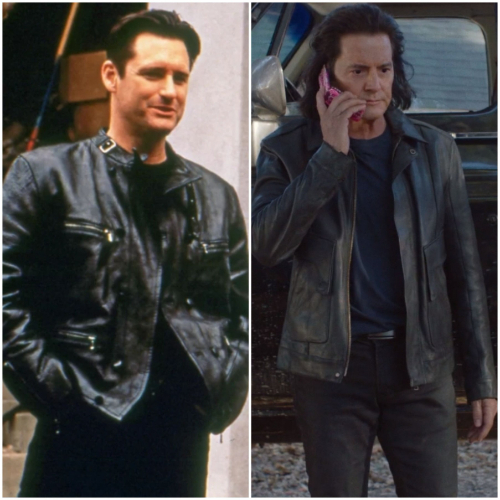
Then too we have Robert Blake's mystery man, whom can be the perfect replacement for BOB, or perhaps even an amalgamation of the Killer and the Arm.
Pullman plays Fred Madison whom obviously murdered his wife Renee in jealousy, can't remember or accept it, and changes faces once to get out of prison and appears to be doing it at the end for a second time to escape the pursuing police after he's murdered her lover.
Which was actually at the start of the film.
If that isn't directly tied in some way in spirit to Twin Peaks, I would be extremely shocked.
There are many shots of the darkened highway in that 1997 Lynch film, and those images will turn up once again in Part 18 of Twin Peaks the Return, where Dale Cooper, and not Fred Madison, is behind the wheel of the car now, driving at night when most of what surrounds him cannot be seen, except for the road and its interchanging line down its middle.
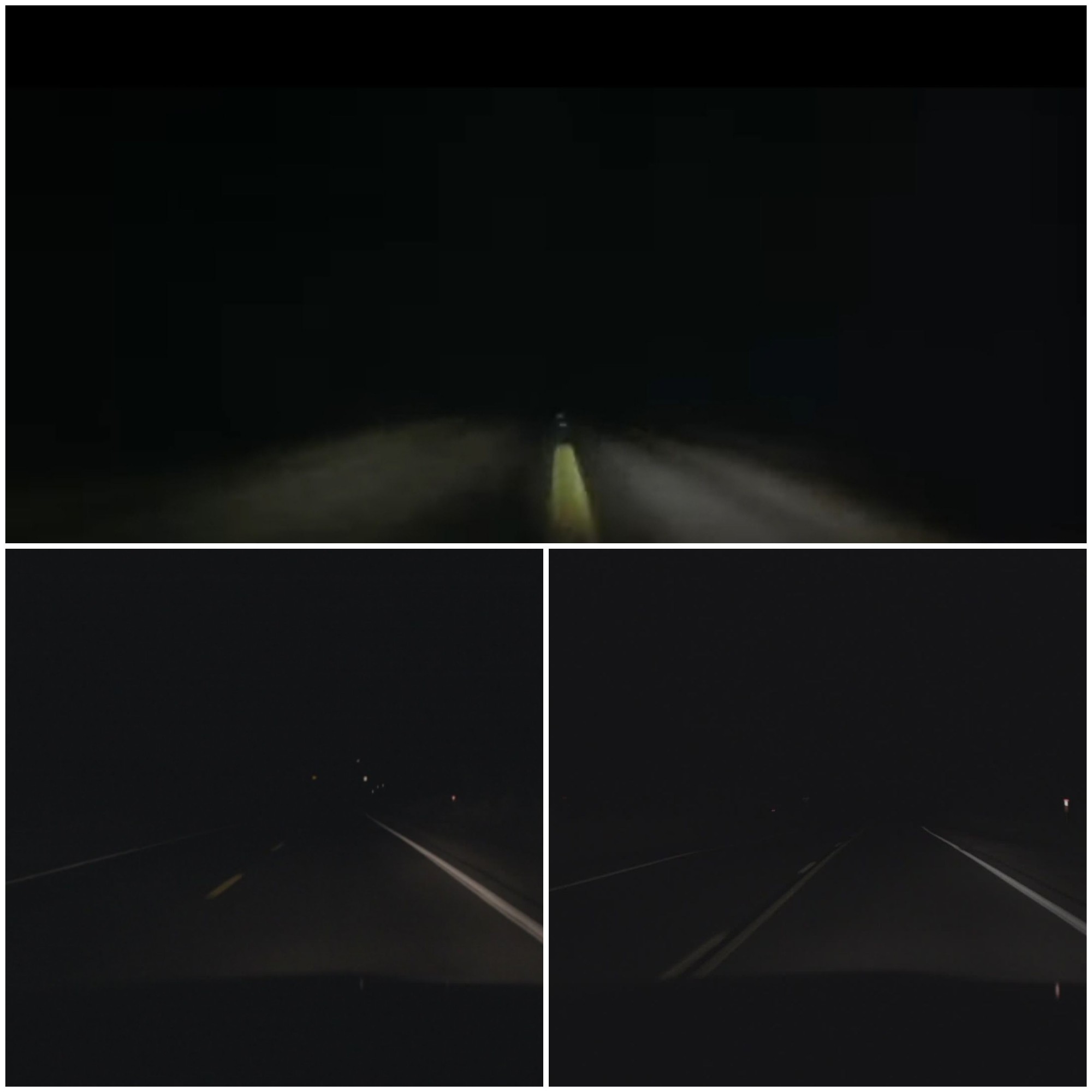
Once again, fans, when looking for similarities between both works, point to Leland Palmer, but there exists more a connection between Fred and Cooper, as obviously stressed in The Return's finale.
Same, to a lesser extent, is the connection between Dale and the chipper, cheerful, go getter of Betty from "Mulholland Drive" whom is Diane Selwyn's idealized self in a dreamworld, where her real self, represented by Rita, has forgotten her identity. They are both "too perfect" as Audrey Horne would say in wise judgement.
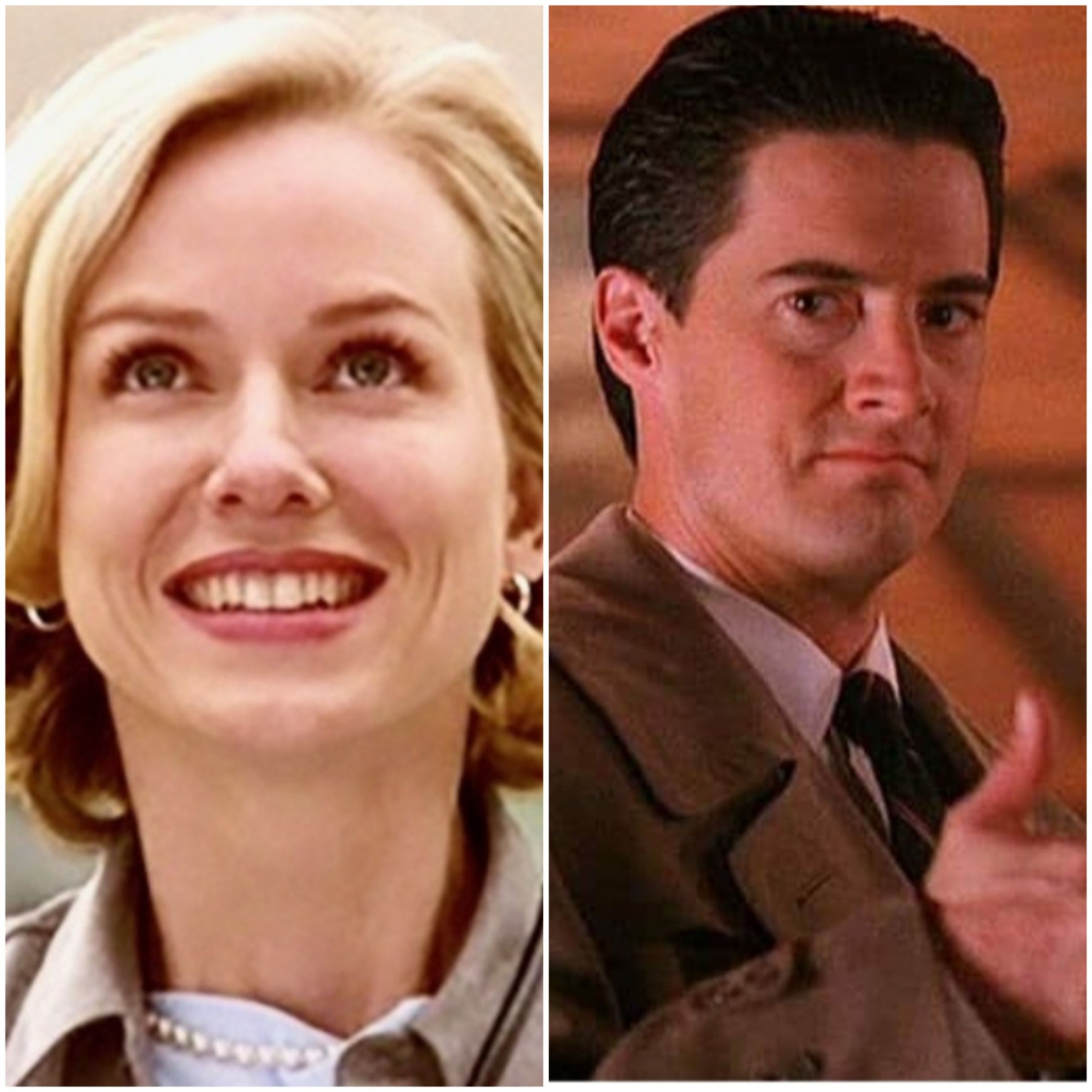
And when we see the truth of what has happened to Selwyn, and the horror of what she has done, we understand how the dream was dreamt to help momentarily save her from the sad reality.
In the end, however, Diane appears (assuming it isn't just another dream as well) to shoot herself, murder akin to the destruction of self inside Lynch's mind, be it a physical or spiritual death.
Maybe too this offers the strangest possibility of all for whom Carrie Page really is.
Yet another aspect of Dale Cooper.
Her need to get out of Dodge fast is merely Cooper's own desire to escape, as was her sleeping confession "It's a long way. In those days...I was too young to know any better."
Her statement "It's a long way" coincides perfectly with the Fireman's admonishing of Dale that he was far away.
They make that journey together, one behind the wheel, the other in the passenger seat, but maybe they are nothing more than two halves of the same person.
That could be why Carrie suddenly becomes submissive when exiting the car in Twin Peaks, silent as her companion questions Alice Tremond at the doorstep, walks in unison with Richard down the Palmer front walk stairs and is so attuned to his reactions outside the house and maybe even his thoughts. She seems to become dependent on what he is thinking, her actions related to how he is feeling. It alligns perfectly with the idea that the Red Room is simply Cooper's mind, echoing what the Log Lady asked in one of her other introductions: "In a dream, are all the characters really you? Different aspects of you? Do answers come in dreams?"
If Judy always remains Laura, then Dale Cooper can never escape being whomever the dreamer is outside of the dream, and it permeates almost every aspect.
Which can bring us right back to Laura Palmer and the whisper.
Was it Laura whom really whispered to Dale Cooper within the Red Room, telling him something he was not willing to hear.
Or was it really just himself all along?
~A House With Many Rooms~
If this is all Cooper's mind, Laura, or whomever she was, is dead and she can ever only be a memory never the real person she truly was in her interactions with him.
The truth she is trying to tell him becomes an unwanted thought basically, but one brought about by his own thinking not hers.
So in this knowledge, we can begin to look at all the characters within the dream as reflections of Dale Cooper, or the dreamer, himself. While they may look like other people, deep down they are secretly him, or contain some knowledge about him he might not want to face. The characters become either puppets for his amusement (Leland), echoing his role as the killer in BOB's possessing him, or unwanted messengers of the truth (the Laura of the Red Room).
He might control them, sure, but they also have the power to frighten him.
Or to baffle with some mystery.
This can hold especially true for the supernatural creatures in Twin Peaks, whom are seen to possess others. They each, likewise, possess some truth, from BOB to Laura/Judy.
If BOB is the most vile aspect of the dreamer than the Giant is him at his best. It was intimated in the second season opener that the Giant came from Dale Cooper, when, after his second visitation, he appeared to disappear as a golden ball into Cooper's head.

make tv GIFs like this at MakeaGif
And if there exists the spectrum for both great good and evil within the man, what lies in between?
The possibility for both.
In this gray area, we find the inhabiting spirit Mike, represented in both the possessed form of Phillip Gerard and the Arm.
It bothered me, initially, that BOB's origin did not include any sighting of Mike (BOB's accomplice until Mike's redemption), until I accepted that it wasn't necessary. Mike is BOB, existing with him and his severed arm in a way which echoes the word Trinity to the event that heralded BOB's arrival.
Mike was the aspect for him to change, though, or more accurately, his conscience.
He exists, in a way, as either a form of torment or hope, for the dreamer, the killer, that he can save himself if he truly wants.
For, Mike eternally pursues BOB but, as mentioned before, the only time we witnessed him attempt to actually kill his enemy it led to his own demise. They must coexist or face mutual destruction.
Consider too that in that same ending for the International Pilot's release, it includes a scene of Cooper dreaming away, all as his left arm seems to convulse and twitch, as if having a life of its own.

make tv GIFs like this at MakeaGif
Mike is there waiting for Cooper too as he unlocks the furnace room of the Great Northern, with his hotel room key, just as it was Mike whom we saw urging Dale Cooper to wake up earlier in the series.
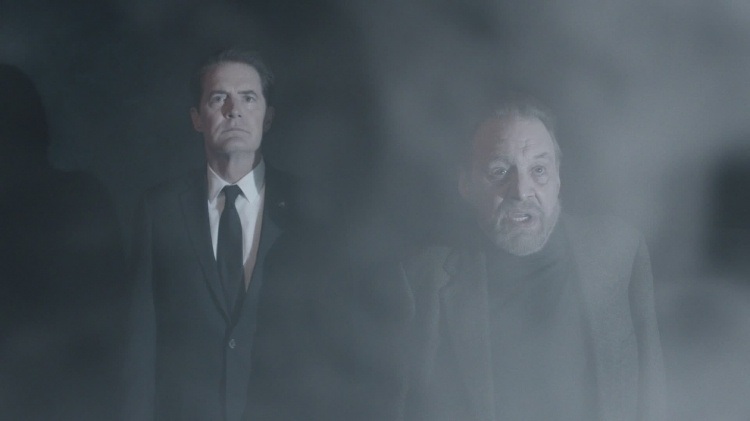
It appears important somehow for Mile to be here, in this room, to greet Cooper.
I have tried to not make reference to any unused portion in the FWWM script, but I think that now, as I near the ending to a theory which must reach its ending now, and has already gone on far too long, I will.
In a fragment of deleted or unused dialogue, after BOB has returned to the Lodge after murdering Laura Palmer (despite Cooper having told her not to take the ring) Mike and the Arm speak in unison: "BOB, you're not going home without me. I want all my garmonbozia".
In a Missing Piece, we see how the word "home" was to eventually play a larger role in the ending, strangely uniting Cooper, Mike/Arm and BOB (another Trinity) altogether in its invocation.
After the events in the train car have played out and BOB has returned to the Lodge, the scene featuring the Dale we saw in Laura's dream plays out for a second time, this time with Cooper seemingly aware from the Arm's statement concerning the ring, "Someone else has it now" that they are in the future.
When Cooper asks if he can leave, the Arm simply tells him this:
"You are here, now there is no place to go BUT HOME!"
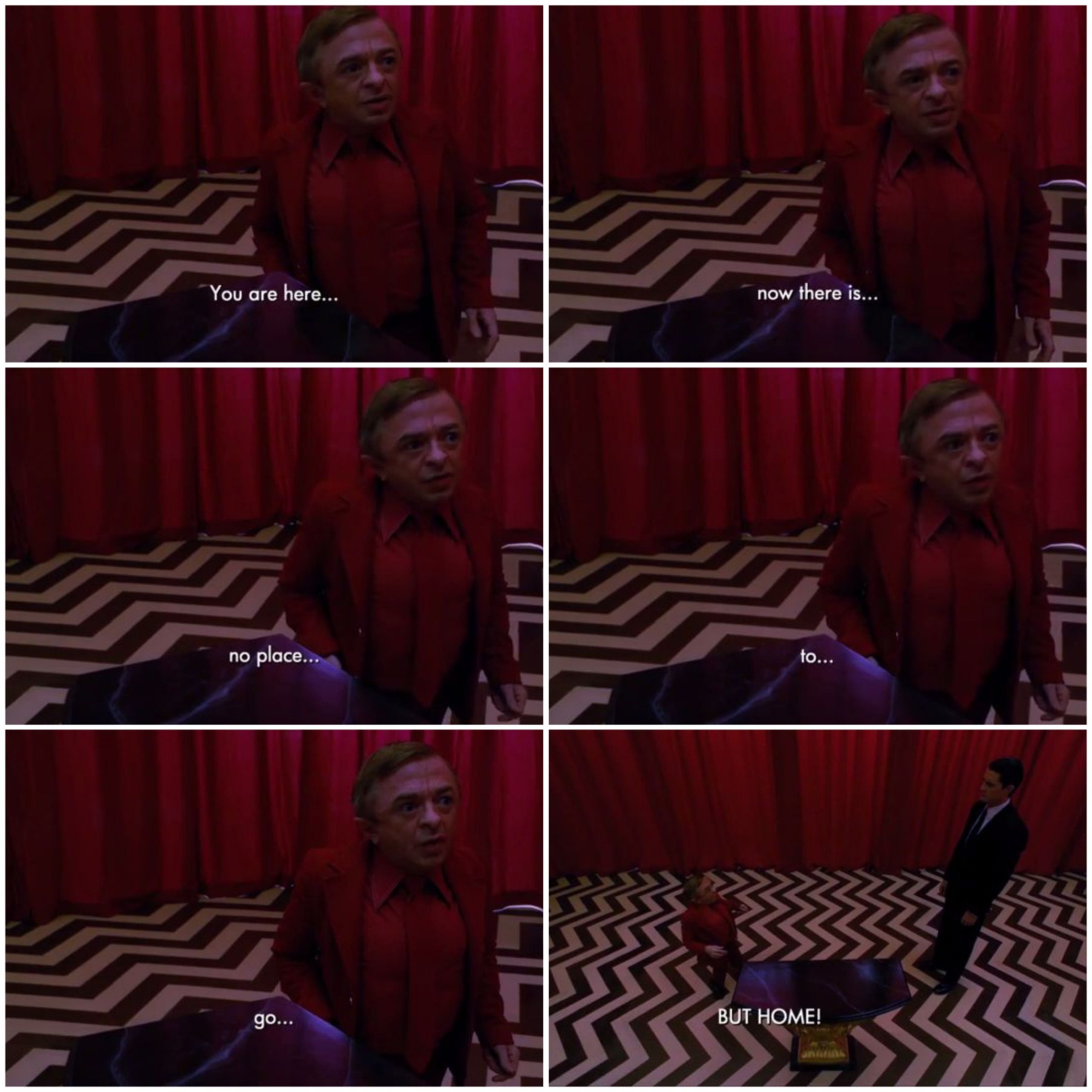
For some reason, the Arm then starts to laugh uncontrollably before he begins his infamous dance, all to Angelo Badalamenti's famous piece of music, "Dance of the Dream Man".

make tv GIFs like this at MakeaGif
It might seem odd until we accept that the Red Room wasn't any different from Twin Peaks or Deer Meadow. Cooper could go to any and they would all be the same. Just like his doppleganger later screaming "Non-exist-ent!, the Arm, or rather Mike or the dreamer's ability to take matters into his own hand, is aware that they live inside of a dream. The dreamer is trapped wherever he goes within it, be it inside or outside the Red Room, and so the question strikes the Arm as morbidly funny enough to break into hysterics over.
All as Cooper watches on.
An ominous piece of music soon takes over and Lynch shows us a close up of Dale's face.
Yet there is something about his expression as the Chevron floor is imposed over it, the camera sliding towards the curtain.

make tv GIFs like this at MakeaGif
It's like he almost understands something.
Something we don't.
I believe Dale Cooper intrinsically knew that were two options for him: to keep on dreaming or to go home, just like the Arm directed.
But once again, like we saw him do at the end of The Return, Cooper chose to keep the dream going, the next Missing Piece showing the continuation of where the original series left off: with his doppleganger being possessed by BOB and the mirror smashed, fragmented and bloody over the sink.
Never offering him a true reflection.
But that is how Dale Cooper prefers it.
Keeping the dream alive without an ending.
So then he never needs to go home.
Or admit that he was guilty.
And, in this way, for us viewers, whom love the dream of Twin Peaks and all of the characters living inside of it, I'm afraid we are just as guilty too.


